
Week 12 | Mechanical Design, Machine Design
Group Assignment
This project was developed collaboratively as part of a team effort, integrating mechanical design, electronics, and digital fabrication to build a functional string art machine. The process involved research, prototyping, system integration, and iterative testing to achieve a coordinated and reliable system.
Video
Slide
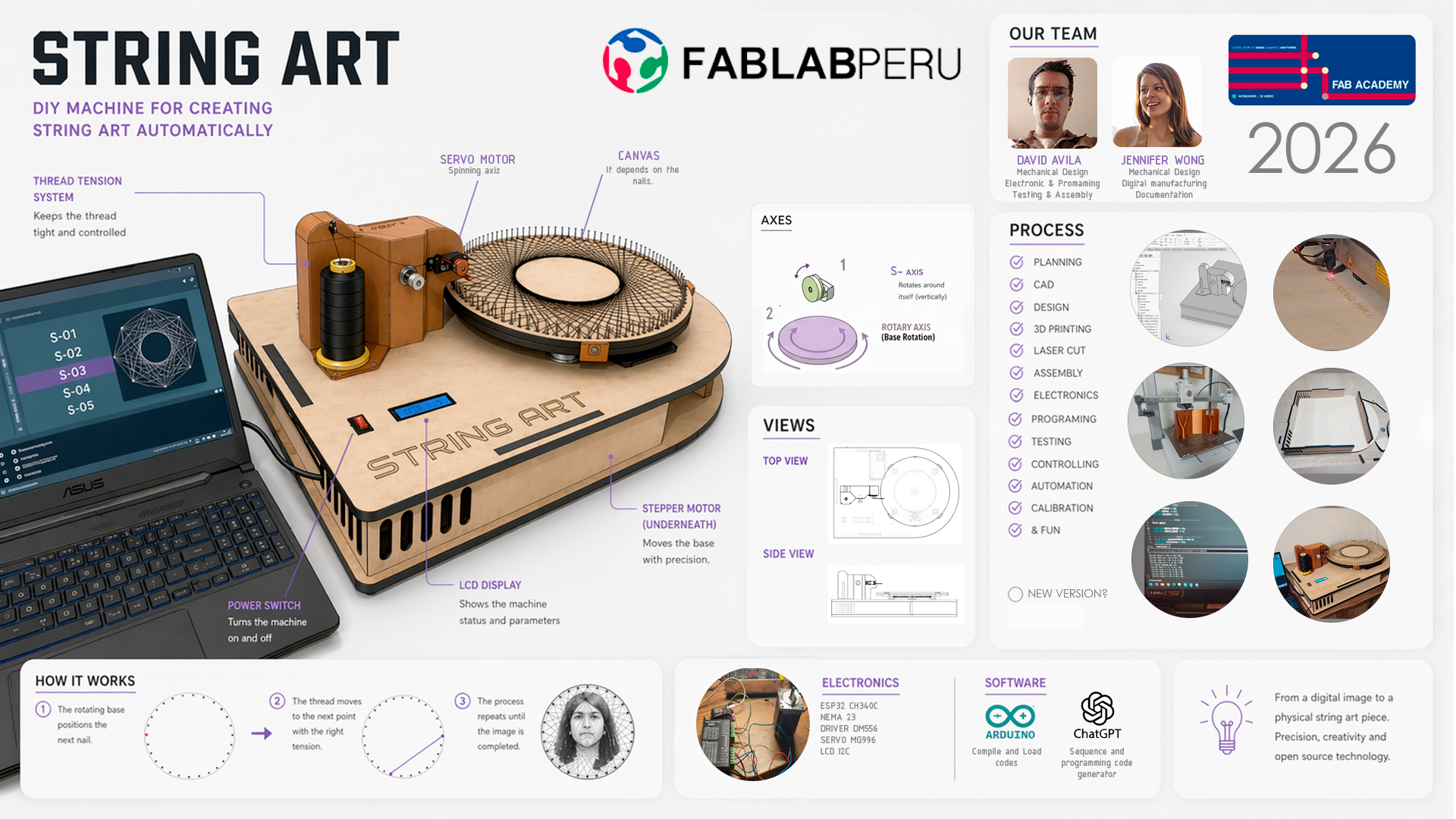
For a detailed description of the group development process, including design decisions, technical implementation, and results, please refer to the following link:
Group assignment documentation
Individual Contribution
My contribution to the development of the machine focused on early-stage research, mechanical design of key components, prototyping, and process documentation.
1. Research and System Definition
I was actively involved in the initial research phase, analyzing existing string art machines and evaluating different design approaches. Based on this analysis, I contributed to defining the system architecture, identifying key components, and developing the bill of materials (BOM).
Additionally, I participated in coordinating the project structure through team meetings, helping to establish a clear technical direction and a shared understanding of the system requirements. This stage laid the foundation for the subsequent design and fabrication processes.
2. Thread Control System Design
I was responsible for the design of the thread control system, specifically the structure that integrates the servomotor with the thread tensioning mechanism.
This subsystem was critical, as it required ensuring stability, precise positioning, and consistent tension control during operation.
The design process included:
- CAD modeling in Rhinoceros software of the main component and associated parts
- Definition of the servomotor mounting and orientation
- Integration of the mechanical thread tensioner
- Design of connectors and auxiliary elements for proper system integration
The final design prioritized compactness, functionality, and manufacturability using 3D printing technologies.
4. Prototyping and Iteration
I developed multiple iterations of the designed system, producing three to four versions through 3D printing. Each iteration allowed for testing and refinement based on:
- Tolerance adjustments
- Structural stability
- Assembly feasibility
- Performance under real operating conditions
In parallel, I designed and fabricated additional supporting components, such as structural connectors that enabled proper integration between different parts of the machine.
5. Digital Fabrication
I was directly involved in the fabrication process using digital manufacturing tools, primarily 3D printing. This included file preparation, slicing parameter configuration, and evaluation of printed parts.
This hands-on process ensured that all components met the functional and dimensional requirements of the system.
6. Assembly and Testing
I participated in the assembly of the machine, contributing to the integration of mechanical and electronic subsystems. I was also involved in initial testing, particularly focusing on validating the performance of the thread control system.
These tests were essential to identify design limitations and implement iterative improvements.
7. Platform Configuration
I contributed to defining the distribution of nails on the rotating base, a critical parameter for the functionality of the string art system. This configuration directly affects the resolution and quality of the generated patterns.
8. Material and Component Management
I supported the sourcing and acquisition of materials and components required for the project, ensuring the availability of resources for fabrication and assembly.
9. Documentation and Communication
I was responsible for documenting the development process through photographs and videos, capturing key stages such as fabrication, assembly, and testing.
Additionally, I contributed to the creation of written content for the project website and the development of the final video, ensuring clear and structured communication of the project outcomes.
Two-Week Work Timeline
| Task | Day 1 | Day 2 | Day 3 | Day 4 | Day 5 | Day 6 | Day 7 | Day 8 | Day 9 | Day 10 |
|---|---|---|---|---|---|---|---|---|---|---|
| Reference analysis | ● | ● | ||||||||
| System definition | ● | ● | ● | |||||||
| CAD design | ● | ● | ● | ● | ||||||
| 3D printing & prototyping | ● | ● | ● | ● | ||||||
| Mechanical assembly | ● | ● | ● | |||||||
| Electronics integration | ● | ● | ● | |||||||
| Testing & troubleshooting | ● | ● | ● | |||||||
| Final adjustments | ● | ● | ● | |||||||
| Documentation | ● | ● | ● | ● | ● | ● | ● | ● | ● |