Adaptive Regenerative Construction Kit

An Architectural System Bridging Ancestral Knowledge, Environmental Data, and Digital Fabrication

1) The beginning

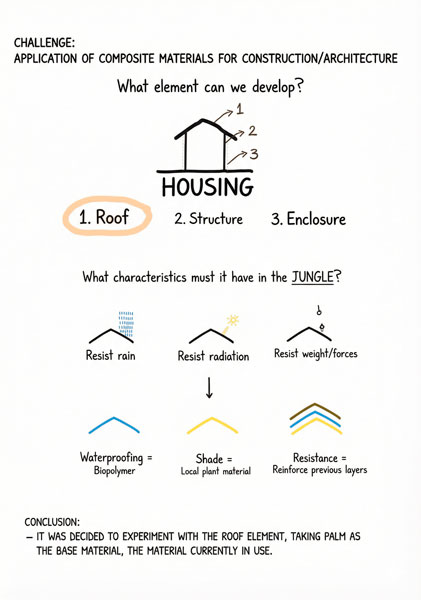
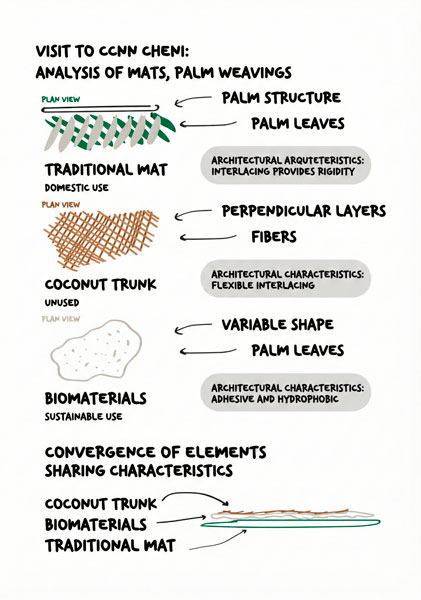
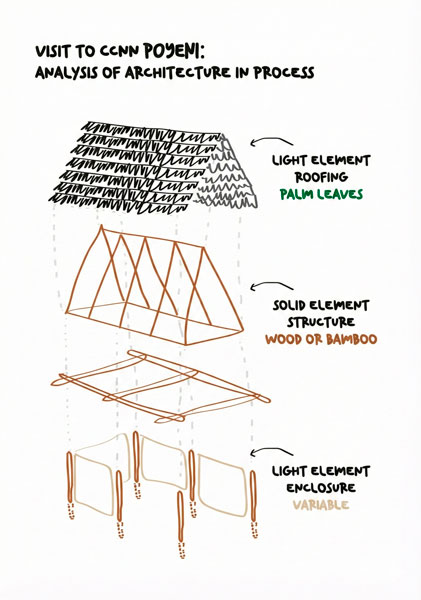
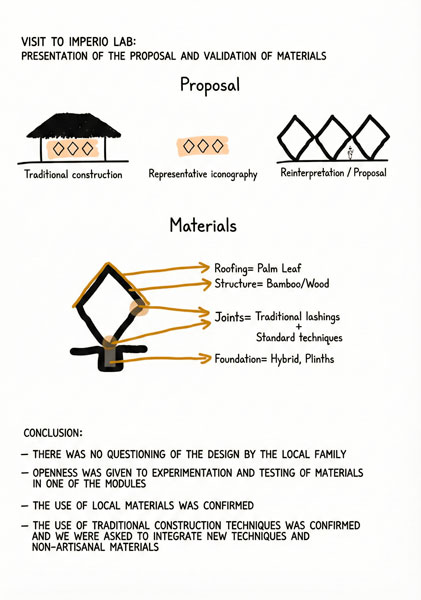
The project originates from a series of field visits carried out as part of a REGENERATIVE ARCHITECTURE initiative developed within the Regen project, together with Fiorella Mendoza. Both of us arrived at REGEN driven by our shared interest in architecture, territory, and regenerative thinking, and through these visits we began to actively participate in the development of the project. During several days of immersion, we engaged directly with Asháninka communities and their architectural practices. These experiences allowed us to observe, understand, and reflect—through our own architectural perspective—on how construction processes are carried out within these ancestral contexts. This first close encounter with Asháninka culture was fundamental: it revealed essential aspects of traditional construction that already work in deep harmony with the environment, but that could potentially be supported and enhanced through complementary architectural strategies.

The project originates from a series of field visits carried out as part of a REGENERATIVE ARCHITECTURE initiative developed within the Regen project, together with Fiorella Mendoza. Both of us arrived at REGEN driven by our shared interest in architecture, territory, and regenerative thinking, and through these visits we began to actively participate in the development of the project. During several days of immersion, we engaged directly with Asháninka communities and their architectural practices. These experiences allowed us to observe, understand, and reflect—through our own architectural perspective—on how construction processes are carried out within these ancestral contexts. This first close encounter with Asháninka culture was fundamental: it revealed essential aspects of traditional construction that already work in deep harmony with the environment, but that could potentially be supported and enhanced through complementary architectural strategies.

Final project sketch Final project sketch Final project sketch Final project sketch

Made by: Fiorella Mendoza & Esteban M. Valladares

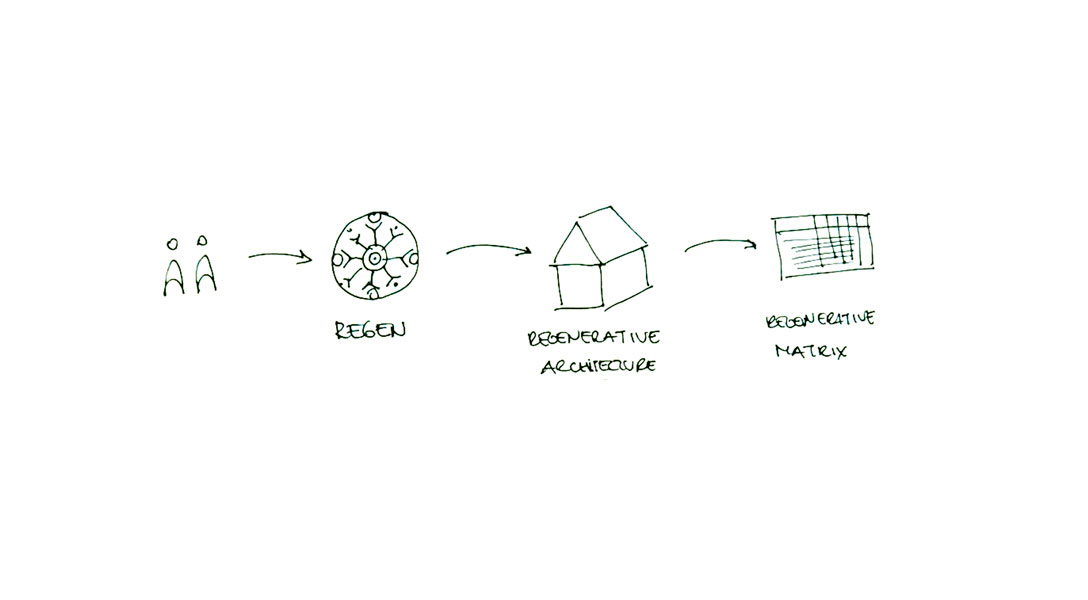
Rather than imposing new systems or overshadowing ancestral practices, the intention emerged to add value—to support manual and ancestral construction processes through architectural knowledge, digital tools, and fabrication methods, always with respect and sensitivity. From this experience, and from the work developed within Regen, a regenerative matrix was created. This matrix was not merely technical; it was a structured repository of knowledge that categorized and filtered materials according to their architectural roles within a traditional dwelling—such as roof, structure, and enclosure. Each category incorporated specific variables related to material behavior, environmental performance, durability, availability, harvesting distance, and required effort. It is from this matrix, and from the collective field experience, that the Adaptive Regenerative Construction Kit begins to take form.

From Matrix to Geometry, from Geometry to Kit

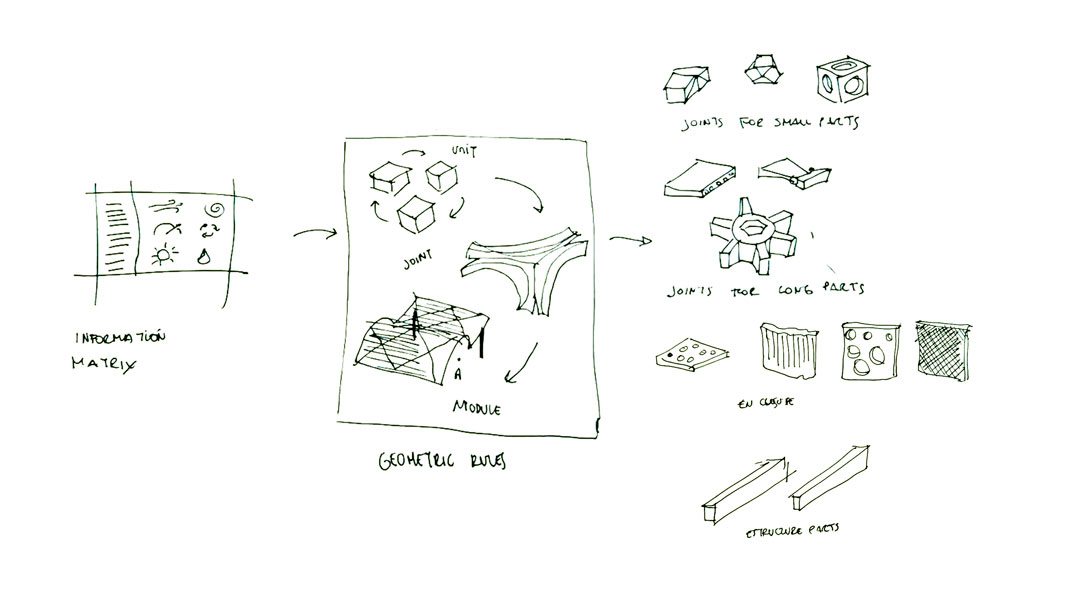
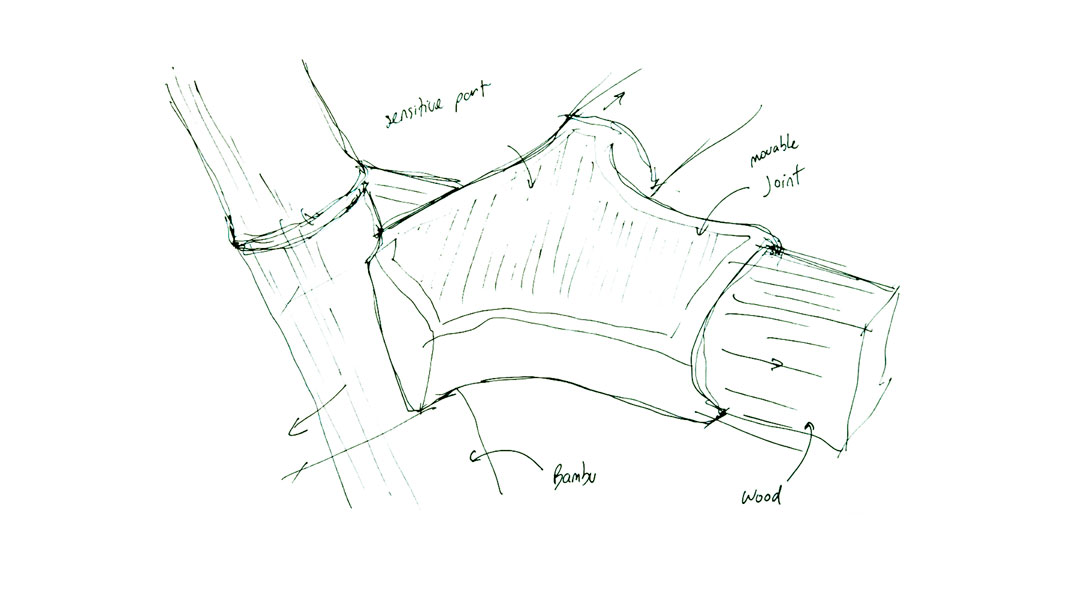
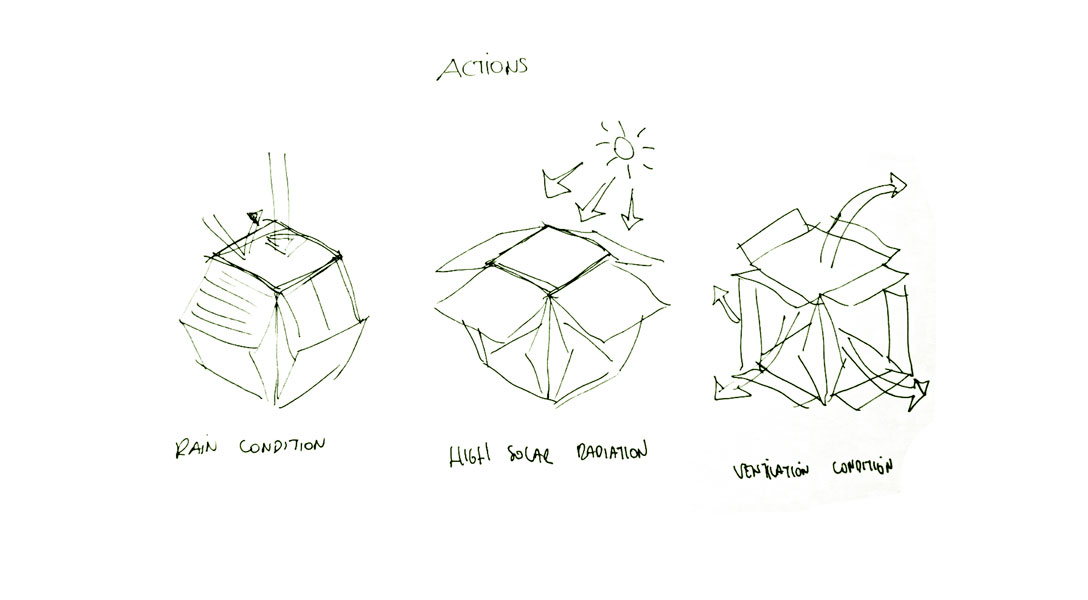
Building upon this original regenerative matrix, the accumulated information and experiences began to suggest not only material choices, but also geometric rules. These rules emerged as design constraints and opportunities: certain configurations were more suitable for enclosures, others for roofs, others for structural connections—always informed by structural logic, material resistance, durability, and environmental performance. Geometry, in this sense, is not arbitrary. It is a direct response to the matrix: a translation of material intelligence, territorial conditions, and ancestral knowledge into parametric and architectural rules. It is precisely at this point that the Adaptive Regenerative Construction Kit emerges. By defining geometric rules, it becomes possible to propose a system of connectors and components that articulate how different natural materials meet, connect, and perform together within an architectural language derived from the territory itself. For example, palm leaves used in roofing require geometries that prioritize impermeability and water management. In this case, the kit proposes connectors and configurations that respond to rain by adjusting, protecting, or reinforcing the enclosure. Similarly, when an enclosure must allow light to pass through, the kit introduces sensitive elements capable of reacting to solar orientation, modifying their configuration to regulate light and heat. These actions are not isolated mechanical responses; they are architectural expressions of the regenerative matrix. The drawings and diagrams that follow aim to clarify this logic, showing how knowledge becomes geometry, geometry becomes system, and system becomes a buildable, adaptive architectural element.

Single image
Single image
Single image
Single image

Project Summary

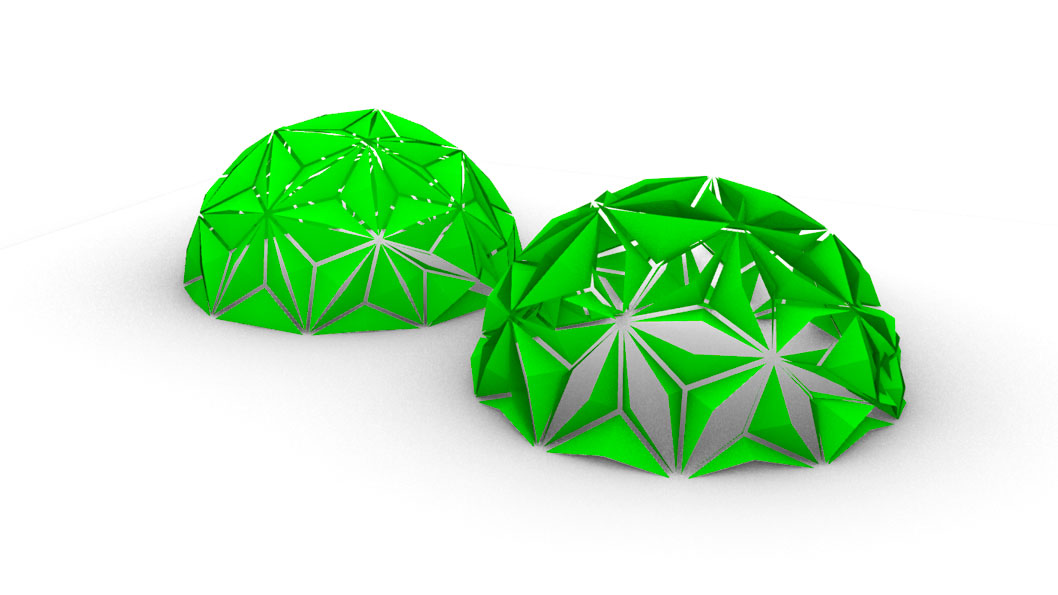
This project explores adaptive and regenerative architectural systems. During Week 02, I developed a parametric definition in Grasshopper that generates a dome composed of triangular modules capable of opening and closing according to solar radiation values. At this stage, the responsiveness is simulated through geometric logic embedded in the parametric model. For my final project, I will focus on designing and prototyping one of the mechanical joints that enables the articulation of this kinetic dome system.
Single image

The Adaptive Regenerative Construction Kit is a modular architectural system designed to support and enhance traditional construction practices through adaptive and regenerative principles. Developed from the REGENERATIVE ARCHITECTURE framework of the REGEN project, this proposal does not seek to replace ancestral ways of building, but to work alongside them—introducing tools that improve durability, adaptability, and environmental responsiveness while respecting local knowledge and material culture. The project focuses on a system of geometric modules and intelligent connectors that can be assembled into multiple architectural configurations. These elements respond to environmental conditions such as wind, sunlight, rain, and temperature, allowing structures to adapt over time while remaining rooted in local construction logics. Technology is used as a supportive layer, enabling traditional architectures to evolve without losing their identity.

Problem

In many contexts within the Amazon, traditional construction systems rely on techniques that are deeply connected to place, culture, and available materials. However, these systems often face challenges related to durability, environmental stress, and long-term adaptability, especially under changing climatic conditions. At the same time, contemporary architectural technologies are frequently introduced as replacements rather than complements, leading to a loss of cultural continuity and local agency. There is a clear need for architectural solutions that respect ancestral knowledge while offering tools that can strengthen and extend its performance over time.

Proposed Solution

This project proposes a construction kit composed of modular geometric elements and adaptive connectors designed to integrate seamlessly with traditional building systems. Instead of altering the core structure or construction logic, the kit enhances key points of connection, movement, and environmental interaction. The connectors act as mediators between materials, allowing components to adjust, rotate, open, or close in response to environmental inputs collected through basic sensors. By translating information from a regenerative material and environmental matrix into physical behavior, the system enables architecture to respond dynamically while remaining culturally grounded.

Target User

The primary users of this system are local communities in the Amazon region, who build with materials and techniques rooted in ancestral knowledge. Architects, designers, and Fab Lab facilitators act as collaborators rather than decision-makers, supporting the adaptation of the system to each specific context. The kit is designed to be understandable, replicable, and adaptable, allowing communities to appropriate the system using accessible fabrication tools and local materials.

Key Features

  • Modular geometric elements compatible with traditional construction systems
  • Adaptive connectors that enhance structural performance and flexibility
  • Environmental responsiveness through basic sensing (wind, light, rain, temperature)
  • Design logic informed by a regenerative material and territorial matrix
  • Scalable configurations from small elements to larger architectural assemblies
  • Technology integrated as support, not replacement, of ancestral knowledge

Initial Plan

Write a simple plan with 4–6 steps.

  1. Translate the regenerative material and environmental matrix into design parameters
  2. Define the base geometric module and connector system
  3. Develop parametric models to explore scalability and variation.
  4. Fabricate and assemble initial prototypes
  5. Integrate sensors and basic control logic into the connectors
  6. Test adaptability, movement, and environmental response

Open Questions

  • How can adaptive connectors improve durability without increasing complexity?
  • Which environmental inputs are most relevant for meaningful architectural response?
  • How can the system remain accessible and maintainable for local communities?
  • What balance should exist between passive behavior and active sensing?
  • How can future bio-based materials further align the system with regenerative cycles?
Fab Academy Documentation · Final Project (Concept)