19. Invention, Intellectual Property and Income
- Develop a plan for dissemination of your final project.
- Complete your final project, tracking your progress
Individual Assignment
Introduction
This week I explored invention, intellectual property, and income generation in relation to my final project. The objective was to understand the different forms of intellectual property protection available, determine which are most suitable for my project, and explore how the project could potentially be shared or commercialized in the future.
I also looked at different business entity structures in India, common software licensing models, and selected a suitable license for my project.
Invention vs Innovation
Although the two terms are often used interchangeably, they refer to different concepts.
Invention
An invention is the creation of a completely new product, process, or idea that did not previously exist. It introduces something original and unique.
Innovation
Innovation is the improvement or modification of an existing product, process, or idea. It focuses on making something better, more efficient, or more useful rather than creating something entirely new.
For my final project, Sweep is primarily an innovation. Rather than reinventing the vinyl record player, it adds modern functionality that allows users to automatically select individual tracks while preserving the traditional analogue listening experience.
Business Entity Types in India
Before commercialising a product, it is important to understand the different business structures available in India. Each has different legal responsibilities, taxation, liability, and suitability depending on the size of the business.
For-Profit Business Structures
Sole Proprietorship
The simplest form of business ownership. It is owned and managed by a single individual and requires very little formal registration.
- Single owner
- No separate legal identity
- Unlimited personal liability
- Suitable for freelancers and small businesses
Partnership Firm
A business operated by two or more individuals who share ownership, responsibilities, and profits under the Indian Partnership Act, 1932.
General Partnership
- Equal management rights
- Unlimited liability
- No separate legal entity
Limited Liability Partnership (LLP)
- Governed by the LLP Act, 2008
- Separate legal identity
- Liability limited to each partner's investment
- Popular for professional firms and consultancies
One Person Company (OPC)
Introduced under the Companies Act, 2013, the OPC allows a single entrepreneur to operate as a registered company while maintaining limited liability.
- Single owner
- Separate legal entity
- Limited liability
- Suitable for solo founders planning future growth
Private Limited Company (Pvt Ltd)
The most common business structure for technology startups and growing businesses.
- Separate legal entity
- Limited liability
- Can raise investment
- Suitable for startups and scalable businesses
- Minimum two directors and two shareholders
Public Limited Company (Ltd)
Designed for large organisations that intend to raise funds from the public through the stock market.
- Listed on NSE or BSE
- Regulated by SEBI
- Suitable for large enterprises
- Highest compliance requirements
Producer Company
A specialised company structure intended for farmers, agricultural producers, and cooperatives.
- Member owned
- Separate legal identity
- Designed for agricultural businesses
Non-Profit Organisations
Trust
One of the oldest legal structures for charitable organisations in India.
- Created through a trust deed
- Managed by trustees
- Suitable for charitable and religious organisations
Registered Society
Governed by the Societies Registration Act, 1860, this structure is commonly used by clubs, associations, and NGOs.
- Minimum seven members
- Democratic management
- Suitable for community organisations
Section 8 Company
A structured non-profit company registered under the Companies Act, 2013.
- Separate legal identity
- No profit distribution
- Eligible for tax exemptions
- Suitable for foundations and NGOs
Hybrid / Specialised Structures
Nidhi Company
A member-owned savings and lending company regulated under the Companies Act and RBI guidelines.
- Only serves its own members
- Commonly used for community finance groups
Joint Venture (JV)
A contractual collaboration between two or more businesses working together on a specific project.
- Can be domestic or international
- Common for large engineering and technology projects
Comparison
| Business Type | Legal Identity | Liability | Best For |
|---|---|---|---|
| Sole Proprietorship | No | Unlimited | Small businesses |
| General Partnership | No | Unlimited | Shared ownership |
| LLP | Yes | Limited | Professional firms |
| OPC | Yes | Limited | Solo founders |
| Private Limited | Yes | Limited | Startups |
| Public Limited | Yes | Limited | Large companies |
| Producer Company | Yes | Limited | Agricultural businesses |
| Trust | No | Unlimited | Charities |
| Society | No | Unlimited | NGOs and associations |
| Section 8 Company | Yes | Limited | Formal non-profits |
| Nidhi Company | Yes | Limited | Member savings groups |
All companies registered under the Companies Act, 2013 are administered by the Ministry of Corporate Affairs (MCA).
Intellectual Property
Intellectual Property (IP) refers to creations of the human mind that can be legally protected. These legal rights allow inventors, designers, artists, and businesses to control how their work is used while also benefiting financially from their creations.
Different forms of intellectual property protect different aspects of a project. Since my final project contains mechanical design, electronics, software, branding, and documentation, several forms of IP could potentially apply.
Major Types of Intellectual Property
Patents
Patents protect new inventions, products, manufacturing methods, or technological improvements. Once granted, they provide the inventor with the exclusive right to make, use, manufacture, or sell the invention for a limited period.
- Protects inventions and technical innovations
- Typically valid for 20 years
- Requires the invention to be novel and non-obvious
Copyright
Copyright protects original creative works rather than ideas themselves. This includes software, documentation, books, artwork, videos, music, and photographs.
- Software source code
- Documentation
- Images and graphics
- Videos and presentations
- CAD renders
Trademark
A trademark protects names, logos, slogans, and other brand identifiers that distinguish one company's products from another.
- Product names
- Logos
- Company branding
- Marketing identity
Trade Secrets
Trade secrets protect confidential information that gives a business a competitive advantage. Unlike patents, trade secrets remain protected only while the information remains secret.
- Manufacturing methods
- Algorithms
- Business processes
- Internal documentation
Industrial Designs
Industrial design protection covers the visual appearance of a product rather than its technical function. This includes shape, styling, and aesthetic features.
- Product appearance
- Industrial styling
- External form
- Visual design
Geographical Indications (GI)
Geographical Indications identify products that originate from a particular region and whose quality or reputation is linked to that location.
- Darjeeling Tea
- Mysore Silk
- Kanchipuram Silk
- Champagne (France)
Choosing Intellectual Property
The type of protection required depends entirely on the project. A single project can often use multiple forms of intellectual property simultaneously.
For my project, possible protection methods include:
- Patent for the mechanical track selection mechanism.
- Industrial Design for the enclosure and overall product appearance.
- Trademark for the product name Sweep and future branding.
- Copyright for all software, PCB designs, documentation, images, and CAD models.
Official Intellectual Property Portal (India)
All intellectual property registrations in India are managed by the Office of the Controller General of Patents, Designs and Trade Marks (CGPDTM).
- Official Website: https://ipindia.gov.in/
- E-Filing Portal: https://ipindiaonline.gov.in/
Patent Registration Process (India)
A patent application generally follows five major stages.
1. Prior Art Search
Before filing a patent, it is important to ensure that the invention is genuinely new. Existing patents and publications should be searched to avoid duplicating previous work.
Useful databases include:
2. Filing the Patent
The patent application is submitted through the online filing portal.
The main forms include:
- Form 1 – Patent Application
- Form 2 – Complete or Provisional Specification
- Form 28 – Startup declaration (reduced fees)
A provisional specification can be filed first to secure the filing date, followed by the complete specification within 12 months.
3. Publication
After filing, the application remains confidential before being published in the official patent journal.
- Standard publication occurs after 18 months.
- Form 9 can be submitted to request early publication.
4. Request for Examination
Patent applications are not examined automatically.
The applicant must submit:
- Form 18 – Request for Examination
- Form 18A – Expedited Examination (eligible applicants)
The request must be filed within 48 months from the filing date.
5. Examination and Grant
An examiner reviews the application and issues a First Examination Report (FER).
Any objections must be addressed before the patent can be granted.
- FER response period: 6 months
- Patent validity: 20 years from the filing date
Patent Protection Outside India
If an Indian resident wishes to file patents in other countries, Section 39 of the Indian Patents Act, 1970 must be followed.
Route A — File in India First
- Submit the Indian patent application.
- Wait at least six weeks.
- If no secrecy directions are issued, foreign filing is permitted.
Route B — Foreign Filing Licence (FFL)
- Submit Form 25.
- Obtain a Foreign Filing Licence before filing overseas.
- Approval typically takes around 10–21 days.
Filing overseas without following these procedures can result in cancellation of the Indian application and legal penalties.
International Patent Filing
Patent Cooperation Treaty (PCT)
The PCT system allows a single international patent application that can later enter more than 150 participating countries.
- Single international application
- 30–31 months before entering national phases
- Simplifies international filing
Paris Convention
The Paris Convention allows direct filing in other countries while keeping the priority date of the first application.
- Must file within 12 months
- Separate applications for each country
Software Licensing
After deciding how the project could be protected, the next step was to determine how it would be shared. Software and documentation can be released under different licenses depending on how much freedom the creator wants to give others.
MIT License
Official website: https://opensource.org/license/mit
The MIT License is one of the most popular open-source software licenses. It is short, simple, and highly permissive.
- Free for anyone to use.
- Allows modification and redistribution.
- Commercial use is permitted.
- Original copyright notice and license must be included.
- Ideal for projects intended for wide adoption.
This license encourages collaboration while keeping attribution to the original author.
GNU General Public License (GPL)
Official website: https://www.gnu.org/licenses/gpl-3.0.en.html
The GNU GPL is a strong copyleft license. Anyone may use, modify, and distribute the software, but any modified versions must also remain open source under the same license.
- Allows modification and redistribution.
- Requires derived work to remain open source.
- Source code must remain available.
- Encourages collaborative development.
This license is commonly used for community-driven open-source projects where future improvements should remain publicly available.
Creative Commons Licenses
Official website: https://creativecommons.org/licenses/
Creative Commons licenses are primarily intended for creative works such as documentation, images, videos, presentations, and educational material rather than software.
Instead of providing only one license, Creative Commons offers several options depending on how much freedom the creator wishes to allow.
- CC BY
- CC BY-SA
- CC BY-ND
- CC BY-NC
- CC BY-NC-SA
- CC BY-NC-ND
Each license combines different permissions relating to attribution, commercial use, derivative works, and share-alike requirements.
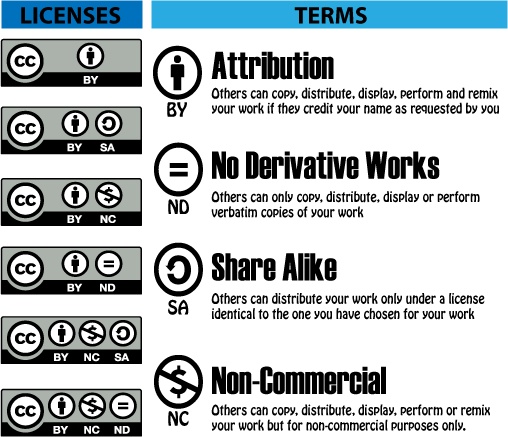
Reference: https://libguides.longwood.edu/copyright/creativecommons
Choosing a License
For my final project I decided to use a Creative Commons license for the project documentation and design files. Creative Commons provides an online license chooser that recommends the most suitable license based on a few simple questions.
Creative Commons License Chooser: https://creativecommons.org/chooser/
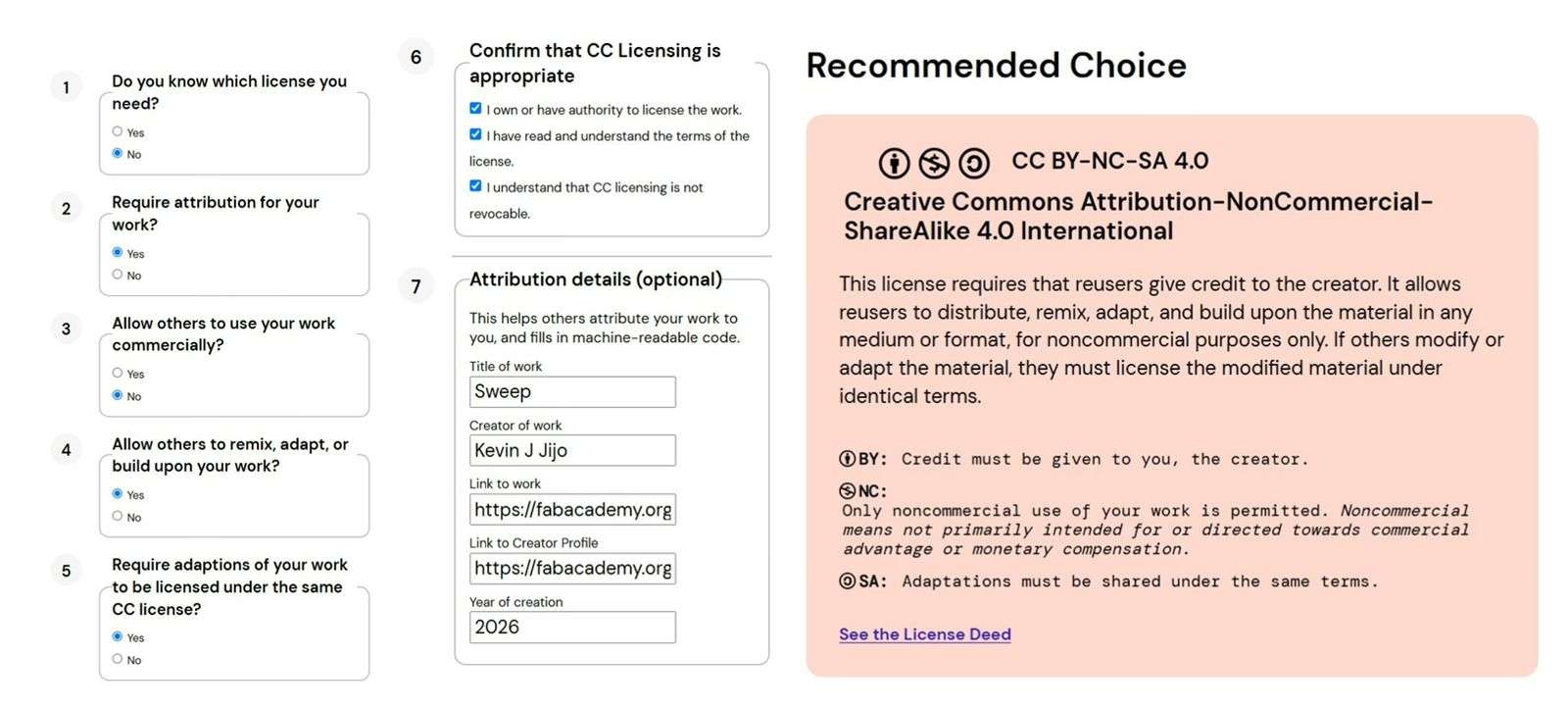
After answering the questions provided by the license chooser, the recommended license for my project was CC BY-NC-SA 4.0.
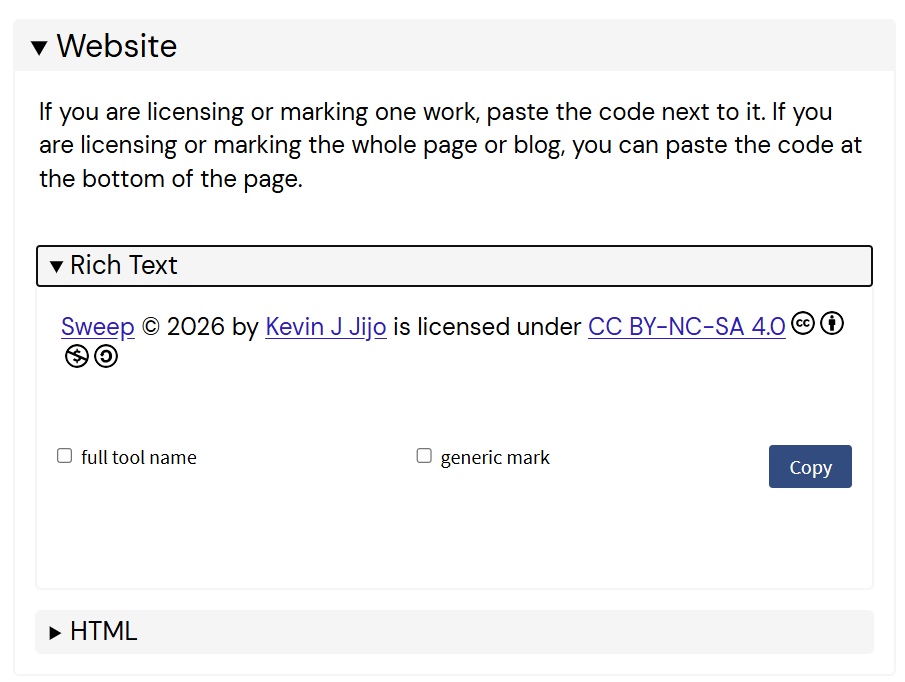
The license allows others to:
- Share the project.
- Modify and build upon the project.
- Give appropriate credit.
- Keep derivative work under the same license.
- Not use the work commercially without permission.
Generated License Statement
Sweep © 2026 by Kevin J Jijo is licensed under CC BY-NC-SA 4.0.
To view a copy of this license, visit
https://creativecommons.org/licenses/by-nc-sa/4.0/
Creative Commons also provides HTML code that can be directly embedded into a webpage to display the selected license with the official Creative Commons icons.
<a href="https://fabacademy.org/2026/labs/kochi/students/kevin-jijo/final-project.html">Sweep</a>
© 2026 by
<a href="https://fabacademy.org/2026/labs/kochi/students/kevin-jijo/about.html">Kevin J Jijo</a>
is licensed under
<a href="https://creativecommons.org/licenses/by-nc-sa/4.0/">
CC BY-NC-SA 4.0
</a>
Updating the License
The project license was updated on both the final project page and the project development page to clearly state how the project may be used and shared.
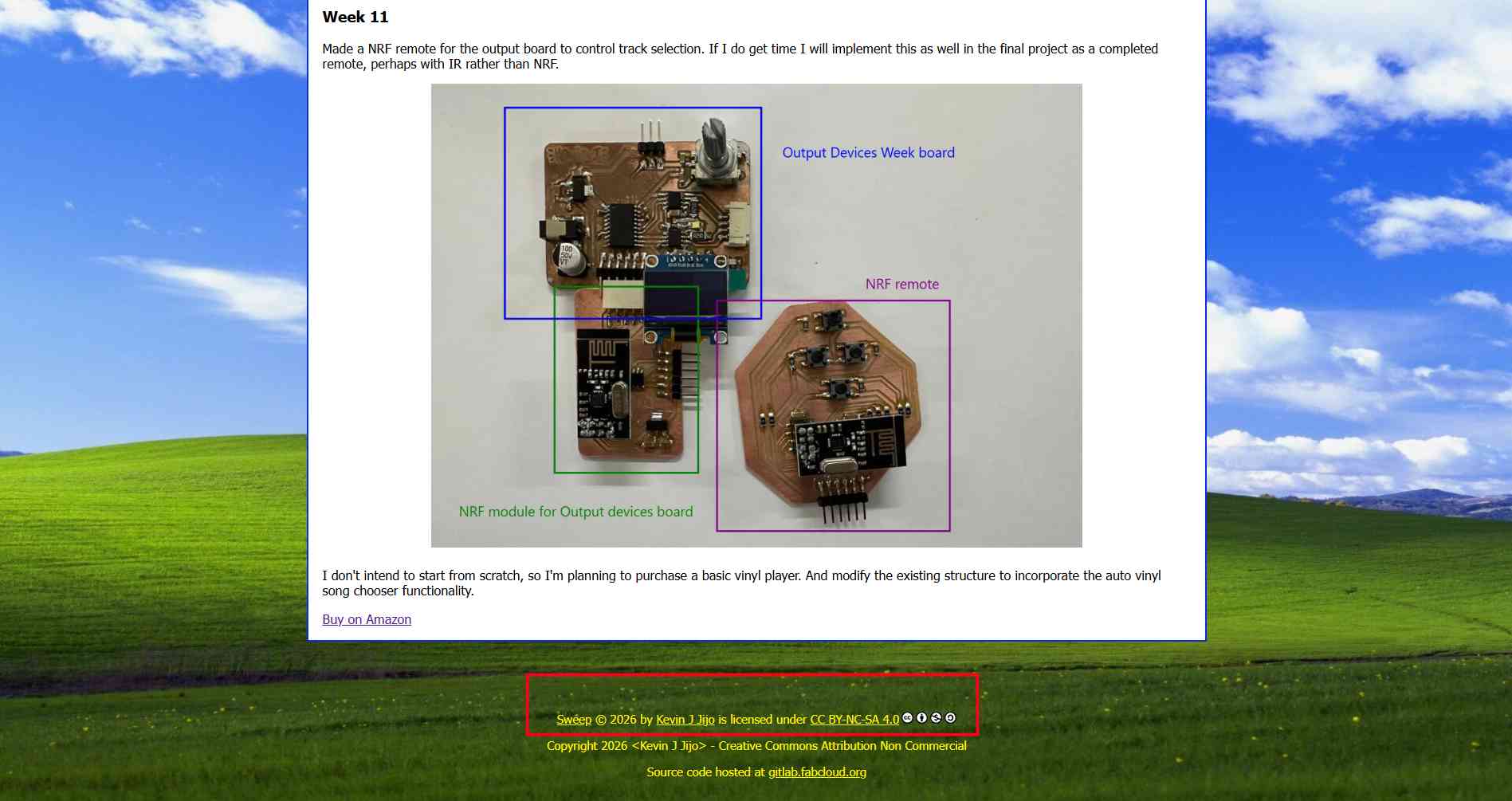
Dissemination Plan
The goal of this project is simply to make listening to vinyl records a little more convenient while preserving the analog experience. I hope others can use, modify, and build upon the project freely, whether for personal use, learning, or future improvements. If it encourages more people to enjoy vinyl records in their own way, then the project has achieved its purpose.
To know more about the project, please refer to the Project Development documentation in the repository.