Invention and Innovation
An invention is a unique or novel device, method, composition, or process that has been created for the first time. It represents an original concept or a significant improvement upon existing technology that fulfills a specific need or function.
An innovation, on the other hand, is the process of taking an invention and successfully bringing it to market or implementing it in a way that creates value. Innovation involves not just the creation of something new, but also the practical application and commercialization of that invention.
What is Intellectual Property?
Intellectual Property (IP) is a category of property that covers creations of the mind — inventions, designs, artistic works, names, symbols, and so on. Unlike physical property, it is intangible, but the law still treats it as something that can be owned, licensed, sold, or protected.
For a project like NanoJam, IP is relevant because the device combines several "things of the mind":
-The circuit design (custom PCB)
-The firmware (code running on the XIAO ESP32-S3)
-The 3D-printed enclosure design (CAD files)
-The user interface graphics on the OLED
-The name and visual identity of NanoJam itself
Each of these can, in principle, be protected by a different kind of IP right.
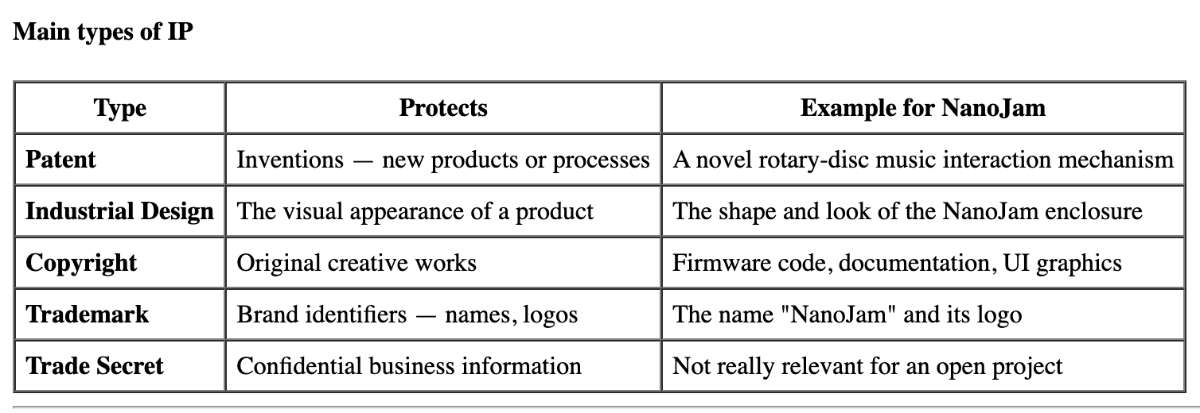 (prompt for Claude: differentiate the main IP's in accordance to NanoJam)
Patents
A patent gives the inventor the right to exclude others from making, using, selling, or importing the invention for a limited period (usually 20 years) in the country where the patent is filed.
Important things I learned:
- There is no such thing as a global patent. You have to file in each country/region where you want protection.
- The invention has to be novel, non-obvious, and useful.
- Patents are expensive to file and maintain, and only make sense when there is a real commercial reason.
- Filing also means publishing the invention , so the trade-off is: protection in exchange for disclosure.
- For NanoJam, which builds on a lot of existing prior art (MP3 players, rotary encoders, ESP32-based audio projects), filing a patent does not make sense. The novelty is mostly in how the pieces are combined, not in any one new technical idea.
How to apply for a patent in India?
Patent applications in India are filed through the Indian Patent Office or online.
The inventor prepares a provisional or complete specification and files it with the Indian Patent Office. After publication and examination, objections are addressed before the patent is granted.Once cleared, the patent is granted for 20 years from the filing date.
source - IP India
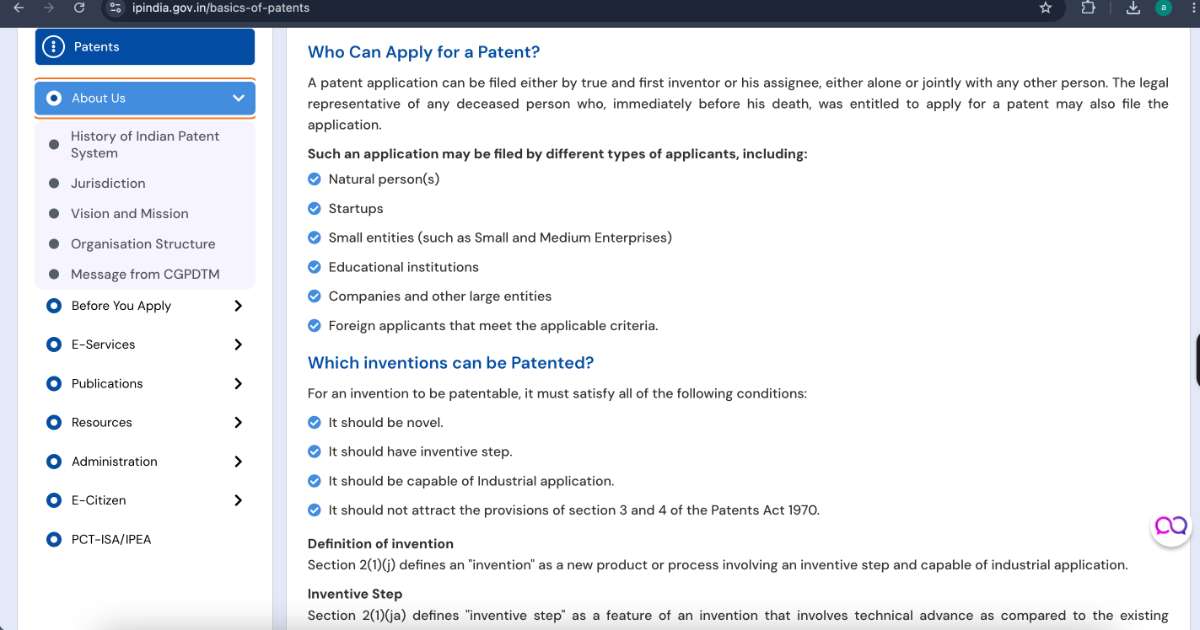 Apply Here
Patent Application Types:
Apply Here
Patent Application Types:a) Ordinary Application (Normally, filed for an application without claiming priority)
b) Application for Patent of Addition (allowed for improvement or modification of the parent patent application)
c) Divisional application (in case of a plurality of inventions disclosed in the main application).
d) Convention Application, claiming priority date based on filing in convention countries.
e) National Phase Application under PCT.
For more details refer Patent Details
Patent Protection Outside India
Patents are territorial rights. A patent granted in India protects an invention only within India.
Inventors seeking protection abroad can file directly in other countries or use the Patent Cooperation Treaty (PCT) route.
The PCT allows a single international application to be submitted before entering the national phase in selected countries.
The PCT does not provide a worldwide patent. Protection must still be pursued separately in each country.
Global Filing Methods
PCT (Patent Cooperation Treaty) Route: Gives you a single international application that buys up to 30–31 months of time to choose and enter over 150 target member countries.
Paris Convention Route: Allows you to file directly in individual foreign countries within 12 months of your initial Indian filing date.
Company structure in India
(source - Structures in India)There are several different types of companies in India that range from sole proprietorships to public limited companies, each with their unique characteristics and advantages. One must choose the best business structure for startups and enterprises to do business and achieve success.
he types of business structures in India include:
1. Sole Proprietorship: A business owned and managed by a single individual. It is the simplest form of business structure, where the owner has complete control and is personally liable for all debts and obligations of the business.
2. Partnership: A business owned by two or more individuals who share profits, losses, and management responsibilities. Partnerships can be general (where all partners are equally responsible) or limited (where some partners have limited liability).
3. Limited Liability Partnership (LLP): A hybrid structure that combines elements of partnerships and companies. Partners have limited liability, protecting their personal assets from business debts, while enjoying the flexibility of a partnership.
4. Private Limited Company: A privately held company that limits the liability of its shareholders. It can have a minimum of 2 and a maximum of 200 shareholders, and shares cannot be publicly traded.
5. Public Limited Company: A company that can offer its shares to the public and has a minimum of 7 shareholders. It is subject to stricter regulatory requirements and is suitable for larger businesses seeking to raise capital from the public.
6. One Person Company (OPC): A business structure that allows a single individual to operate as a company. It provides limited liability protection to the owner while allowing them to enjoy the benefits of a corporate structure.
7. Section 8 Company: A non-profit organization that operates for charitable purposes. It is registered under Section 8 of the Companies Act, 2013, and is exempt from certain taxes while being subject to specific regulations governing non-profit entities.
8. Joint-Venture Company: A business arrangement where two or more parties come together to undertake a specific project or business activity. Each party contributes resources, shares risks, and profits according to the terms of the joint venture agreement.
9. Non-Government Organization (NGO): A non-profit organization that operates independently of government control. NGOs work towards social, environmental, or humanitarian causes and rely on donations, grants, and volunteers to achieve their objectives.
What is a Startup?
A startup is a newly established business venture that is typically in the early stages of development. Startups are often characterized by their innovative ideas, high growth potential, and a focus on solving specific problems or addressing market gaps. They are usually founded by entrepreneurs who seek to bring new products, services, or technologies to the market.
What are its benefits
1. Innovation and Disruption: Startups often bring fresh ideas and innovative solutions to the market, disrupting traditional industries and creating new opportunities for growth.
2. Economic Growth: Startups contribute to economic growth by creating jobs, generating revenue, and attracting investment. They can stimulate local economies and drive technological advancements.
3. Flexibility and Agility: Startups are typically more flexible and agile than established companies, allowing them to quickly adapt to changing market conditions and customer needs. This can lead to faster product development and a more responsive approach to market demands.
4. Entrepreneurial Opportunities: Startups provide opportunities for entrepreneurs to turn their ideas into reality, fostering creativity and encouraging risk-taking. They can serve as a platform for individuals to pursue their passions and make a meaningful impact in their chosen fields.
5. Access to Funding: Startups often have access to various funding sources, including venture capital, angel investors, and crowdfunding platforms. This can provide the necessary capital to fuel growth and scale operations.
6. Community and Networking: Startups often thrive in collaborative environments, fostering a sense of community and providing opportunities for networking and mentorship. This can lead to valuable partnerships, knowledge sharing, and support for entrepreneurs.
How to register a Startup?
In India, startups can register under the Startup India initiative, which provides various benefits and incentives to promote entrepreneurship. The registration process involves the following steps:
1. Incorporate a Company: The first step is to incorporate a company under the Companies Act, 2013. This can be done by registering as a Private Limited Company, Limited Liability Partnership (LLP), or One Person Company (OPC). The incorporation process involves filing the necessary documents with the Registrar of Companies (ROC) and obtaining a Certificate of Incorporation.
2. Register with Startup India: After incorporating the company, the next step is to register with the Startup India portal. This involves creating an account on the portal, providing details about the startup, and uploading the required documents, such as the Certificate of Incorporation and a brief description of the business.
3. Obtain Recognition: Once the registration is complete, the startup can apply for recognition under the Startup India initiative. This involves submitting an application along with the necessary documents, such as a letter of recommendation from an incubator or a letter of funding from an angel investor or venture capital firm. The application will be reviewed, and if approved, the startup will receive a recognition certificate from the Department for Promotion of Industry and Internal Trade (DPIIT).
4. Avail Benefits: Once recognized, startups can avail various benefits under the Startup India initiative, such as tax exemptions, access to funding, and support for intellectual property rights. Startups can also participate in government schemes and programs designed to promote entrepreneurship and innovation.
CLICK for Startup Playbook.
Copyright
Copyright protects original works of authorship — writing, music, art, code, photographs, drawings. Unlike patents, copyright is automatic: the moment I write firmware or draw a CAD file, I already hold the copyright on it. I don't need to register anything.
For NanoJam, copyright covers:
the firmware source code
the KiCad schematic and PCB files
the CAD enclosure files
the documentation pages
photos and renders of the device
Copyright is the right that all the open-source licenses (MIT, GPL, Creative Commons) actually rest on. You can only license something to others if you hold copyright on it in the first place.
Trademarks
A trademark distinguishes the goods or services of one creator from another. It can be a word, logo, shape, color, or even a sound.
Quick symbols:
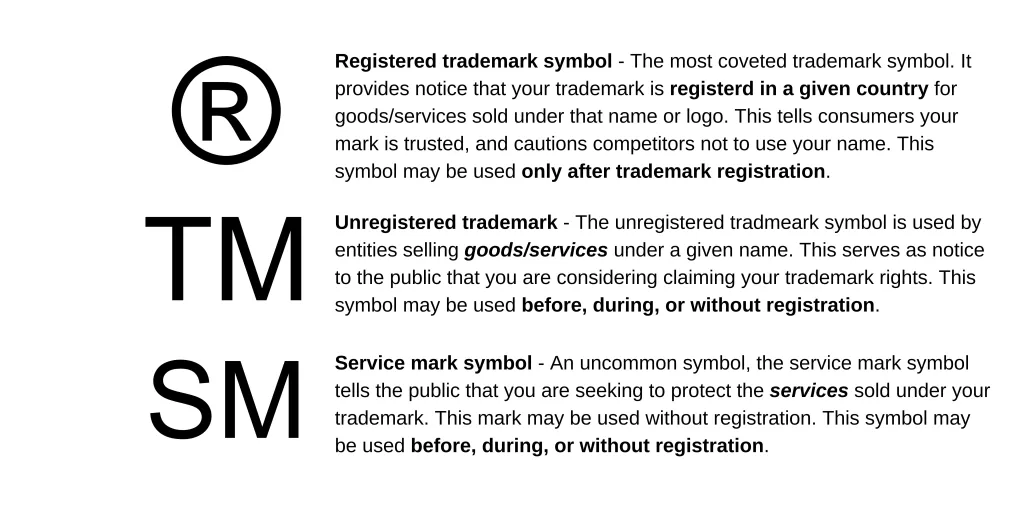
img
For NanoJam, the name and the small logo I am designing could in principle be trademarked, but I do not plan to register one. The project is non-commercial and the name is more of an identifier than a brand.
Trade Secrets
Trade secrets protect confidential information that has commercial value because it is secret — like a recipe or a manufacturing process. To qualify:- The information must be commercially valuable because it is secret
- It must be known only to a limited group
- The owner must take reasonable steps to keep it secret (NDAs, access controls, etc.)
Since I want to share everything about NanoJam openly, trade secrets are the opposite of what I want. Mentioned here for completeness.
Licenses
Holding copyright on something does not automatically tell anyone else what they are allowed to do with it. A license is the document that says: "here is what you can and cannot do with my work." Without a license, the default is "all rights reserved" — meaning nobody can legally reuse it.
For open projects, there are a few well-known license families:
MIT License The MIT License is one of the most permissive open-source licenses. It basically says: do whatever you want with this software — use it, copy it, modify it, sell it — just keep the original copyright notice and don't sue me if it breaks.
It is the most popular software license on GitHub. Great for code that you want to be reused as widely as possible, including in commercial products.
GPL (GNU General Public License) The GPL is a copyleft license. It also lets you use, modify, and share the software — but with one big condition: anything you build on top of GPL code must also be released under the GPL. This keeps the software open forever, but it can be restrictive if you want to combine GPL code with proprietary code.
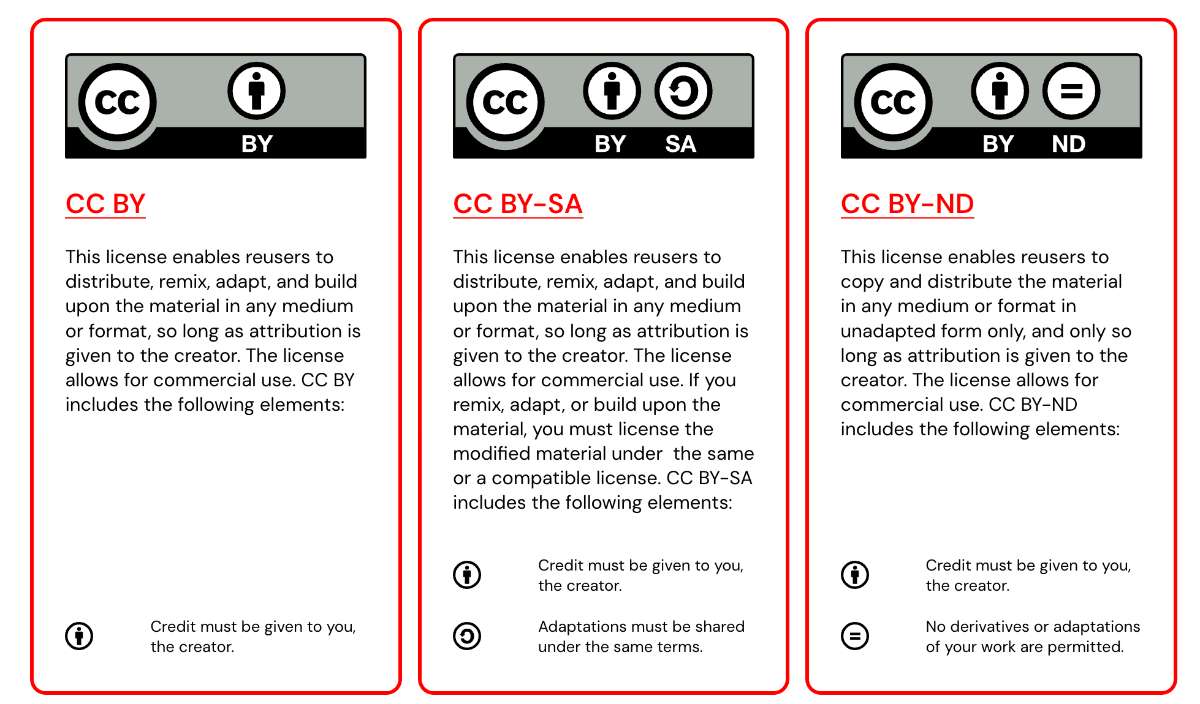
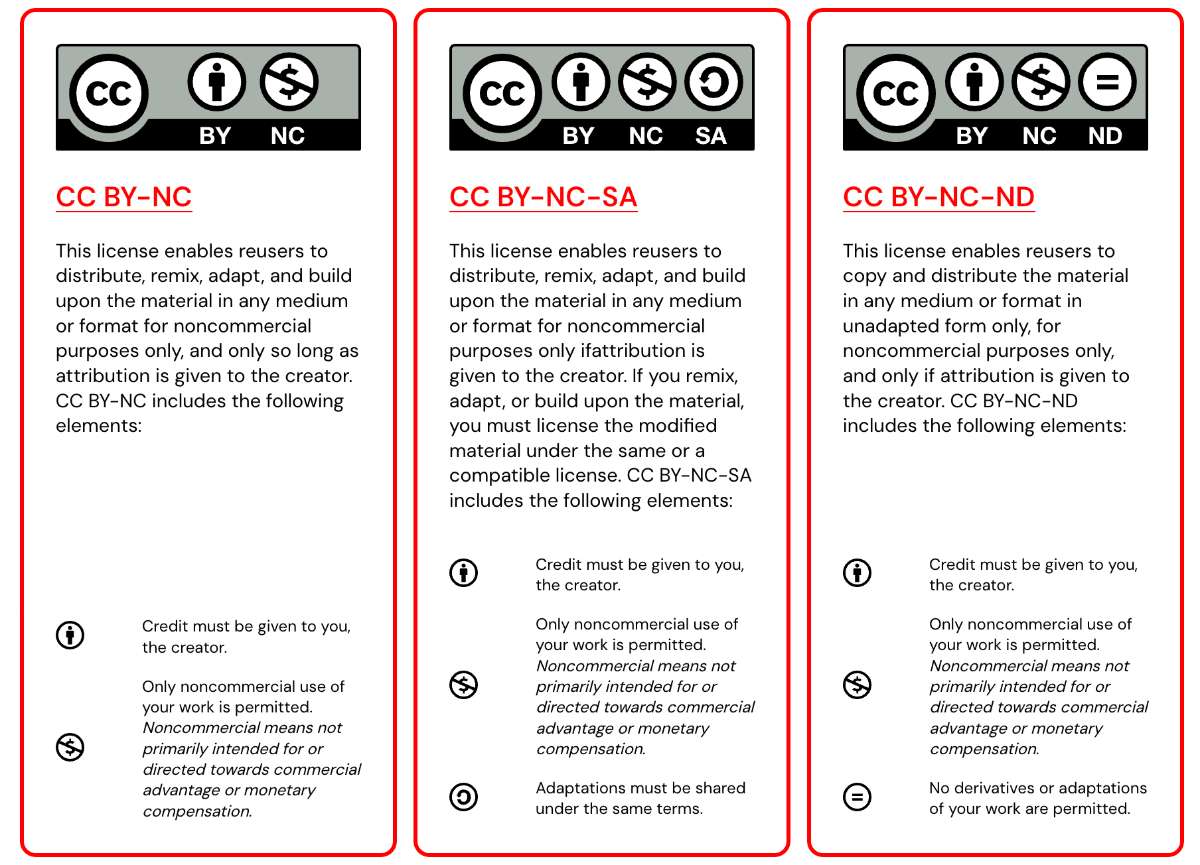
Creative Commons (CC) Creative Commons is a family of six licenses designed mainly for creative works (images, documentation, designs) rather than code, though they can be used for anything. CC licenses let you mix and match three conditions:
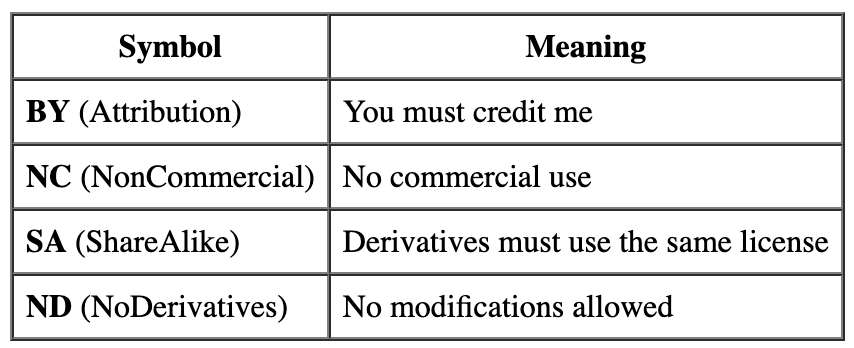 (prompt : generate table for CC symbols)
There are six different license types, listed from most to least permissive here:
 img
imgChoosing a License for NanoJam
After reading through the options, I decided to license NanoJam under CC BY-NC-SA 4.0.My reasoning:
BY (Attribution) — I want to be credited if someone uses or remixes my work. This also helps anyone who finds a derivative version trace it back to the original documentation.
NC (NonCommercial) — NanoJam is a learning project and I don't want someone to take it as-is and sell it on Amazon. If a company wants to commercialize it, they should talk to me first.
SA (ShareAlike) — If someone builds on top of NanoJam, I want their version to also stay open so the community can keep learning from it. This feels like the right spirit for a Fab Academy project.
This license fits the openness Fab Academy encourages, while keeping the project from being silently absorbed into a commercial product.
Generating the license
I used the Creative Commons License Chooser to generate the license text.Steps I followed:
- Opened the chooser and answered the questions about how I want my work to be used.
- The chooser confirmed my selection as CC BY-NC-SA 4.0.
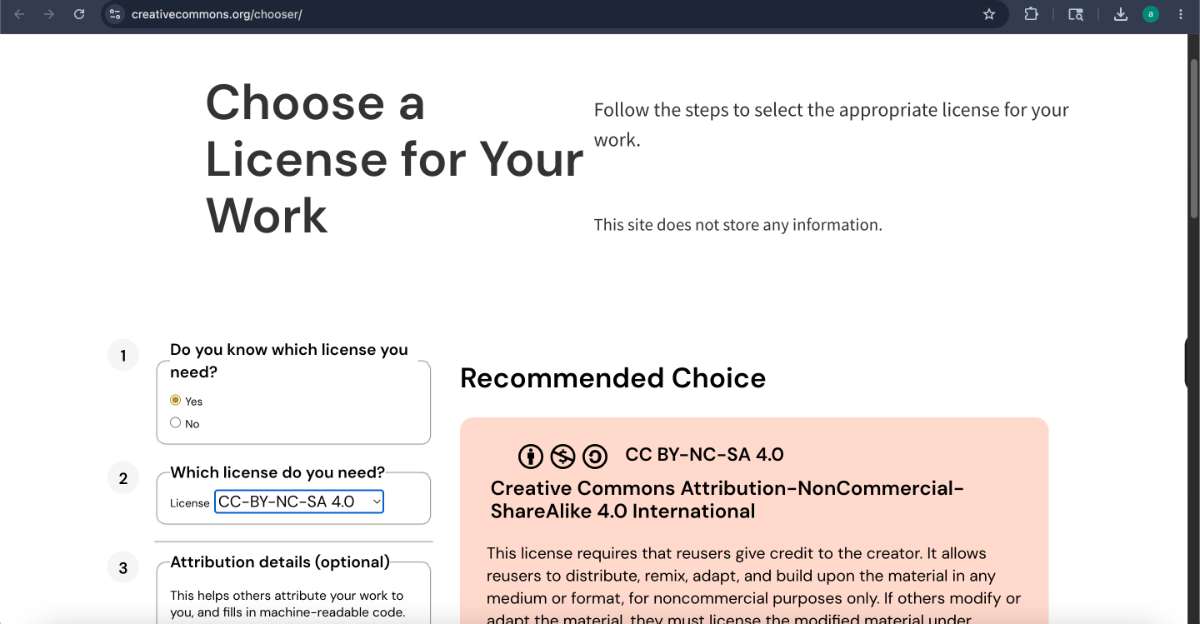
- Filled in the attribution details — title, creator name, link to the work, link to my profile, year.
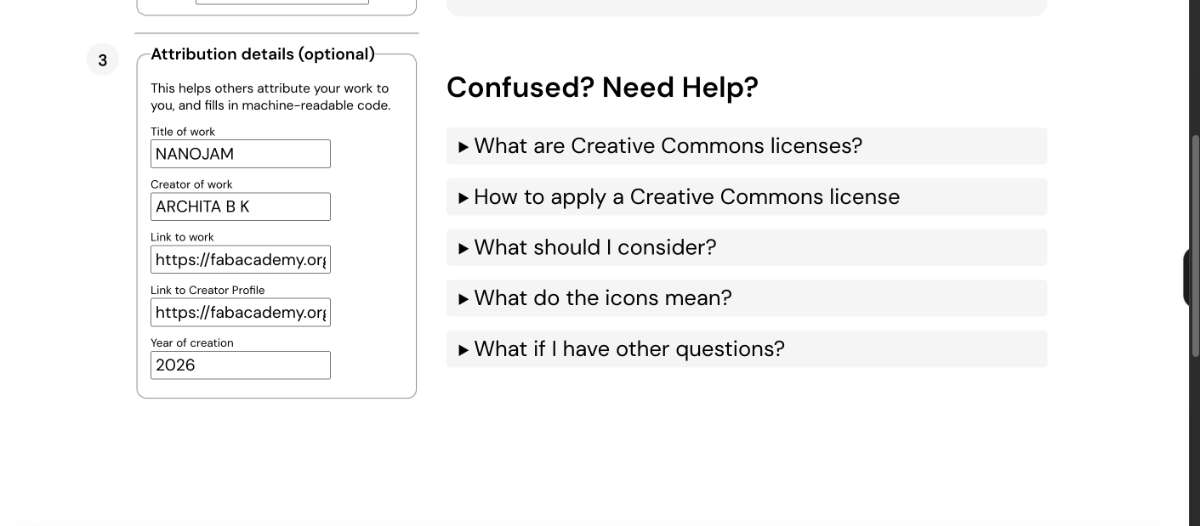
- Copied the generated HTML snippet to embed on my final project page.
The license badge for NanoJam looks like this:
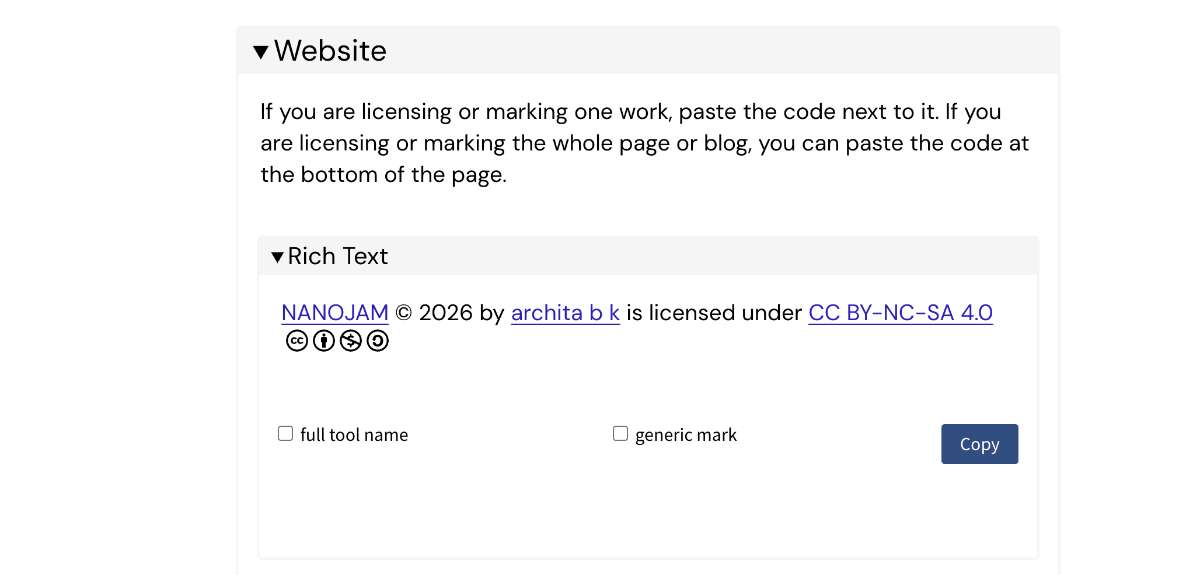 NANOJAM © 2026 by archita b k is licensed under CC BY-NC-SA 4.0


Dissemination Plan
Dissemination is about how I want the project to reach people once it is finished. For NanoJam, I want it to live as both a finished object that people can see and try, and as a set of files that other makers can build on.Future plans
NanoJam started as a single object, but I would like it to grow:Modular firmware — the current firmware is tightly tied to my exact hardware. I want to refactor it so people can swap out the OLED, the encoder, or the audio amp and still have the project work.
Open call for skins — the rotating disc interface lends itself well to custom artwork. I would love for the community to design and share their own disc graphics.
Wireless variant — adding Bluetooth audio output would make it possible to use NanoJam with wireless headphones, which fits the handheld, on-the-go nature of the device.
Workshop kit — at some point I would like to turn NanoJam into a workshop kit that beginners can assemble in a weekend, since the build touches on PCB assembly, 3D printing, and embedded firmware all in one project.
Why open? Honestly, almost everything I learned in Fab Academy came from people who documented their projects openly — instructor pages, past student documentation, forum posts, GitHub repos. NanoJam owes a real debt to that openness. Releasing the project under CC BY-NC-SA is the simplest way to pay that forward, while still keeping a say in how the work is used.