Week 17: Applications and Implications
Assignment
Plan a final project masterpiece that integrates the range of units covered, answering:
- What will it do?
- Who's done what beforehand?
- What sources will you use?
- What will you design?
- What materials and components will be used?
- Where will come from?
- How much will they cost?
- What parts and systems will be made?
- What processes will be used?
- What questions need to be answered?
- How will it be evaluated?
Your project should incorporate 2D and 3D design, additive and subtractive fabrication processes, electronics design and production, embedded microcontroller design, interfacing, and programming, system integration and packaging.
Where possible, you should make rather than buy the parts of your project.
Projects can be separate or joint, but need to show individual mastery of the skills, and be independently operable.
What will it do?
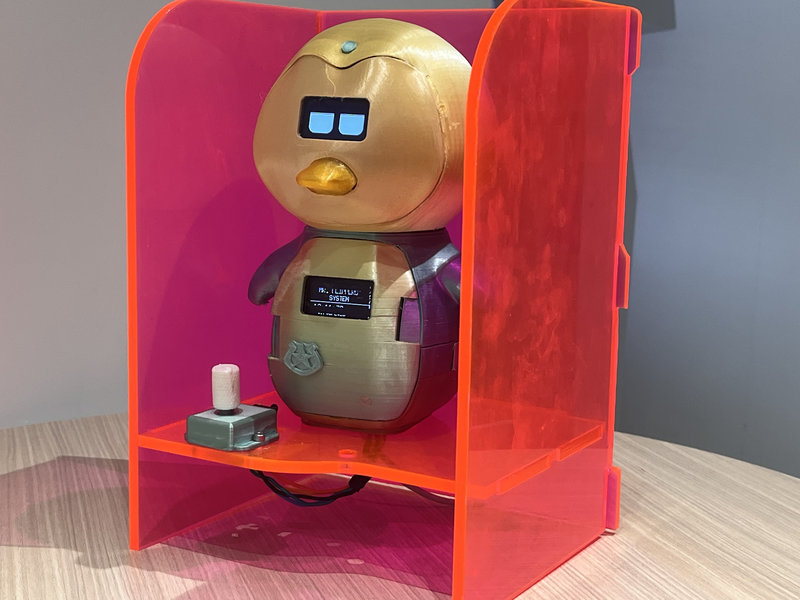
MR. Flippers is a penguin shaped desk bot that helps you stay focused while studying/working at your desk. It lets you set Pomodoro or custom focus timers, tracks your sessions in a Focus Blueprint log, plays voice alerts through a speaker, and uses a camera to detect if you are slouching. Everything runs standalone,just plug it into a wall and it works.
Who has done what beforehand?
Posture monitors and focus timers exist separately as apps or commercial products, but none combine both into one offline standalone device with a personality. The closest things online are simple Pomodoro timers with buzzers or ESP32 posture monitors, but they don't have audio feedback, session tracking, and an expressive character.
What sources will you use?
- Seeed Studio documentation for XIAO ESP32-C3 and ESP32-S3 Sense
- U8g2 and FluxGarage RoboEyes library documentation
- RTClib and DFRobotDFPlayerMini references
- Fab Academy documentation from previous students for PCB and enclosure inspiration
- Claude AI and ChatGPT
What will you design?
- A custom PCB with connectors for all components
- A full 3D printed penguin enclosure with multiple shells, twist-and-lock head joint, and internal mounting holders for every component
- A camera bracket inside the head shell
- A stand/holder for MR Flippers
- Custom stickers for MR Flippers
What materials and components will be used?
| Component | Purpose | \\
|---|---|
| XIAO ESP32-C3 | Main controller |
| XIAO ESP32-S3 Sense | Camera for posture detection |
| DS3231 RTC | Timekeeping |
| KY-040 Rotary encoder | Menu navigation |
| 2 × OLED displays | Face expressions and stats |
| DFPlayer Mini + 8Ω speaker | Voice alerts |
| Custom milled PCB | Connects everything |
| PLA filament | Penguin enclosure |
| 5V USB-C adapter | Power |
| MicroSD card | Audio file storage |
Where will they come from?
Most components came from the Fab Lab or were ordered through Amazon and Robu. The XIAO ESP32-S3 Sense was sourced as a substitute when the original Arducam was unavailable locally.
How much will they cost?
| Item | Qty | Link | Unit Price (Nu.) | Total (Nu.) |
|---|---|---|---|---|
| XIAO ESP32-C3 | 1 | link | Nu 1,643.47 | Nu 1,643.47 |
| XIAO ESP32-S3 Sense (camera) | 1 | link | Nu 3,762.31 | Nu 3,762.31 |
| DS3231 RTC Module | 2 | link | Nu 238.05 | Nu 476.10 |
| KY-040 Rotary Encoder Module | 2 | link | Nu 253.94 | Nu 507.88 |
| 1.3 inch OLED Display Module | 3 | link | Nu 546.53 | Nu 1,639.59 |
| DFPlayer Mini MP3 Module | 2 | link | Nu 258.60 | Nu 517.20 |
| 8Ω 3W Mini Speaker | 2 | link | Nu 167 | Nu 334 |
| MicroSD Card | 1 | link | Nu 599 | Nu 599 |
| Total | Nu 9,479.55 | |||
What parts and systems will be made?
- 3D printed: head shell, face plate, body shells, belly plate, feet, flippers, beak, camera bracket, internal holders and standoffs for every component
- Milled and soldered: custom PCB
- Programmed: full menu system with timers and Focus Blueprint on the C3, posture detection on the S3, communication between both boards via UART
What processes will be used?
- 3D design in Fusion 360 using the Form workspace for organic shapes
- 3D printing for all enclosure parts
- PCB milling and soldering
- Embedded programming in Arduino IDE
- Making custom stickers using the vinyl cutter for subtractive fabrication
- Laser cutting a holder for MR Flippers.
- Embedded programming in Arduino IDE
What questions need to be answered?
- Will the posture detection be reliable enough in different lighting conditions without false alerts?
- Will the posture detection be reliable enough even while working which requires small movements
- How accurately can MR Flippers track and store when your best focus times were?
- Will 3.3V produce enough volume from the speaker through the DFPlayer?
- Will all the 3D printed joints hold together reliably after full assembly?
How will it be evaluated?
MR. Flippers works if, without a laptop connected it can boot up with the intro animation, navigate the full menu using the rotary encoder, run accurate custom timers and sounds, save session data, detect sustained slouching, and play audio alerts through the speaker.
Current progress
The custom PCB has been milled and soldered multiple times fixing short circuits and ground connection issues. The 3D printed penguin enclosure has gone through several redesigns and reprints to get the joints, holders, and shell fits right and printing is still ongoing. The menu system including all timer options and the Focus Blueprint is fully working and tested. What still needs to be completed is integrating the DFPlayer and speaker for audio, finishing the posture detection with the S3 camera, and completing the final assembly of all the printed parts.
Answers to Technical Questions
Will 3.3V produce enough volume from the speaker through the DFPlayer?
Initially, the speaker volume was too low because the DFPlayer was connected to a 3.3V supply. To solve this, I redesigned and remade the PCB so that the DFPlayer was connected to the 5V pin instead. The speaker was then loud enough for voice alerts and sounds (music) to be clearly heard from a normal desk distance.
Will the posture detection be reliable enough in different lighting conditions without false alerts?
Will the posture detection be reliable enough while working, which requires small movements?
Unfortunately, I was not able to fully implement and test the posture detection feature before the Fab Academy deadline. Due to time constraints, I decided to prioritize completing the core functions of MR. Flippers, including the timer system, Focus Blueprint, audio alerts, custom PCB, and enclosure. The posture detection system is a feature I plan to continue developing after Fab Academy, where I will be able to properly test its performance in different lighting conditions and during normal desk work.
Heroshot!!
Thank you bye!
Files (Fusion Zip files):
- Kicad PCB board
- Desk bot Arduino IDE File
I couldn't add the fusion file since it is too large.