Previous ideas
Final Project
Idea 2. Interactive remote call with my child
The problem
I been thinking about how to enhance the remote interaction, i.e. video calls, with my 2-year old daughter. I don’t think the talking head on a screen is the best option for it for either of us. For example, I usually can’t see her face because the camera is pointing in random directions and the screen reacts to every touch by mistake. Also she’d rather move around than sit in front of a screen, which she can do for a 5-10 minutes or so.
The idea
I’ve been thinking about a figure “doll” for my child to interact with and carry around. It has camera, microphone and wifi connection to make calls over the internet and a remote connection to my laptop/phone with various remote controls, especially moving the camera (the head). Additionally, the figure could be put on a remote control car that I can drive to move around with my kid. There also could be some extra funny features on remote control like wiggling and/or other gestures. There’s a light in the head of the figure, or some other visible signal, which turns on when I switch on the app on my computer, signaling that I’m available for her to call me, for which there is a button for her to do.
Idea 3: FerroFluid game/puzzle
I got interested in this material: Ferrofluid is fluid that reacts to magnetic fields as it has nano-sized particles of iron in it. I found it from this video: How This Guy Makes Mesmerizing Fluid Sculptures | Obsessed | WIRED
The Idea
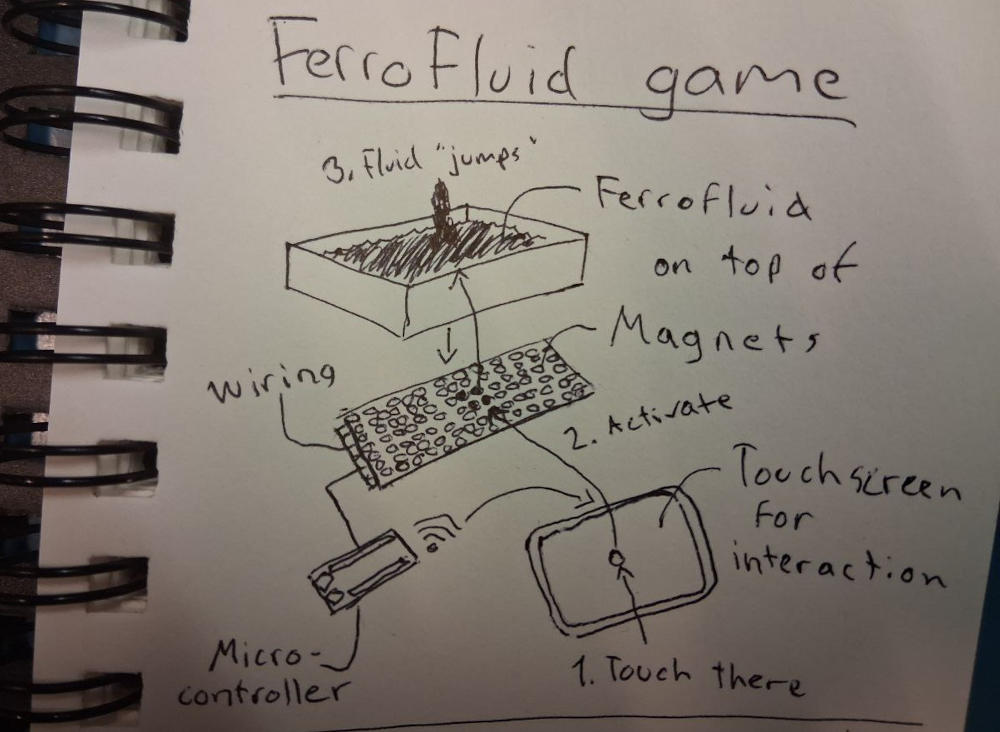
Small ferrofluid/magnetorheological container on top of a area of small magnets. Put many small electromagnets next to each other and place a container on top of them and pour of ferrofluid in it. The magnets can be programmed to go on and off, thus making the fluid react by going up and down. This would allow interaction with ferrofluid, for example with touch screen computer/tablet, so that what you press becomes magnetized in the area of magnets making the fluid react to the user’s hand.
The remote controlled haptic tablet/computer sends signals which magnets are active and controls a program for the magnets, creating a similar constellation out of the magnets which then creates a upward protruding shapes of the fluid. Pressing longer increase the voltage (or whatever increases the magnetic field?) which would make the surface rise higher. Touching the screen creates “topological” changes on the surface under the fluid spikes. There can also be ready-made programs, such as waves, ripples, movements, figures, faster or slower, making the fluid “dance” etc.
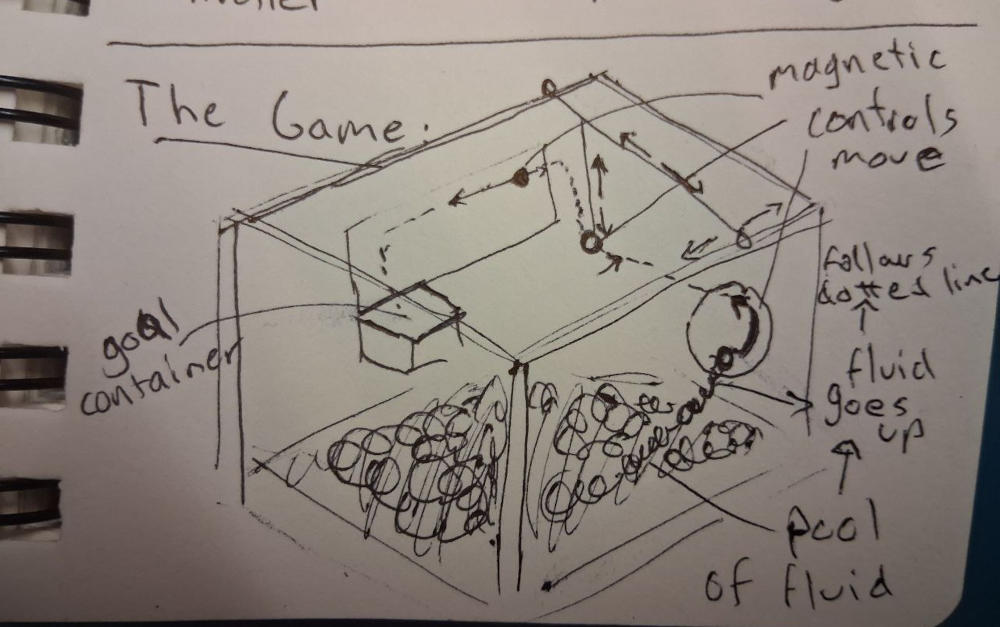
A further idea is to make a puzzle of the interaction with ferrofluid. For example, need to move the
ferrofluid in place A to place B using remote controlled electromagnets.
- climbing with movable magnets
- rotations of the magnetic surfaces
- other ways to use magnets to make the fluid move around
In the end, when the fluid reaches its goal, it begin "dancing" in upbeat music.
The game possibly includes other sounds as well, for intance on each achieved level.
Who will use it? Curious people I guess.
Idea 4: Interactive Physical “Painting”
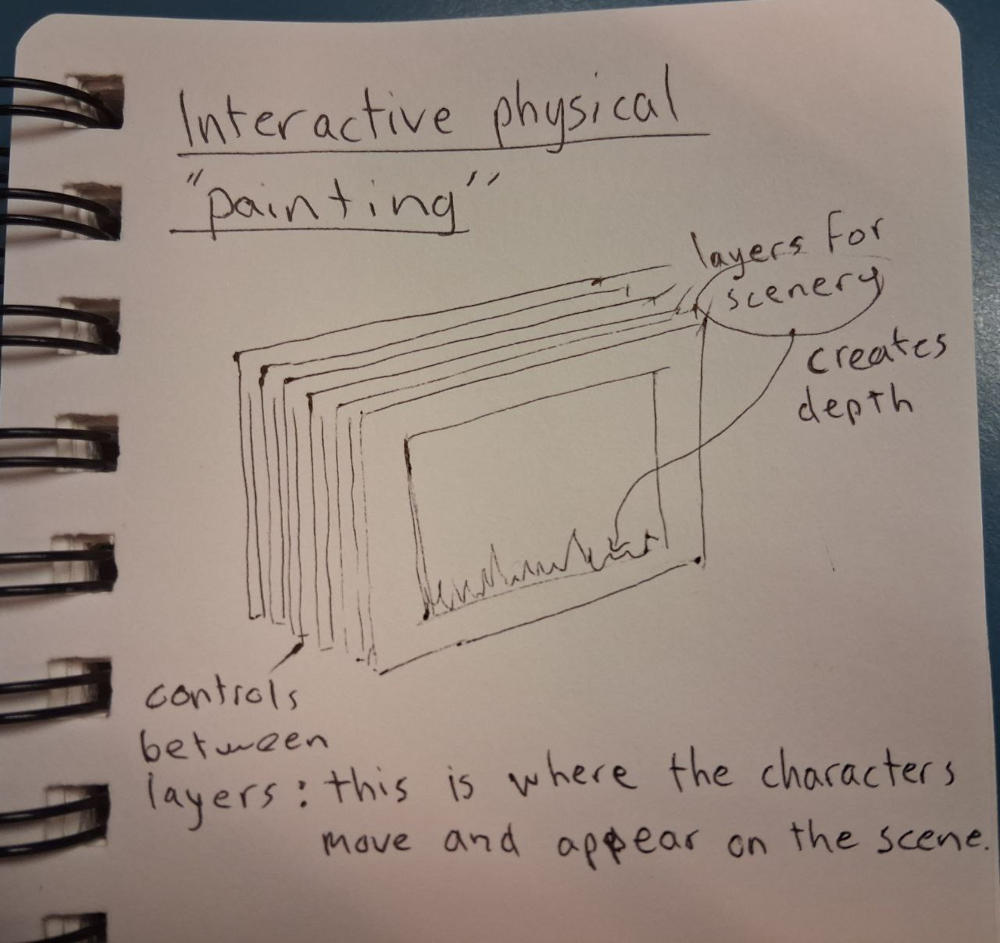
A analgue (non-digital) 3D painting on a wall that moves/changes as the day/night goes on, eg. sun and moon, works as a clock, moon calendar affects the form of the moon at night. Possibly changes with seasons as well. Layers (of activity) that create depth in the painting Apart from seasons and time of day, there might be an embedded fairytale or small game that a user can play. Move a character from place to another and then something happens (narrative on the way). Narrrative continues in between the tasks / puzzles. I haven't yet figured out the controls exactly, and whether this is actually feasible. There could be some pop up engineering implemented.
Who will use it? Children at least.