





NODO
Planning review for the Smart Lean Cell final project, using a dynamic Gantt chart to organize fabrication, electronics, integration, and documentation.
The midterm review was used to evaluate the current state of the final project and convert the remaining work into a clear production plan. The project, Smart Lean Cell, combines a modular manufacturing station, conveyor movement, sensor-based detection, custom electronics, and interface development.
The Gantt chart below organizes the work by project phases. It helps identify what has already been validated, what is currently in progress, and what must be completed before final integration.
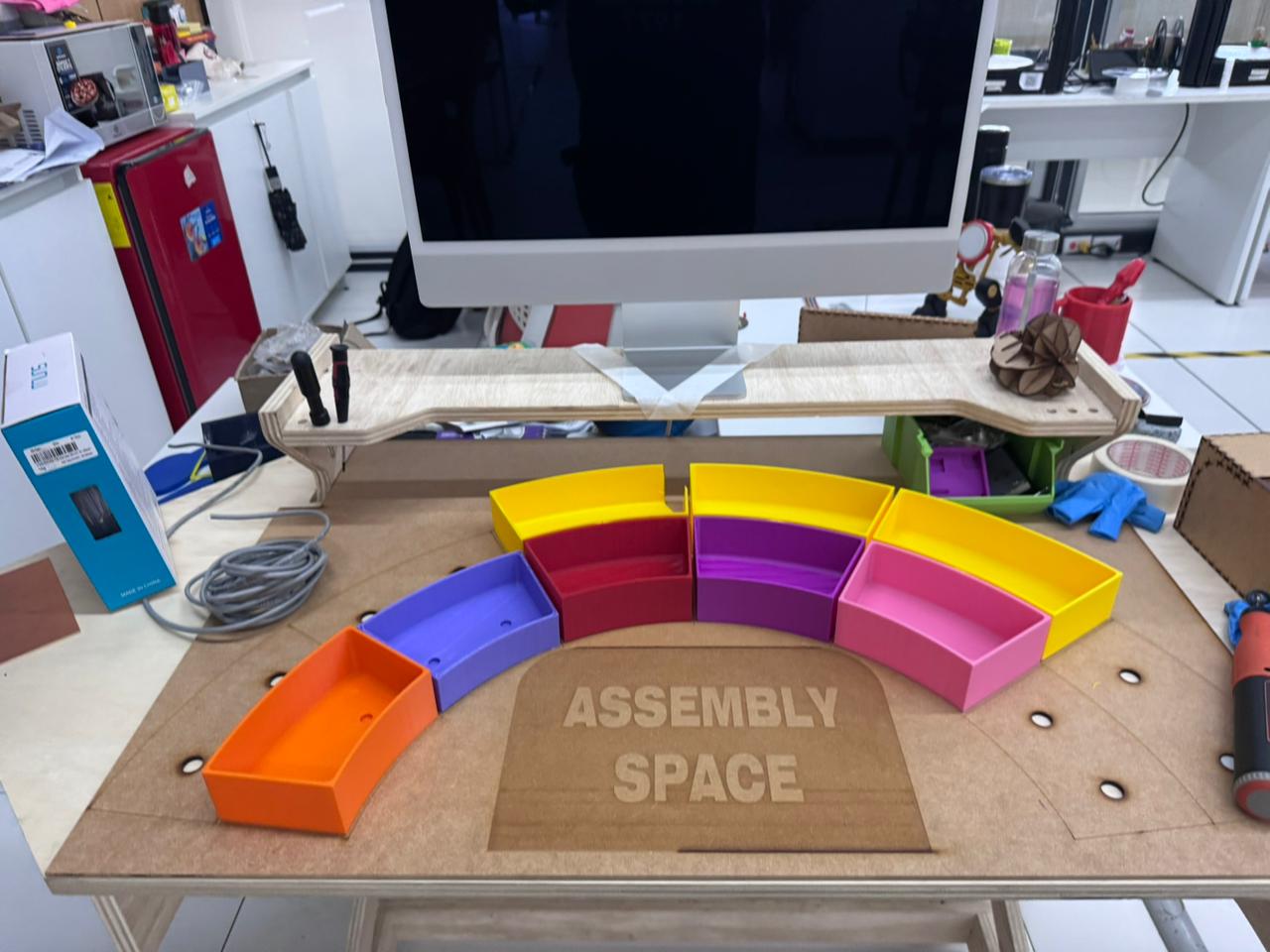
View Final Project PageThe current prototype already shows the physical direction of the Smart Lean Cell. The assembly area, modular containers, curved layout, and working surface are being tested as part of the final project development. This progress image helps connect the planning chart with the real prototype being fabricated in the lab.
Use the filters to focus on a single phase. Click each bar to read the planned output and the reason it matters for the final project.
Click a Gantt bar to inspect the objective, deliverable, and connection with the final project.
The planning chart shows that the final project is not a single build event. It is a sequence of connected decisions. The first part of the work focuses on defining the concept, reviewing the lean manufacturing context, and translating the idea into a modular station. This phase gives direction to the mechanical and electronic work.
The central part of the plan is dominated by fabrication and electronics. The mechanical structure and conveyor system must be solved before integration can be reliable. In parallel, the custom electronics and output device work define how the station will sense, move, and communicate.
The final part of the timeline concentrates on integration, testing, interface development, and documentation. This is where the individual assignments connect to the final project: input devices provide sensing, output devices provide movement, mechanical design provides the conveyor structure, and interface programming provides the monitoring layer.
These dates define the review path from midterm planning to final evaluation. They were added to the project plan because the final prototype must be technically ready before the presentation window, while documentation and evaluation decisions continue after the final presentation.
| Date | Deadline / Event | Project Action |
|---|---|---|
| May 20, 2026 | Final presentation registration opens. | Confirm presentation intention and align the final project scope. |
| June 3, 2026 | Deadline for weekly assignment submissions. | Complete and review all weekly documentation before final integration. |
| June 8-12, 2026 | Final presentations. | Present the Smart Lean Cell prototype, workflow, and learning outcomes. |
| June 24, 2026 | Deadline for local-to-global evaluation. | Complete local review and prepare the project for global evaluation. |
| Before global evaluation | Student, local, and global review meetings. | Use feedback from each review level to correct documentation and technical gaps. |
| July 1, 2026 | Deadline for global evaluation decisions: pass, provisional, or future. | Verify that the project evidence supports the expected evaluation decision. |
| July 27-31, 2026 | FAB26 Graduation. | Graduated students have free entry; this is the closing milestone after evaluation. |
| Dependency | Why It Matters | Next Action |
|---|---|---|
| Mechanical structure and conveyor path | The actuator cannot be tested realistically until the belt and support system are defined. | Use Machines Design to validate the conveyor and 12V DC motor approach. |
| Custom PCB and motor driver wiring | The board must send stable logic signals while the driver handles motor current separately. | Continue testing the FabXIAO board with the L298N and external motor supply. |
| Sensor, dashboard, and timing logic | The cell needs feedback to detect objects and represent system behavior in the interface. | Connect input sensing and application programming into a single test workflow. |
The review clarified that the most important risk is integration. Individual tests can work separately, but the final project requires them to operate as a system. The Gantt chart makes this visible by placing mechanical, electronic, programming, and documentation tasks on the same timeline.
Another important learning is that actuator selection affects the rest of the project. Servo tests were useful for understanding output control, but the conveyor belt requires a 12V DC motor and a suitable driver. This decision connects the output devices assignment with the upcoming machine design work.
From this point, the main goal is to reduce uncertainty: finish the conveyor mechanism, validate motor control, integrate sensing, and document each test with enough detail to reproduce the final system.