Assignment 18:- Invention, Intellectual Property, and Income
Hero shot
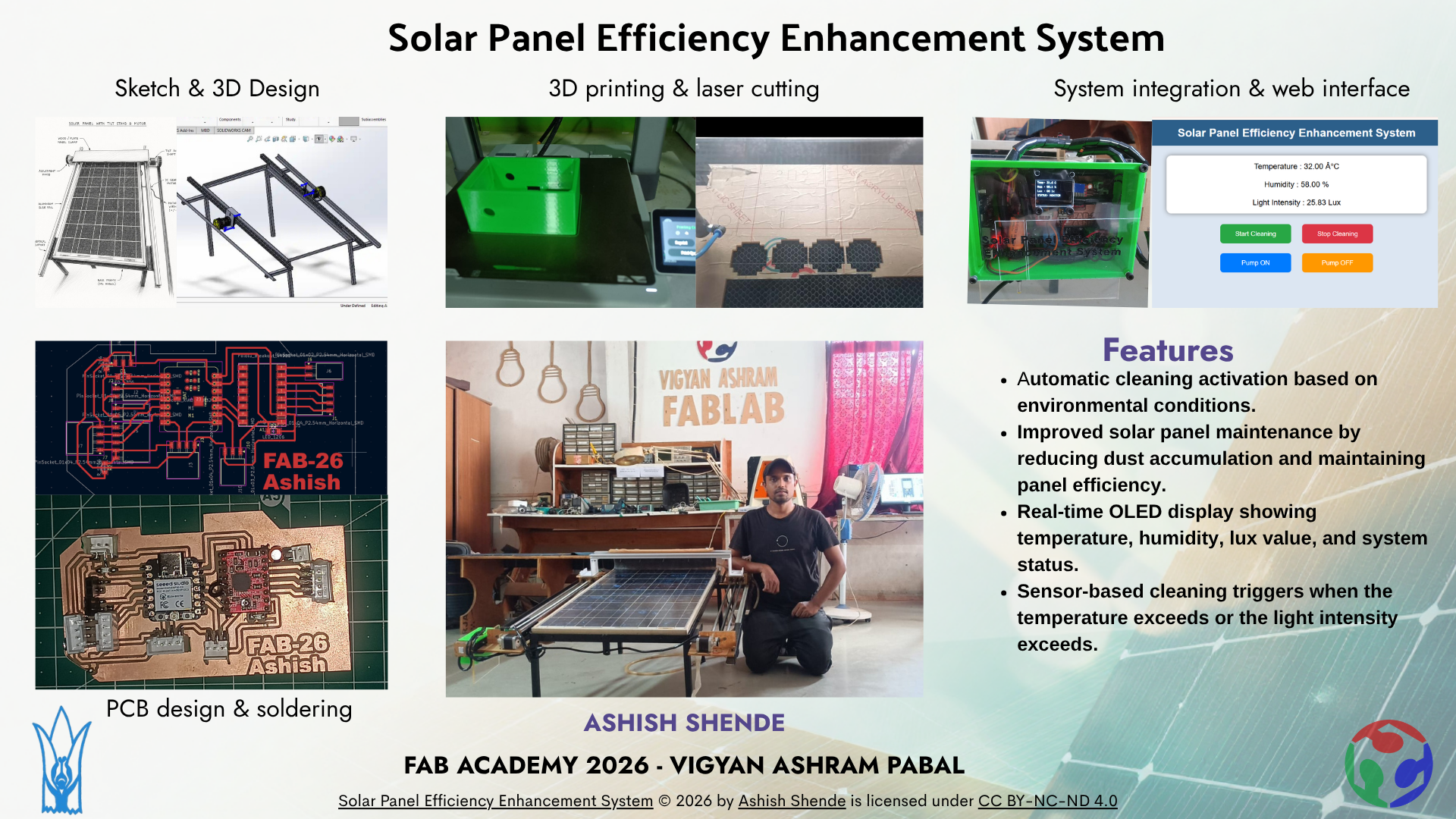
This is a documentation of what I learned during the week of invention, intellectual property, and income. I think my invention will have a significant impact when it's developed into a practical solution that users can adopt in real-life applications.
Now that I am almost done with my final project, Solar Panel Efficiency Enhancement System, I am trying to figure out different ways to convert it into a product that can be used by residential users, commercial buildings, industries, and solar farm operators. It’s designed to automatically monitor environmental conditions and clean solar panels to help maintain efficiency and reduce manual maintenance and water consumption.
Meanwhile, I am learning about intellectual property rights and how to protect my design, mechanical cleaning mechanism, electronic system, and software from unauthorized use or reproduction. I've learned to understand patents, copyrights, and open-source licensing, which has helped me analyze the best way to share and commercialize my project while protecting its originality and innovation.
I want to take this project further and develop it into a reliable and affordable solution that will help in sustainable energy production and improve the performance of solar power systems.
What is an Invention?
An invention is the creation of a new product, process or system that solves a problem in a useful way. It’s about using creativity, knowledge and technology to make something new and useful. An invention is either a completely new thing or a significant improvement of an existing solution that makes it more efficient, reliable or effective.
What is an Invention?
1. Product development Product Innovation involves developing a new product or significantly improving an existing product to offer users better functionality and value. This is an example of product innovation because my Solar Panel Efficiency Enhancement System integrates the monitoring and automated cleaning features into one system.
2. Innovation in Process Process innovation relates to the way in which a task or operation is performed. The automated cleaning mechanism I have in my project reduces the need for manual labor and ensures a consistent cleaning process, improving efficiency and reliability.
3. Service for Innovation Service innovation means the creation of new service delivery methods or enhancement of the user experience. Subsequent versions of my project might be able to provide remote monitoring and maintenance services, so users can keep track of the system’s performance from anywhere.
4. Innovation of Technology Technology innovation is the use of modern technologies to solve existing problems more effectively. My project involves automation of solar panel to improve their efficiency and reduce their maintenance requirements using sensors, a microcontroller and a stepper motor.
5. Innovation in business model business model innovation involves changing the way a product or service is delivered to customers for example, i could offer my solor panel efficience enhancement system as a subcription-based service where users pay a monthly fee for the monitoring and cleaning services, rather then selling the product outright.
Intellectual property (IP)
Intellectual property (IP) refers to a creation of the human mind, such as inventions, designs, software, artistic works and innovations. It gives creators and inventors legal protection, giving them rights over the use, reproduction and commercialization of their creations. Intellectual property fosters innovation by allowing creators to receive recognition and rewards for their ideas and inventions.
Types of Intellectual Property
1. Patents: A patent is a legal right granted to an inventor that gives them exclusive rights to make, use and sell their invention for a certain period of time. It protects new inventions and innovations, preventing others from copying or using the invention without permission.
2. Copyrights: Copyright is a legal protection for original works of authorship, such as literary, artistic, musical and software works. It gives creators the exclusive right to reproduce, distribute and display their work, allowing them to control how their creations are used and shared.
3. Trademarks: A trademark is a symbol, word or phrase that distinguishes a product or service from others in the market. It helps consumers identify and associate a brand with specific qualities or values. Trademarks protect brand identity and prevent others from using similar marks that could cause confusion among consumers.
4. Trade Secrets: Trade secrets are confidential information that gives a business a competitive advantage. This can include formulas, processes, designs or any other information that is not generally known to the public. Trade secrets are protected through confidentiality agreements and legal measures to prevent unauthorized disclosure or use.
5. Industrial Designs: Industrial design refers to the aesthetic aspect of a product, such as its shape, pattern or color. It protects the visual appearance of a product and prevents others from copying or imitating its design.
6. Geographical Indications: Geographical indications are used to identify products that originate from a specific geographical location and have qualities or reputation associated with that location. They protect the unique characteristics of products tied to their geographic origin.
7. Plant Variety Protection: Plant variety protection is a form of intellectual property that grants exclusive rights to breeders of new plant varieties. It encourages innovation in agriculture by providing legal protection for new plant varieties and promoting the development of improved crops.
Develop a plan for dissemination of your final project
Who is the project intended for?
The Solar Panel Efficiency Enhancement System is for residential solar panel owners, commercial buildings, industries, solar farms and organizations that use solar energy systems. It is intended for users who want to improve the efficiency of their solar panels, while reducing the amount of maintenance work and water used.
How is the project currently funded?
This project was developed within the scope of my educational and research efforts during Fab Academy. Costs of materials and electronics research, fabrication and testing were funded by Vigyan Ashram and use of Fab Lab resources.
What is the plan for scaling and future development?
The ultimate goal is to make the project an affordable, reliable solution for wider adoption. Scaling can be facilitated by collaborations with solar installation firms, government renewable energy programs, research funding, startup incubation programs, and private investment. In the future we may extend the solution with IoT connectivity, web based monitoring and performance analytics.
How will the project be protected?
The project documentation, design files, software and hardware designs could be released under a good open source license retaining a proper attribution. For commercial development intellectual property protection might be sought through design registration, patents, copyrights or license agreements depending on future needs.
How will the potential users be made aware?
Awareness can be created through project demonstrations, academic presentation, social media, technical workshop, renewable energy exhibition, Fab Academy documentation and collaboration with Vigyan Ashram. Disseminating project results and performance data will help to show the benefits of the system and encourage adoption by potential users.
Creative Commons License for My Final Project
The Solar Panel Efficiency Enhancement System is licensed under a Creative Commons License.
You are free to share and adapt this work with proper attribution to the original author.
I have chosen a Creative Commons License to distribute my project and protect my work. This license permits others to view, learn from and use my project with credit. It promotes collaboration and the use of collective knowledge and ensures that the original author of the work is credited.
The Solar Panel Efficiency Enhancement System can be shared for educational and research purposes, helping others learn and develop the ideas created during this project.

In stepi go to the creative commons website https://creativecommons.org/choose/ and select the appropriate license for my project. and open this his page check thr license details according to my project and select the checkboxes.
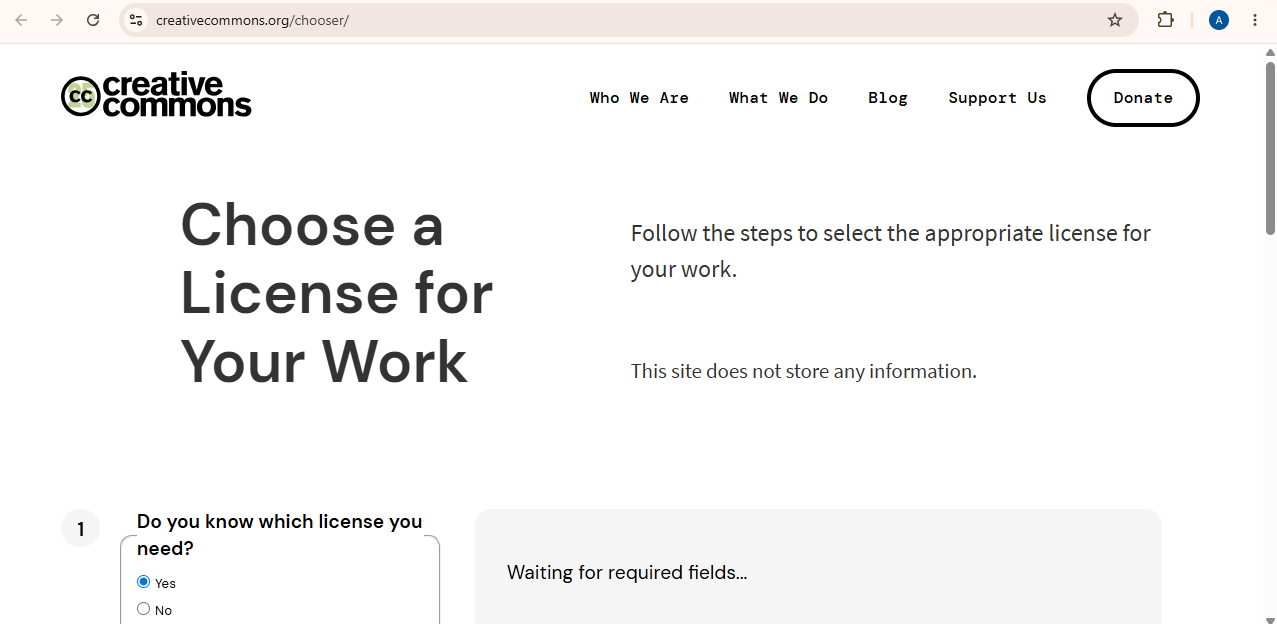
I choose this option because it allows others to use and adapt my work while giving me credit as the original creator. It promotes sharing and collaboration while ensuring that my contributions are acknowledged. By using a Creative Commons License, I can encourage others to learn from and build upon my project while maintaining recognition for my efforts.
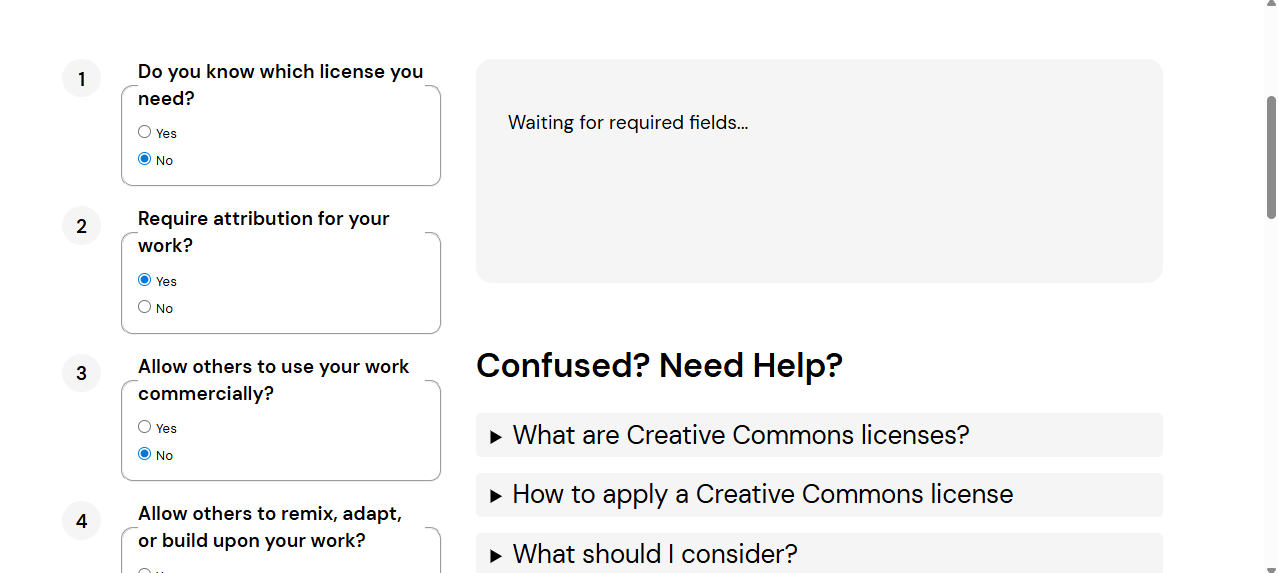
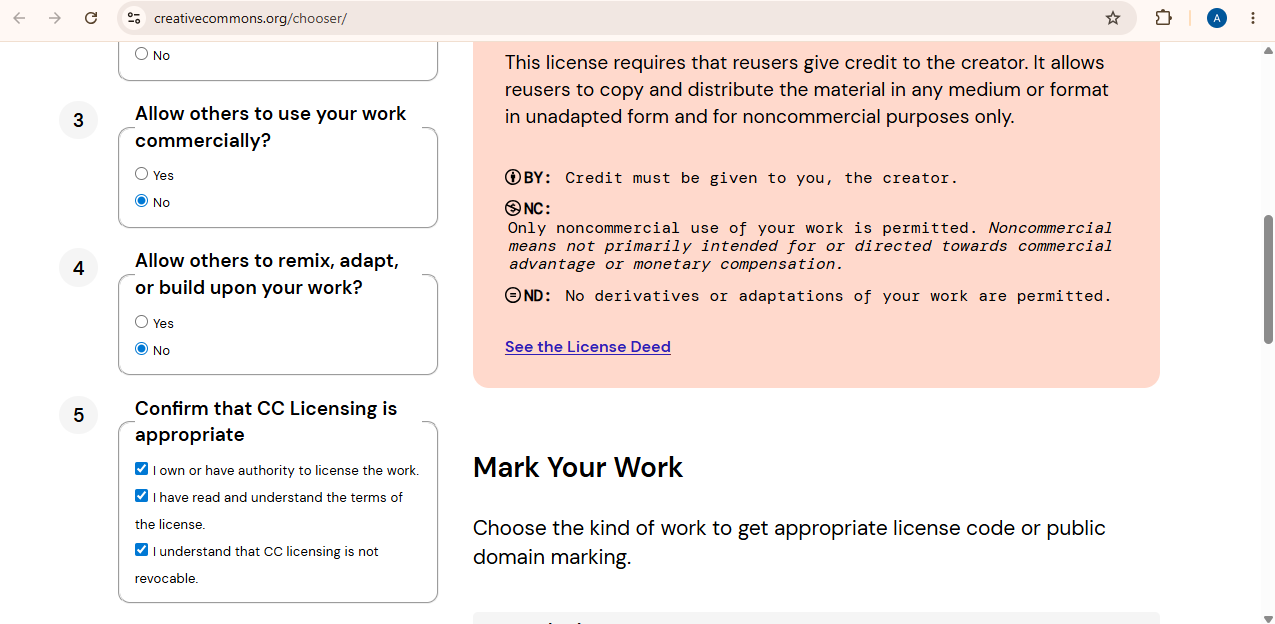
Add a project description, and the license details will be generated based on the options I selected. I can then copy the generated license code and include it in my project documentation, website or any other platform where I share my project. This way, others will know how they can use and share my work while giving me proper credit as the original creator.
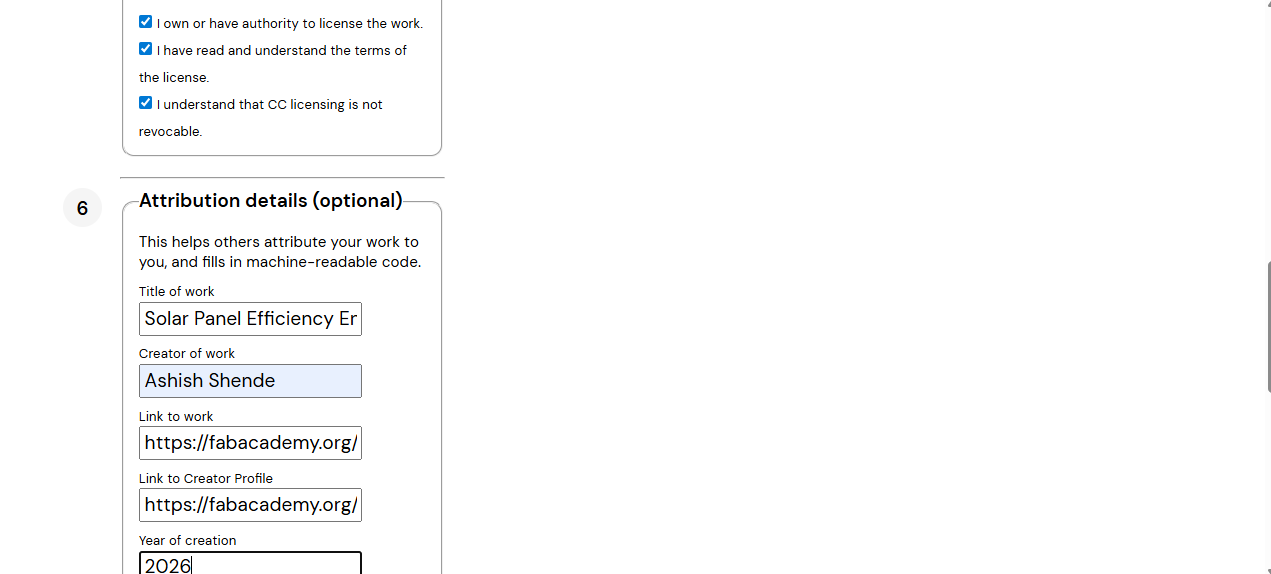
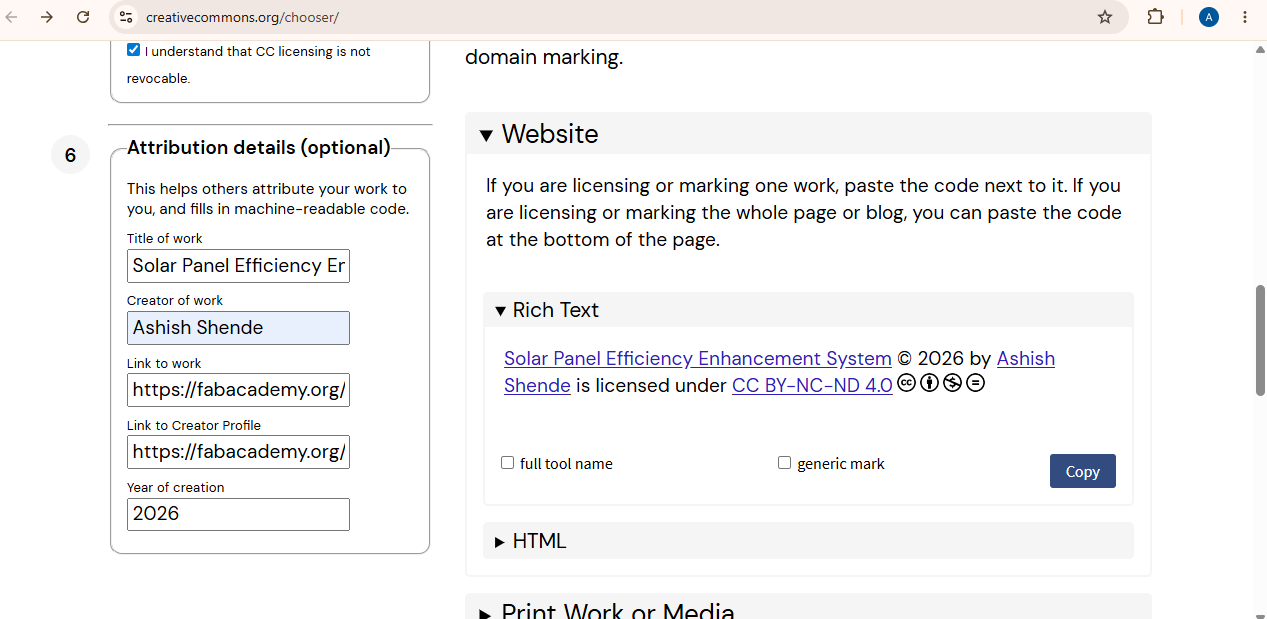
After completing the license selection process, genrate the license HTML code add in my project documention.
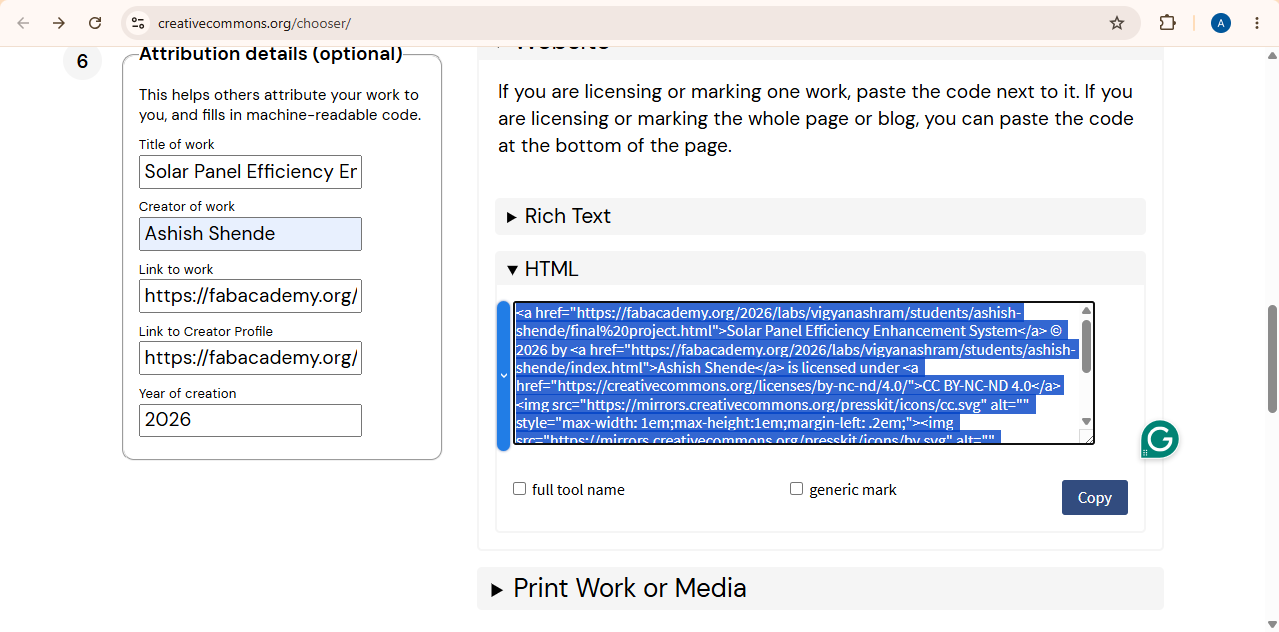
This HTML code add in footer section of my project documention code.
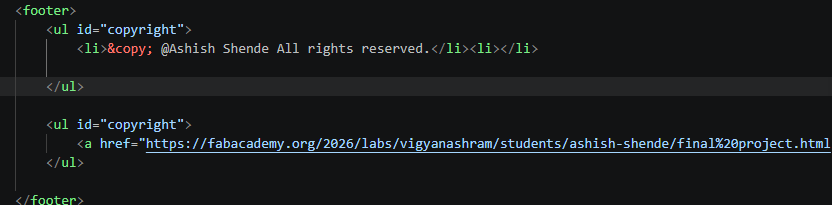
On the web page, the license information will be displayed in the footer section, indicating that the solor panel efficiency enhancement system is licensed under the Creative Commons License. This allows others to understand the terms of use and how they can share or adapt the project while giving proper credit to the original creator. By using a Creative Commons License, I can encourage collaboration and sharing of knowledge while ensuring that my work is acknowledged and respected by others in the community.

Final project, Tracking progress:
What tasks have been completed?
3D structural design completed.
Mechanical design completed and fabricated.
Stepper motor testing completed
sensor integration completed
PCB design completed
Raw code development completed
What the remaining tasks?
Fome attchment design and fabrication for the cleaning mechinsim.
Final assembly and integration of all components.
pcb soldring and tesing
final code develoment and testing.
final system testing and optimization.
presntation slides and veideo preparation.
What will happen when?
in this week, I completed the desigen and fabrication of the mechinical structure and the cleaning mechansim vedio and presentation preparation.
Before the final presntation,i will complete the final project documetation, and all assignments with go through check and review process.
What questions need to be answered?
During development, several questions were addressed:
One of the main questions was whether the stepper motor cleaning mechanism would move smoothly and clean the solar panel surface effectively. After testing, the movement was stable and worked properly for the cleaning process.
Another important question was whether the sensor system could provide reliable environmental data. The DHT22 and BH1750 sensors successfully measured temperature, humidity, and light intensity with stable readings.
There was also a question during the planning stage about whether the system should be battery-powered or use a direct power supply. Initially, I planned to make it battery-based, but during development I used a power supply for stable operation and testing. A future version can include battery integration for portability.
The project also confirmed that Wi-Fi monitoring and control could be integrated successfully. The ESP32 web interface monitored sensor data and controlled the system remotely, making the system more practical and user-friendly.
What will happen when?
in this week, I completed the desigen and fabrication of the mechinical structure and the cleaning mechansim vedio and presentation preparation.
Before the final presntation,i will complete the final project documetation, and all assignments with go through check and review process.
What have you learned?
Through this project, I learned mechanical design and assembly techniques, PCB design and fabrication processes, and different sensor integration methods. I gained experience in ESP32-C3 embedded programming, motor control systems, and interface development. I also improved my skills in system integration, troubleshooting, testing, and debugging to ensure reliable system performance.