Assignment 17:- Applications and implications, project development
In this week assignment, I answered the questions related to my final project.
What will it do?
The Overheating Solar Panel Cooling and Cleaning System is an automated system designed to maintain solar panel efficiency by reducing excessive heat and removing dust from the panel surface. The system continuously monitors environmental conditions using sensors such as temperature, humidity, and light sensors. When the panel temperature exceeds a predefined threshold, the cooling mechanism automatically activates to reduce the temperature. The cleaning mechanism uses a motorized slider with a brush or wiper to remove accumulated dust from the panel surface. The system can also provide real-time monitoring through a web or mobile interface. Its purpose is to increase energy generation efficiency, reduce manual maintenance, and improve solar panel performance.
Who's done what beforehand?
Several researchers and organizations have worked on solar panel cooling and cleaning technologies:
Researchers have developed automatic cleaning systems using rolling brushes and wipers controlled by microcontrollers for scheduled cleaning operations. Such systems showed improvements in solar panel output performance.
Studies have implemented water cooling systems with automatic cleaning mechanisms, where cooling tubes behind the panel reduce operating temperature while automated cleaning removes dust accumulation.
Researchers at Massachusetts Institute of Technology developed a waterless electrostatic dust removal method, where electrical charges repel dust particles from the panel surface without water or brushes.
Review studies show that robotic cleaning systems, hydraulic systems, and automated mechanisms are among the most promising technologies for maintaining photovoltaic systems.
Research also shows that dust accumulation can reduce solar panel efficiency significantly and therefore regular cleaning and temperature control are important.
What sources will you use?
Effect of water cooling temperature on photovoltaic panel performance by using computational fluid dynamics (CFD)
Enhancing Photovoltaic Performance through Water-Based Cooling:
Enhancement of performance and exergy analysis of a water-cooling solar photovoltaic panel
Solar PV Cell Cooling with cool water circulation system
Effect of Dust Accumulation on PV Performance
Experimental Study of Dust on PV Modules
Literature Review (Dust Effect on Solar PV):-
Dust deposition on solar photovoltaic panels significantly affects their performance and energy generation capability. Several studies report that accumulated dust blocks incident sunlight, reducing light transmittance and electrical output. Research shows that efficiency losses due to dust can range from 5% to 50%, depending on environmental conditions, dust density, humidity, and cleaning frequency.
Solar photovoltaic (PV) panels lose efficiency as temperature increases, especially in hot regions such as Vidarbha and drought-prone areas like Pabal. Studies show that PV efficiency decreases by approximately 0.3%–0.5% for every 1°C rise in temperature due to reduced output voltage and internal losses. Water-based cooling techniques, including surface spraying and circulation systems, can reduce panel temperature by 15°C–20°C and improve efficiency by 3%–38%. Additionally, water cooling helps remove dust from the panel surface, improving solar absorption and overall performance.
I found a simple slider mechanism design consisting of a motor, belt, and brush. The motor drives the belt, while the brush attached to the belt moves across the panel surface for cleaning.
What sources will you use?
This project was built using a combination of technical documentation, component datasheets, programming references, and digital fabrication resources. These are the main sources I consulted:
Seeed Studio XIAO ESP32 C3 Documentation – I used the official documentation for pin mapping, technical specifications, and programming references for the microcontroller used in my project.
DHT22 Sensor Documentation – I referred to the datasheet and example guides to understand temperature and humidity measurement and sensor interfacing.
BH1750 Light Sensor Documentation – I used the documentation to understand light intensity measurement and I2C communication.
Stepper Motor and Driver Documentation – I referred to the datasheets and examples to understand motor control, direction, step signals, and movement of the cleaning mechanism.
ESP32 Wi-Fi and Web Server Documentation – I used programming references to create the web interface for monitoring sensor data and controlling the system remotely.
KiCad Documentation – I used the official KiCad manual to design and route my custom PCB. This helped me understand board outline creation, net connections, and exporting fabrication files.
Arduino IDE Documentation and Libraries – Arduino IDE Documentation and Libraries – I referred to Arduino libraries and examples for integrating sensors, OLED display, Wi-Fi communication, and motor control.
Fab Academy Documentation and Previous Student Projects – I reviewed previous projects and documentation to understand design approaches and fabrication processes.
What will you design?
A custom PCB using Seeed XIAO ESP32-S3 as the main controller.
A sensor system with DHT22 and BH1750 for environmental monitoring.
A stepper motor-based solar panel cleaning mechanism.
A Wi-Fi web interface for monitoring and control.
Arduino code for sensor reading, motor control, and system automation.
What materials and components will be used? Where will come from? How much will they cost?
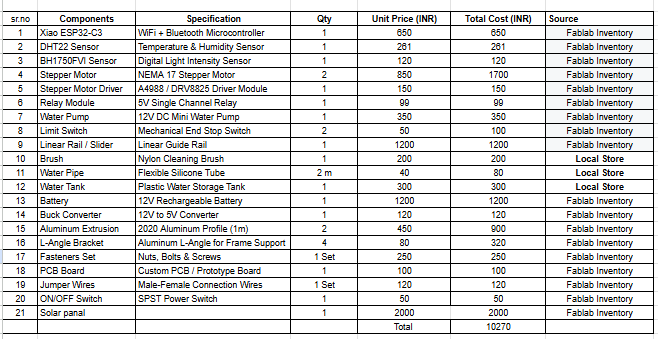
Bill of Materials (BOM)
The following components and mechanical parts are used for building the prototype of the Smart Solar Panel Cleaning and Cooling System:
What parts and systems will be made?
Fully assembled and tested custom PCB.
Sensor system with DHT22 and BH1750.
Stepper motor-based cleaning mechanism.
Web-based monitoring and control system.
Mechanical structure, Laser-cut and 3D printed elements and housing for the solar setup.
Embedded code for automation and system control.
What processes will be used?
1) 2D and 3D Design:- I designed the mechanical structure and enclosure using solidworks and created the PCB layout in KiCad.
2) Additive and Subtractive Fabrication:- I used 3D printing for parts and laser cutting/CNC machining for fabrication.
3) Electronics Design:- I designed a custom PCB integrating ESP32-S3, sensors, and control circuits.
4) Electronics Production:- The PCB was fabricated and components were soldered and assembled manually.
5) Embedded Microcontroller Interfacing:- The ESP32-S3 interfaces with DHT22, BH1750, and motor control modules.
6) Embedded Programming:- I programmed sensor reading, motor control, and automation using Arduino IDE.
7) System Integration and Packaging :- All sensors, electronics, and the cleaning mechanism were integrated into the final solar system structure.
What questions need to be answered?
During development, several questions were addressed:
One of the main questions was whether the stepper motor cleaning mechanism would move smoothly and clean the solar panel surface effectively. After testing, the movement was stable and worked properly for the cleaning process.
Another important question was whether the sensor system could provide reliable environmental data. The DHT22 and BH1750 sensors successfully measured temperature, humidity, and light intensity with stable readings.
There was also a question during the planning stage about whether the system should be battery-powered or use a direct power supply. Initially, I planned to make it battery-based, but during development I used a power supply for stable operation and testing. A future version can include battery integration for portability.
The project also confirmed that Wi-Fi monitoring and control could be integrated successfully. The ESP32 web interface monitored sensor data and controlled the system remotely, making the system more practical and user-friendly.
What worked? What didn't?
Worked:
Temperature and humidity sensors successfully collected data.
Stepper motor movement operated correctly.
Relay control activated cooling devices properly.
Limit switches controlled movement boundaries.
ESP32 communication and interface system worked properly.
Sensor values displayed successfully on the interface
Don't work properly :
Initial motor movement faced insufficient current problems.
Mechanical alignment required multiple adjustments.
Slider movement initially had stability issues.
Cleaning mechanism needed design improvements for smooth operation.
What tasks have been completed?
3D structural design completed.
Mechanical design completed and fabricated.
Stepper motor testing completed
sensor integration completed
PCB design completed
Raw code development completed
What the remaining tasks?
Fome attchment design and fabrication for the cleaning mechinsim.
Final assembly and integration of all components.
pcb soldring and tesing
final code develoment and testing.
final system testing and optimization.
presntation slides and veideo preparation.
What will happen when?
in this week, I completed the desigen and fabrication of the mechinical structure and the cleaning mechansim vedio and presentation preparation.
Before the final presntation,i will complete the final project documetation, and all assignments with go through check and review process.
How was it evaluated?
the project was evaluated based on the following criteria:
Funtionality and Performance:- the system was tested for its ability to cool and clean the solar panel effectively.
The project was evaluated through multiple testing stages to verify system performance and reliability.
Sensor accuracy was tested by checking temperature, humidity, and light intensity readings.
The stepper motor movement and cleaning mechanism were tested to ensure smooth operation.
Cleaning effectiveness and temperature reduction on the solar panel surface were also observed. Finally, the web interface and complete system integration were tested to confirm that all components worked together properly.
What are the implications?
Increase solar panel efficiency
Reduce maintenance effort
Reduce energy losses due to dust and overheating
Support sustainable energy systems
Improve long-term solar panel performance
What have you learned?
Through this project, I learned mechanical design and assembly techniques, PCB design and fabrication processes, and different sensor integration methods. I gained experience in ESP32-C3 embedded programming, motor control systems, and interface development. I also improved my skills in system integration, troubleshooting, testing, and debugging to ensure reliable system performance.