Final Project
Title:-Smart Tulsi Mala(Holi Basil stem beads) Machine
Project idea:-
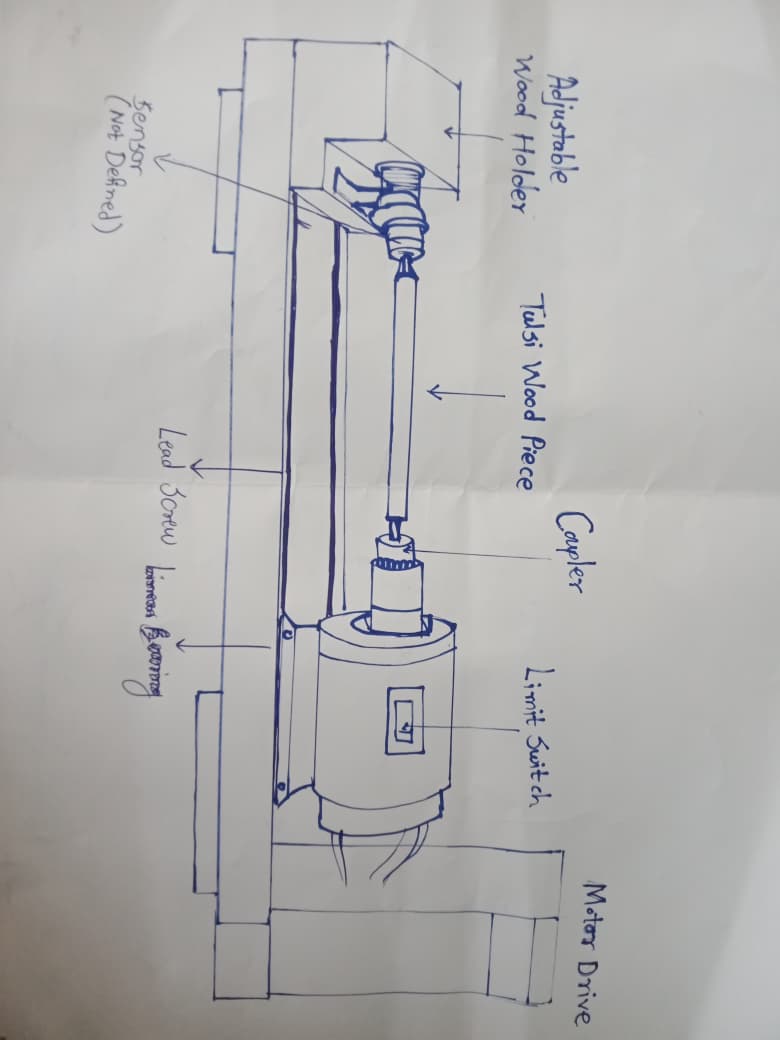
This project is an upgraded version of an existing Tulsi mala bead cutting machine. The original machine only performed bead cutting manually without counting the produced beads.I added a smart electronic system using ESP32C3, OLED display, relay, and push button to automatically count beads and display the total count in real time.The system also supports mobile app control for easier operation.
Sketch of the project:
Problem statement:-
- Workers had to count beads manually after cutting.
- Manual counting takes time and causes mistakes.
- Existing machine had no digital interface or automation feedback.
- No display system was available to monitor bead count.
In many parts of India, Tulsi mala (holy basil bead garland) making is a traditional cottage industry practiced by rural artisans. The beads are typically produced manually from Tulsi stems using hand-operated lathes, which requires continuous hand rotation and shaping. This process is time-consuming, physically exhausting, and limits the productivity of artisans. Women and elderly workers especially face difficulty performing the repetitive manual work due to lower physical strength, leading to physical strain and fatigue. Additionally, the traditional process lacks proper safety measures and involves risks during continuous manual operation. Another major challenge is the absence of any system to record daily production or track working hours of artisans/labourers, making it difficult to measure productivity, manage labour time, and estimate income accurately. As market demand for Tulsi malas increases, artisans are unable to meet production requirements within limited working hours. Therefore, there is a need to develop a simple, affordable mechanized system that can assist artisans by automating the rotation of Tulsi wood, reducing physical effort, improving safety, enabling production tracking, and increasing productivity while remaining suitable for rural Indian conditions.
Literature review
1.Study1
Design of Devices for Making Beads from the Stems of Holy Basil by Yogesh Prasad, S. K. Saha, and M. R. Ravi studied the traditional process of making Tulsi beads used in Tulsi mala. The researchers observed that artisans usually produce beads manually using hand-operated lathes, which requires continuous hand rotation of Tulsi stems. This process is physically tiring, time-consuming, and results in low productivity. To address these issues, the researchers designed improved devices using belt-pulley mechanisms and motorized systems. The study showed that mechanized assistance can significantly increase production and reduce physical strain on artisans. However, the system mainly focused on improving productivity and did not fully address simple production monitoring or labour working-time tracking.
2.Study2
Several studies have shown that small mechanized tools can improve efficiency and reduce physical effort without completely replacing manual work. These technologies help artisans increase production capacity while maintaining traditional craftsmanship. However, many of the available machines are either expensive or designed for large-scale production, which makes them unsuitable for small rural cottage industries.
3.Study3
Studies on small-scale lathe machines and bead making tools indicate that introducing motor-driven systems can reduce repetitive manual labour and improve consistency in bead shape and size. These machines can increase production speed and improve quality compared to fully manual processes. However, fully automated systems may reduce employment opportunities for artisans who depend on this craft for their livelihood. Therefore, semi-automatic solutions are preferred, where machines assist the process but artisans still control the crafting operation.
Research gap
From the reviewed literature, it is observed that traditional Tulsi bead making is labour-intensive and physically demanding, and although some mechanized devices have been developed to improve productivity, several limitations still exist. Most existing systems mainly focus on mechanical rotation and shaping of beads but lack features that support efficient production management. For example, there is no mechanism to automatically count the number of beads produced per day, which makes it difficult for artisans to maintain production records. Similarly, current systems do not provide any method to monitor or record the working hours of labourers, which is important for managing productivity and wages. In addition, bead positioning and cutting in many machines still require manual adjustment, increasing effort and reducing efficiency. Therefore, there is a need for a semi-automatic system that not only assists in rotating the Tulsi stem but also automatically moves the material forward and positions it correctly for bead cutting. Such a system should also include features for bead counting and labour time tracking while remaining affordable, easy to operate, and suitable for rural artisans, ensuring that mechanization improves productivity without reducing employment opportunities.
Reference:-Prasad, Y., Saha, S. K., & Ravi, M. R. (2024). Design of Devices for Making Beads from the Stems of Holy Basil. Journal of Scientific & Industrial Research.
Objectives of the project:-
- To develop a semi-automatic Tulsi mala bead making system that assists artisans in the bead shaping process while keeping the main crafting work under human control, thereby preserving traditional skills and employment opportunities.
- To increase productivity and production efficiency so that artisans can produce more beads within the same working hours and meet increasing market demand.
- To make the system affordable and easy to operate so that it can be used by rural artisans with minimal technical knowledge.
- To improve safety during bead making by reducing the risks associated with continuous manual handling and rotation.
- To enable basic production tracking using app, such as the number of beads produced and the working time of labourers, helping artisans maintain simple production records.
- To support rural livelihoods by enhancing income generation while maintaining the traditional Tulsi mala craft.
Abstract
Tulsi mala (holy basil bead garland) making is a traditional cottage industry practiced by many rural artisans in India. The beads are generally produced manually from Tulsi stems using a hand-operated lathe, which requires continuous manual rotation and shaping. This traditional process is time-consuming, physically demanding, and limits the productivity of artisans. Women and elderly workers often face difficulty performing the repetitive manual work due to lower physical strength, which leads to fatigue and reduced production capacity. In addition, the absence of proper safety measures and lack of a system to record production or labour working hours further affects efficiency and income generation.
This project proposes the development of a semi-automatic Tulsi mala bead making machine designed to assist artisans in the bead-making process. The system automates the rotation of the Tulsi wood while allowing artisans to control the shaping process, thereby preserving traditional craftsmanship and employment. The proposed machine aims to reduce physical effort, improve safety, and increase production efficiency. It also introduces a simple method for monitoring production and labour working time. The design focuses on affordability, ease of use, and suitability for rural conditions. By combining mechanization with traditional skills, the project aims to enhance productivity, support rural livelihoods, and help artisans meet growing market demand while maintaining the cultural value of Tulsi mala making.
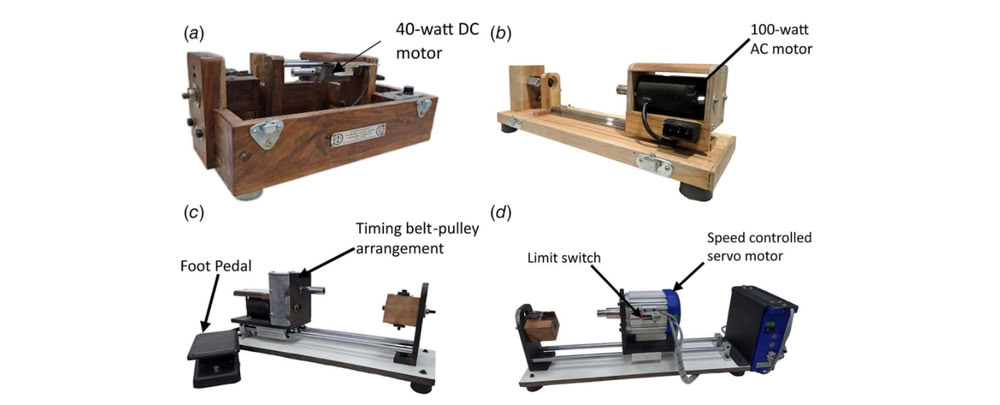
Image taken from Transactions of the ASME
My contribution:-
- Designed PCB for bead counting system
- Integrated OLED display with ESP32C3
- Added push button control
- Programmed bead counting logic
- Connected relay for machine control
- Created mobile app interface
- Designed and fabricated enclosure/casing
- Tested counting accuracy
System Workflow:-
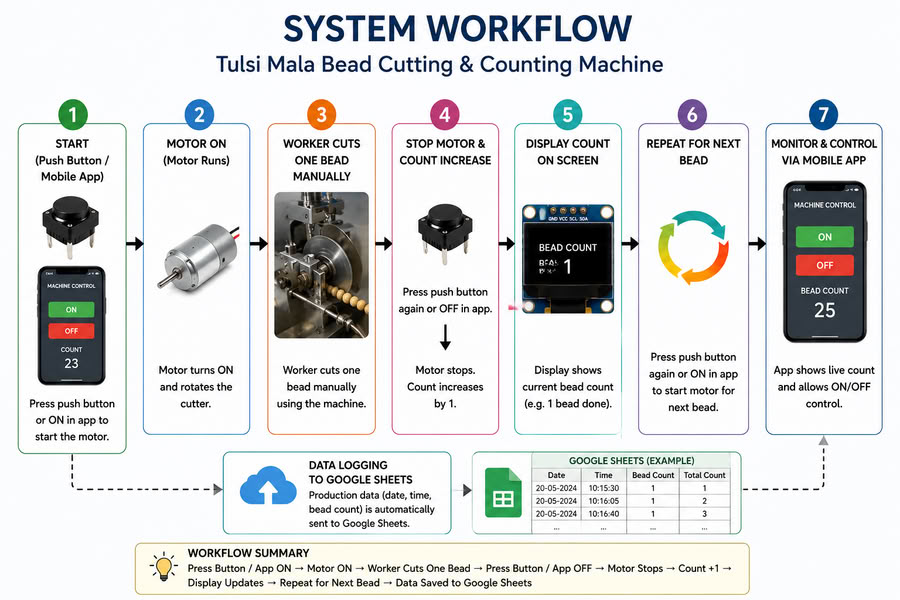
Image generated using ai
Electronics design:-
Designed a custom PCB using KiCad with a XIAO ESP32C3 microcontroller, OLED display, push button, motor control circuit, and power connections. The PCB was fabricated and assembled using SMD components.
PCB Design:-
In the final project PCB making process, I designed the circuit in KiCad software by creating the schematic diagram.
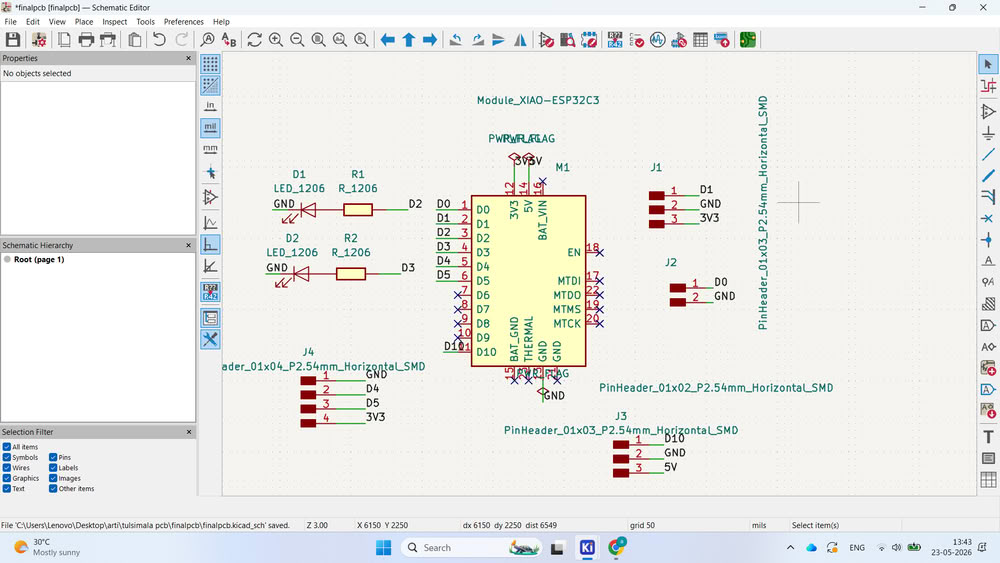
I update it in the PCB editor.
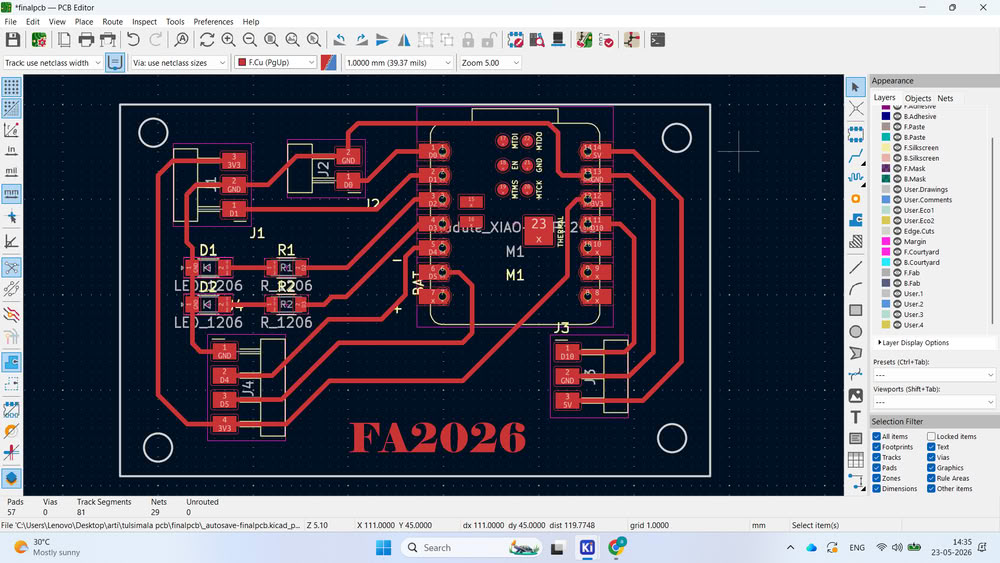
After completing the routing, I generated the Gerber files and PNG files. Then, I converted the PNG files into .rml format using Mods CE for PCB milling.
PCB Milling:-
here is the trace cut result.
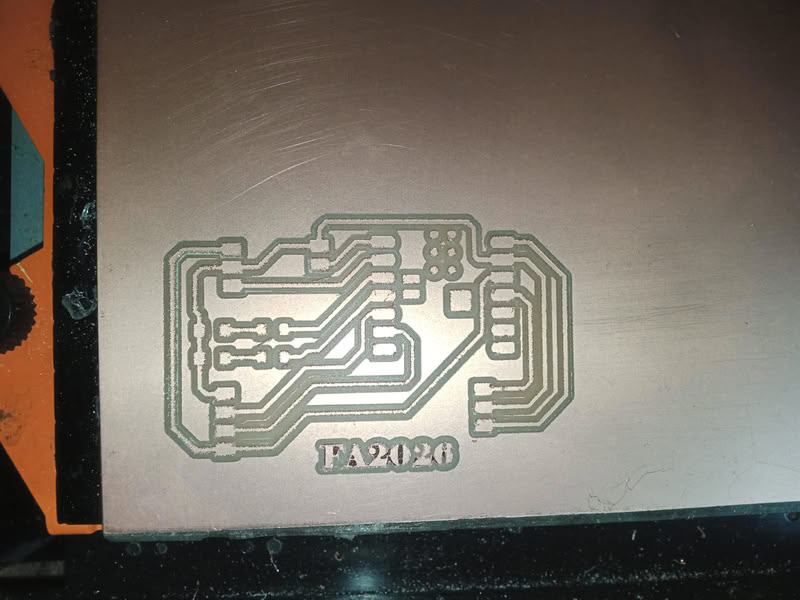
During the cutting process, I changed the milling bit from 1/64 inch to 1/32 inch for the edge cut.
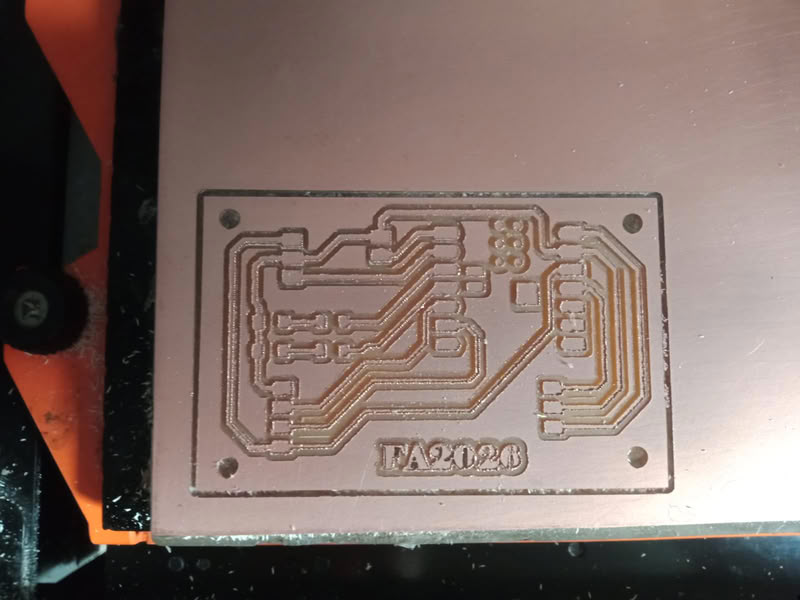
The PCB was cut properly.
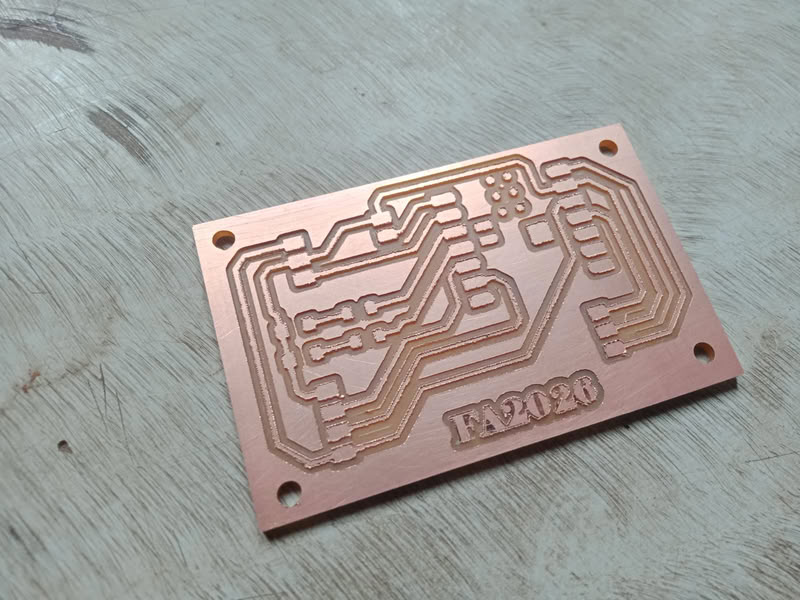
After that, I collected all the required components.
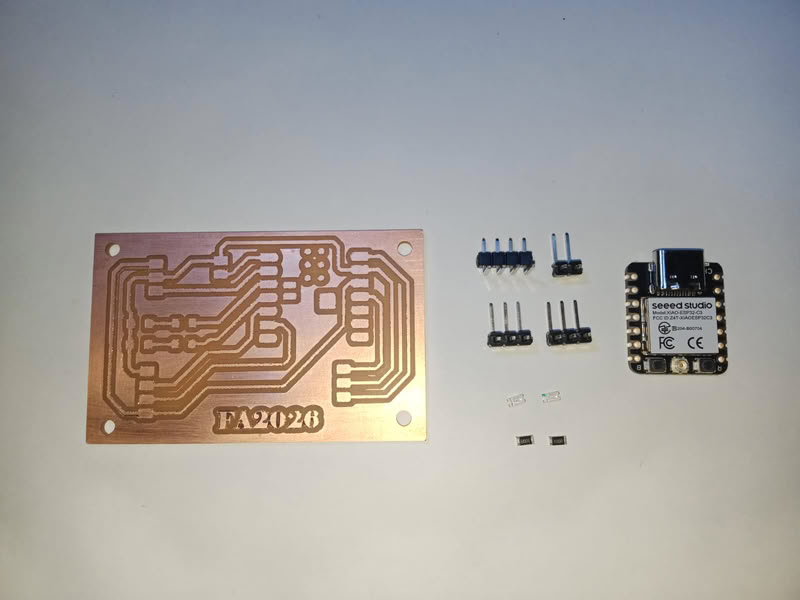
I carefully soldered them on the PCB.
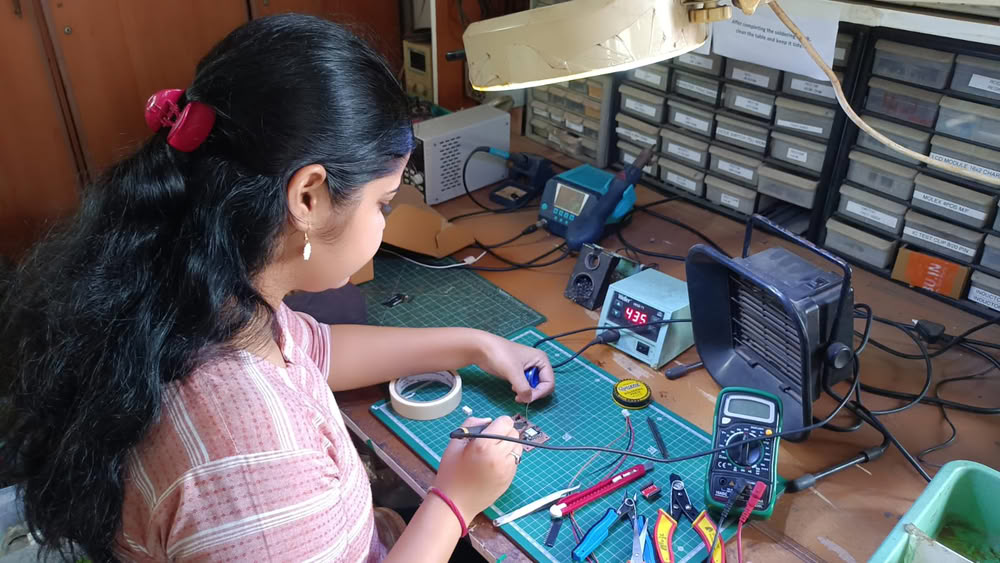
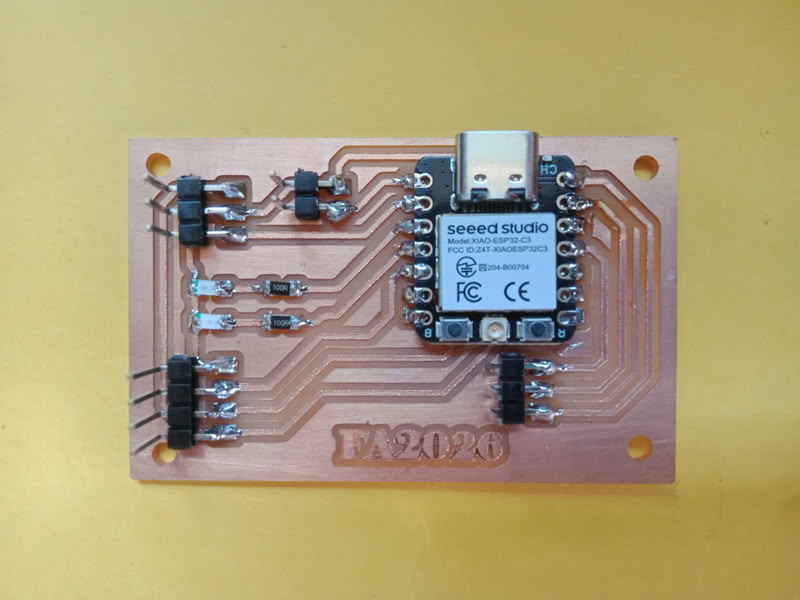
3D designing:-
I designed the casing for my project using the SolidWorks software.
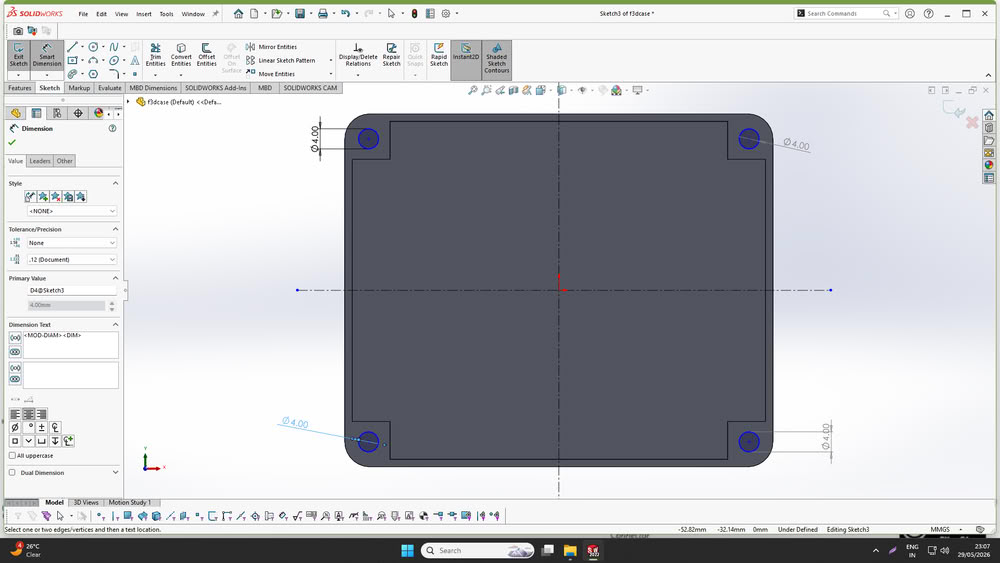
The casing was designed to accommodate all the system components safely and securely. Four corner holes were added to insert nuts and allow proper assembly of the enclosure.A dedicated hole was provided for installing a cable gland to ensure secure cable management.
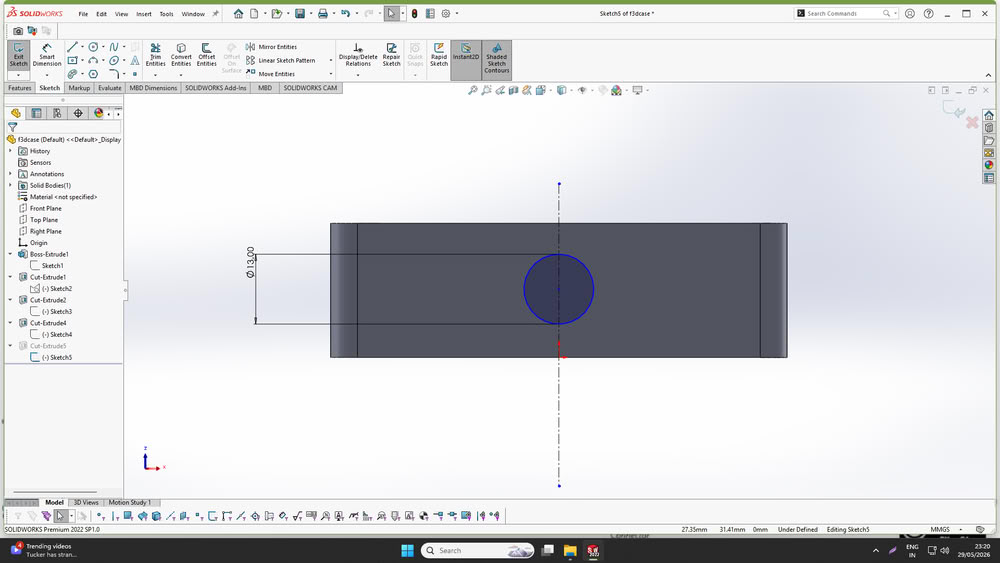
I also designed a slot for connecting the data cable to the XIAO ESP32C3 microcontroller without opening the enclosure.
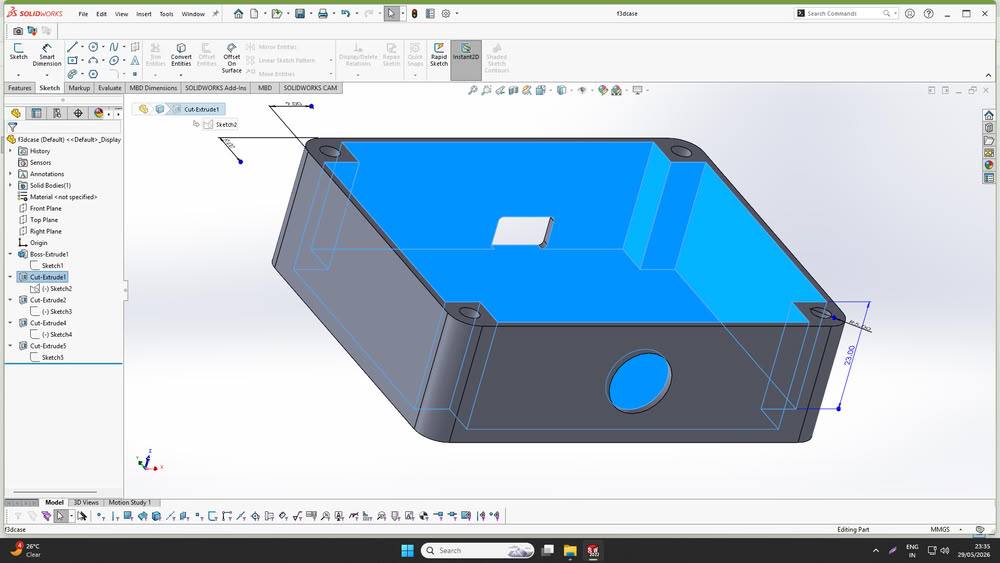
Additionally, I designed a custom holder to mount the casing onto the motor used in the project.
After completing the design, all parts were fabricated using a 3D printer.
2D designing:-
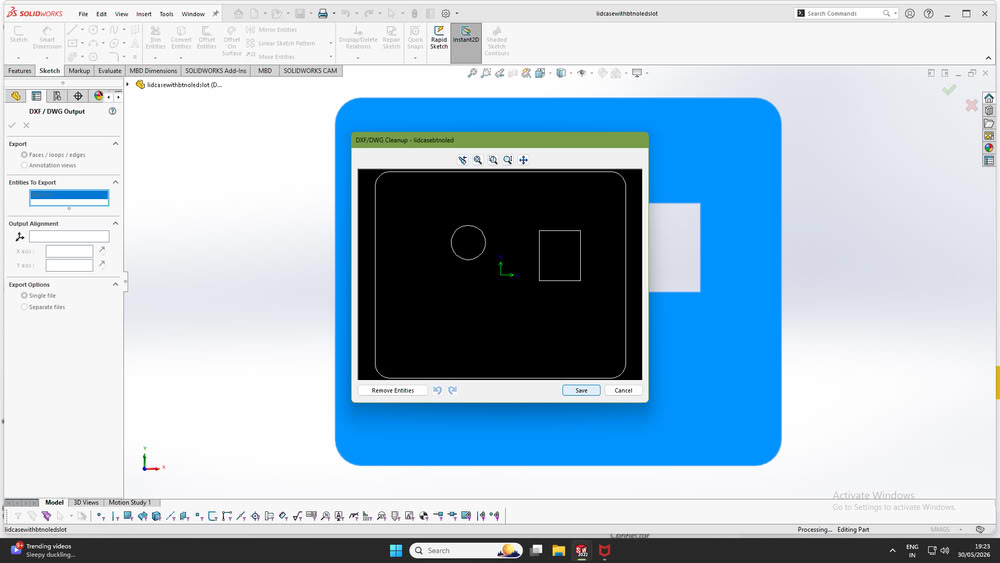
After designing the casing, I designed a lid to cover the enclosure. The lid included a hole for mounting the push button and a rectangular slot for the OLED display, allowing the user to interact with the system and view the bead count easily.
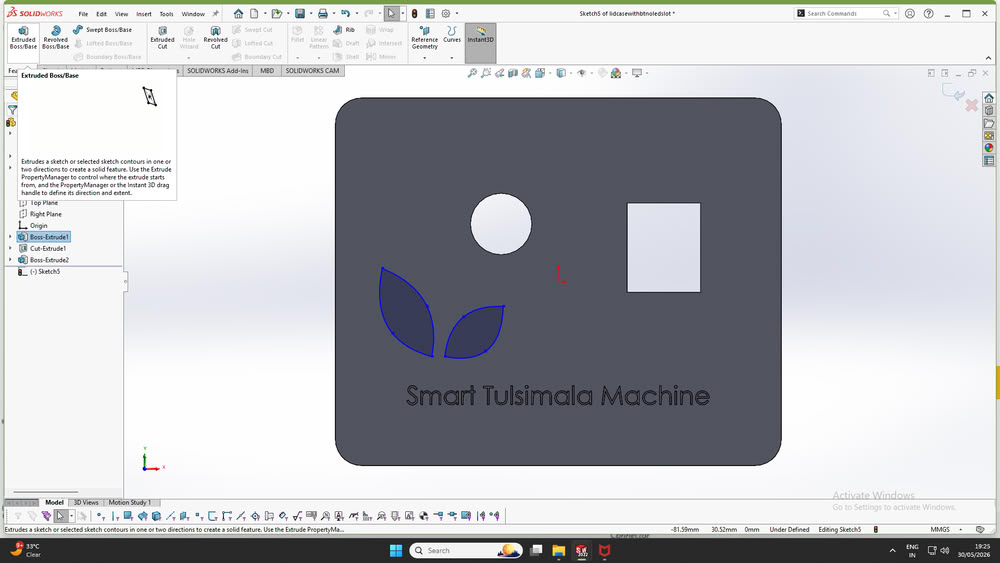
So, I export that file in DXF format.
Assembling 2D, 3D parts:-
I started the 2D and 3D assembly process by assembling all the fabricated parts.
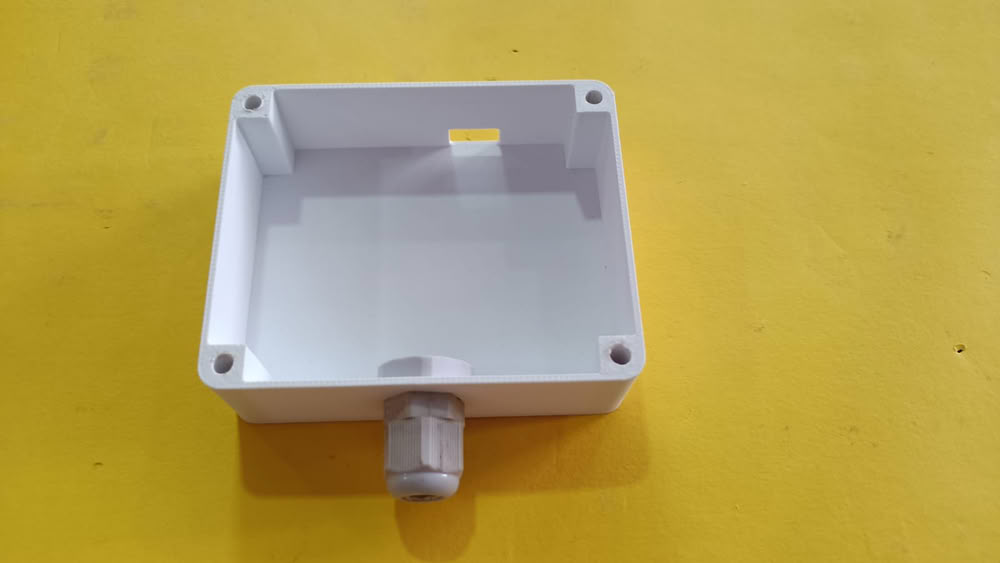
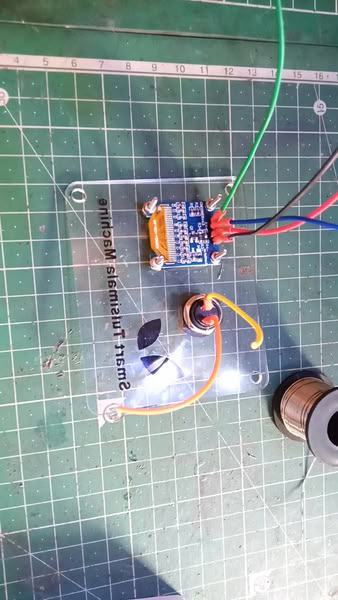
First, I soldered the connections of the push button.
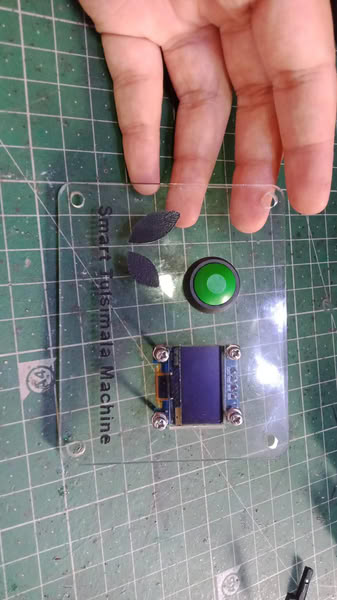
Then I placed OLED Display inside the slot and connect it properly.
After completing the soldering work, I connected all the electronic components and mounted the customized PCB and relay securely inside the casing box, as shown in the image.
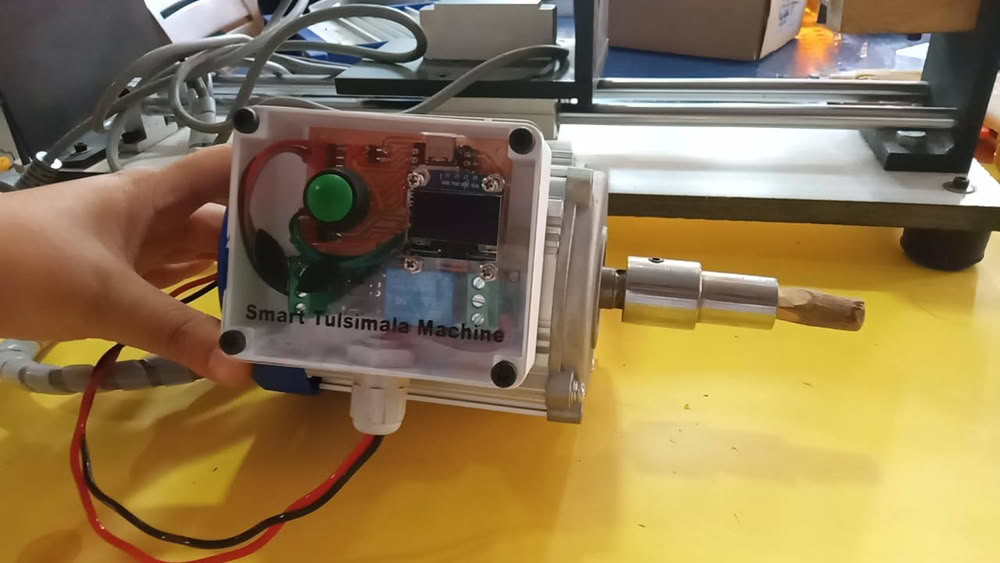
After completing the internal assembly, I attached the custom-designed holder to the casing box. The holder was then fitted into the slot on the motor, allowing the enclosure to be mounted securely on the machine. This completed the mechanical and electronic integration of the project.
Testing Hardware and relay logic:-
I tested the hardware by uploading the code and verifying whether the relay logic worked correctly. During the bead-making process, artisans turn on the motor to cut a Tulsi bead using a cutting tool. Once the bead is cut, they turn off the motor and collect the finished bead. Based on this workflow, I programmed the relay logic so that the bead count increases by one only when the motor is turned off after a cutting operation. This ensures that each completed bead is counted accurately and prevents false counts while the motor is running. The test results confirmed that the relay logic worked as intended.
Bead Cutting and counter:-
The video below demonstrates the Tulsi bead cutting process and the working of the bead counting machine.
Detailed information about the system integration process, including hardware, electronics, software, and testing, please visit the page below.
Click to visit system integration page
Bill Of Material
| Component Name | Amount (₹) |
|---|---|
| XIAO ESP32C3 | 800 |
| 3.3V Relay Module | 76 |
| 0.96 Inch OLED Display | 219 |
| 2 Pin Push Button | 11 |
| SMD LED | 2 |
| SMD Resistor | 4 |
| 2 Pin Connector | 5 |
| 3 Pin Connector | 14 |
| 4 Pin Connector | 11 |
| 3D printed case with holder | 450 |
| Upper transparent acrylic case | 17 |
| Nut 4 | 10 |
| Cable Gland | 15 |
| 2 core 1.5 Sq.mm 0.5feet | 10 |
| Total | 1634/- |
Rupees to dollar conversion
1 USD = ₹94.67
So, total cost = 94.67/1634 = US$17.26
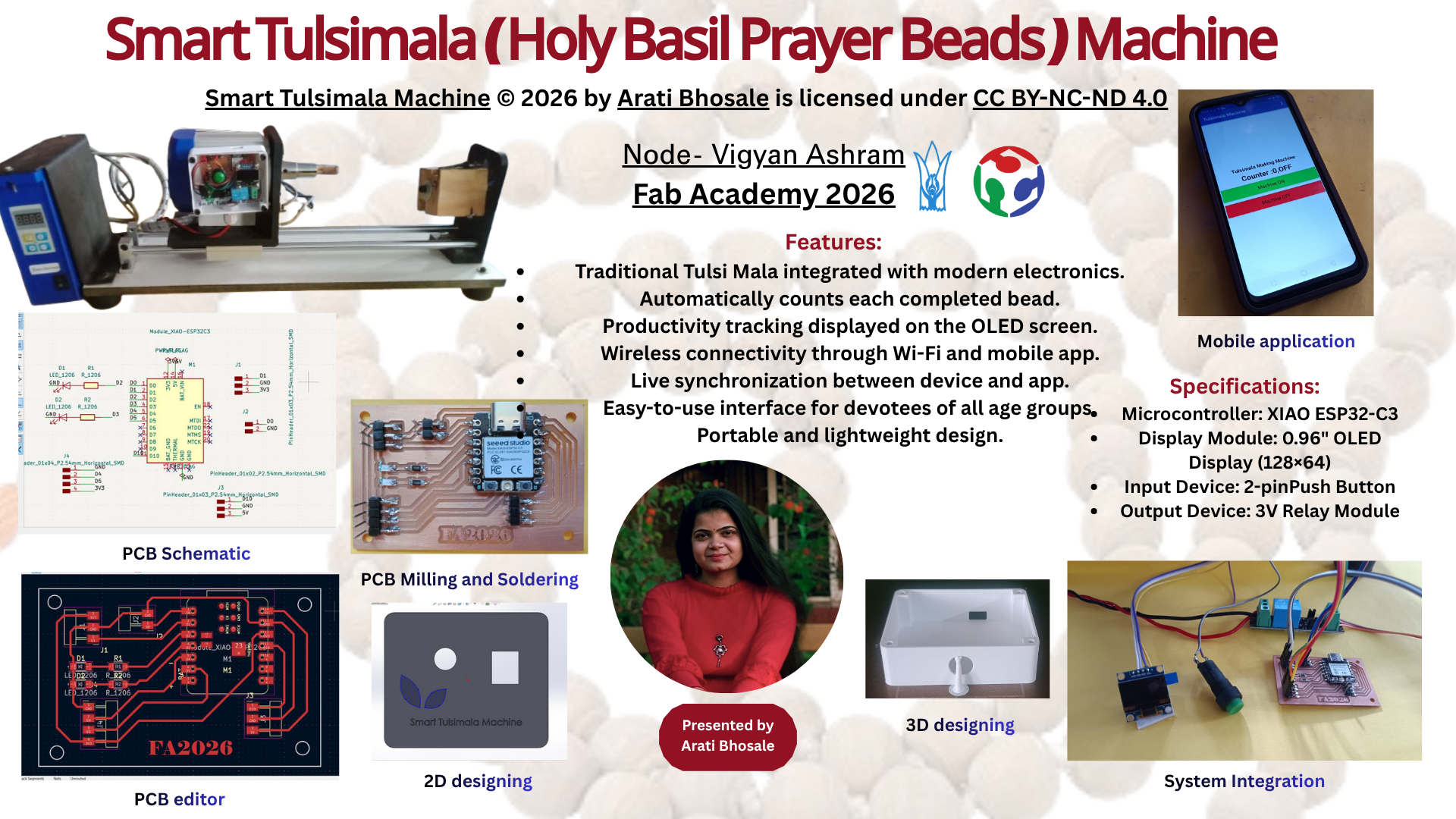
Presentation Slide:-
Final Presentation Video:-
Acknowledgement
I would like to express my sincere gratitude to Dr. Yogesh Kulkarni Director of Vigyan Ashram, for inspiring me to undertake the Fab Academy program. His guidance helped me understand the importance of digital fabrication and the opportunities it offers for personal and professional growth. His continuous motivation, encouragement, and support played a significant role throughout my Fab Academy journey. I am also grateful to Mr. Kishor Gaikwad, Local Instructor, for his constant guidance, technical support, and encouragement during the course. His willingness to help, clarify concepts, and provide practical insights greatly contributed to my learning experience. I would also like to acknowledge Mr. Suhas Labade, Remote Instructor, for his valuable mentorship, constructive suggestions, and timely support. His feedback and technical expertise helped me overcome challenges and improve the quality of my assignments.
I extend my heartfelt appreciation to Mr. Neil Gershenfeld, Director of Fab Academy, for his inspiring weekly lectures, insightful feedback, and vision in creating a global learning platform that empowers makers around the world. I am greatful to Miriam Choi, Global Instructor for her feedbacks and technical assistance during assignments. I am thankful to Mrs. Pradnya Shindekar, Remote Instructor, for her guidance and valuable feedback on assignments throughout the program. I also acknowledge Mr. Ranjeet Shanbaag, Deputy Director of Vigyan Ashram, for his guidance and encouragement regarding various Fab Academy activities and assignments. My sincere thanks also go to Mr. Indrajeet Joshi, Founder and Director of RAT3D, whose valuable support and technical assistance greatly benefited my Fab Academy work.
I would like to acknowledge Mr. Abhijeet Pisal, Coordinator of the Design Innovation Center, for his continuous support during various phases of Fab Academy. I am especially grateful to Mr. Ashish Shende, Manager of Abhiyan Lab, whose motivation, encouragement, and guidance helped me stay focused and confident while completing various assignments. His positive attitude and readiness to assist whenever needed were greatly appreciated. I am equally grateful to Mrs. Reshma Hawaldar, Head of the Food Lab Department, and Mr. Pranit Kambale, IBT Field Officer, for providing materials and assistance whenever required for assignments. Special appreciation is extended to Mrs. Priyanka Chaudhary, Head of the Sewing Lab, for her cooperation and support. I would also like to thank Ms. Priyanka Jadhav, Graphic Designer, for her assistance whenever needed during this journey.
Finally, I would like to express my sincere appreciation to Mr. Vrushabh Zunjurkar, a Fab Academy 2022 graduate, for his constant encouragement, valuable insights, and willingness to share his experiences. I am grateful to Mr. Sumit Thakare, a former Fab Academy student 2024, for his continuous support and technical assistance during assignments. His practical suggestions and readiness to help whenever needed contributed significantly to my learning experience.I also acknowledge Mr. Mitesh Soni and Mr. Aditya Umarikar, DBRT students at Vigyan Ashram, for their support, cooperation, and assistance during various stages of my work. Last but not least, I am also thankful to Dr. Yashwant Prasad for guiding me in shaping and refining my final project idea.
Meet my supporters:-