About this week:-
This week's assignment focused on understanding invention, intellectual property, licensing, and the potential income opportunities that can arise from innovative products. As makers and designers, it is important not only to develop functional solutions but also to understand how our work can be protected, shared, and potentially commercialized.
During this week, I explored different forms of intellectual property, learned about licensing options, and created a dissemination plan for my final project. I also generated a license for my project and studied how innovators can protect their ideas while encouraging collaboration and knowledge sharing.
Understanding the Concept of Invention:-
An invention is the creation of a new product, system, process, or improvement that provides a solution to a specific problem. Inventions can range from completely new technologies to modifications that make existing products more efficient, reliable, or user-friendly.
My final project, the Tulsi Mala Bead Counting Machine, is designed to assist artisans involved in Tulsi mala production. Traditionally, bead counting and cutting involve repetitive manual work that can lead to mistakes and reduced productivity. My project introduces a simple digital solution that helps count beads accurately while improving workflow efficiency.
Innovation often comes from identifying real-world challenges and developing practical solutions. Through this project, I learned that even small improvements can create meaningful value for users.
Introduction to Intellectual Property
Intellectual Property (IP) refers to creations of the mind, including inventions, designs, software, artistic works, symbols, and brand identities. Intellectual property rights allow creators to protect their work and receive recognition for their efforts.
These protections encourage innovation by giving creators ownership of their ideas while allowing them to decide how their work may be used by others.
Understanding intellectual property is important because it helps innovators protect their contributions and establish clear rules regarding sharing, modification, and commercialization.
Types of Intellectual Property
Patents
A patent protects a new invention and provides exclusive rights to the inventor for a specific period. Patents prevent others from making, using, or selling the invention without permission. To qualify for a patent, an invention must be novel, useful, and non-obvious.
Copyright
Copyright protects original creative works such as software code, documentation, images, videos, music, and written content. Copyright protection is automatically granted when an original work is created.
Trademarks
A trademark protects names, logos, symbols, and branding elements that distinguish one product or organization from another. Trademarks help build brand identity and prevent confusion among users.
Industrial Design Rights
Industrial design protection focuses on the visual appearance of a product, including its shape, pattern, color, or overall aesthetic design.
Trade Secrets
Trade secrets include confidential information, manufacturing methods, formulas, or business practices that provide a competitive advantage. These remain protected as long as they are kept confidential.
Dissemination Plan for the Tulsi Mala Bead Counting Machine
Identification of Target Users
The primary users of this project are Tulsi mala artisans, small-scale manufacturers, handicraft businesses, and training centers involved in bead production. The machine is designed to simplify counting operations and reduce manual errors during the production process.
Product Launch and Promotion Strategy
The project will be published through my Fab Academy documentation website and personal portfolio. Project details, design files, source code, assembly instructions, and demonstration videos will be made available for learning purposes.
Live demonstrations can also be conducted for local artisans and interested users to showcase the functionality and benefits of the machine.
Sharing the project online allows a broader audience to learn from the development process and potentially adopt similar solutions in their own work.
Intellectual Property Protection
For this project, I have chosen an open-source approach that encourages learning and collaboration. The project files, documentation, and source code can be shared with the maker community while maintaining proper attribution to the original creator. This approach supports innovation by allowing others to study, modify, and improve the system while recognizing the original contribution.
Pilot Testing and Feedback Collection
The machine will be tested in real working conditions with users involved in Tulsi mala production. Feedback will be collected regarding:
- Ease of operation
- Accuracy of bead counting
- User interface experience
- Reliability of the system
- Suggestions for improvement
This feedback will help identify areas that require further refinement and development.
Educational and Training Materials
To support users, instructional materials will be prepared, including:
- Setup guide
- User manual
- Demonstration videos
- Troubleshooting instructions
- Mobile application usage guide
These materials will help users understand the operation of the system and maximize its effectiveness.
Evaluation and Continuous Improvement
Following practical deployment, user feedback will be analyzed to evaluate the project's performance and impact.:
- Enhanced interface design
- Additional counting features
- Improved enclosure design
- Increased durability
- Better data visualization
Future Development Opportunities:-
- Automatic bead detection sensors
- Production analytics dashboard
- Battery backup system
- Cloud-based record keeping
- Multiple counting modes
- Mobile notification system
Licensing My Project:-
Link to visit creative commonsCreative commons
To share my work responsibly, I created a Creative Commons license for my project using the Creative Commons License Chooser. The selected license allows others to learn from, share, and build upon the project while providing proper attribution to the original creator.The generated license was then added to my project website to clearly communicate how the project may be used by others.
The license chooser presented several questions regarding how I wanted others to use my work. I answered each question based on the permissions and restrictions I wanted to apply to my project.
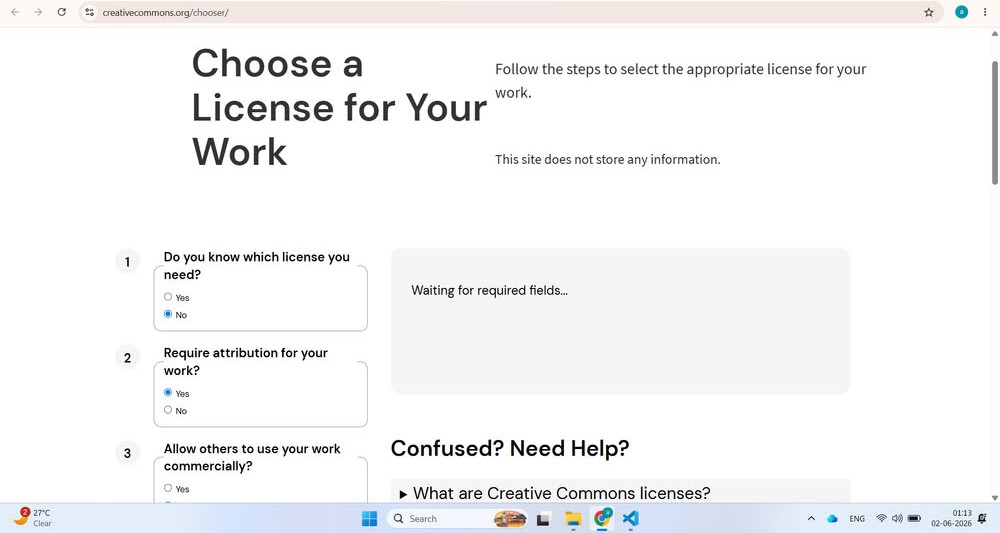
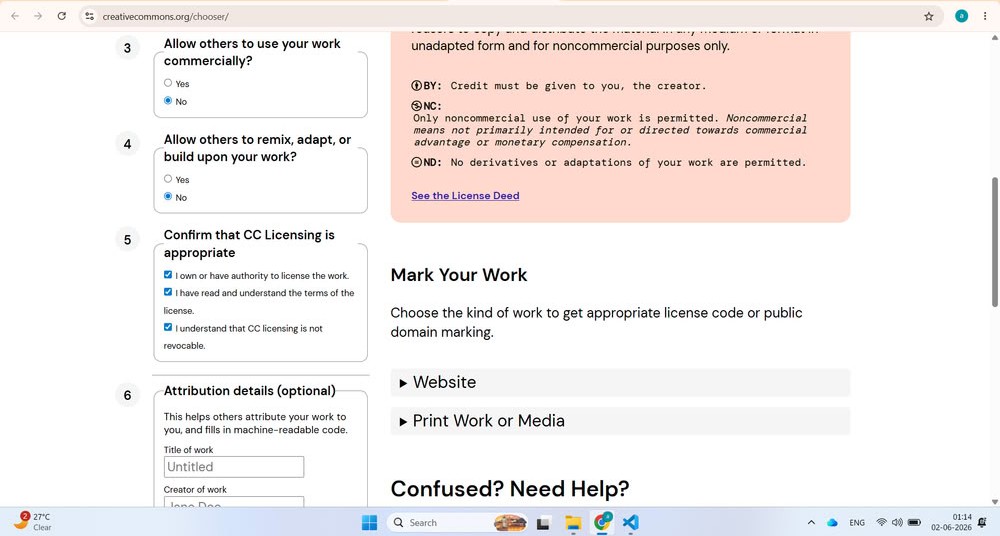
After selecting the appropriate options, I filled in the required information such as the title of my work, creator details, and project information.
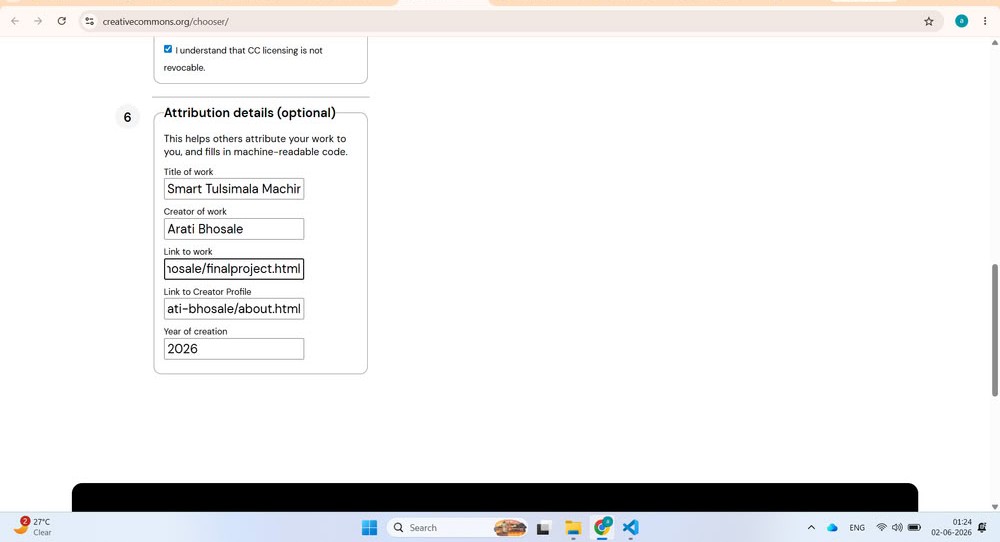
Once all the details were entered, the license was automatically generated.
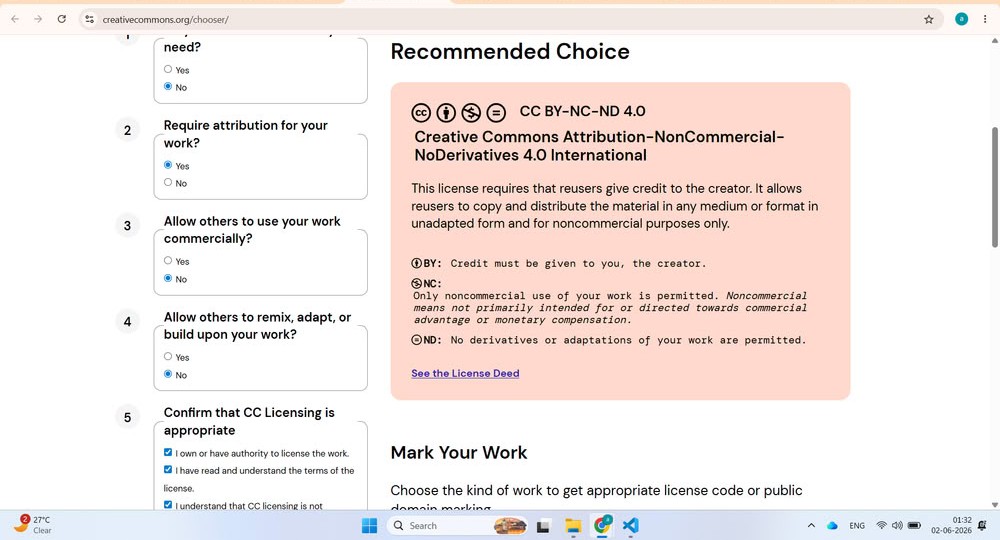
Then I clicked on website option on the right side of the page.
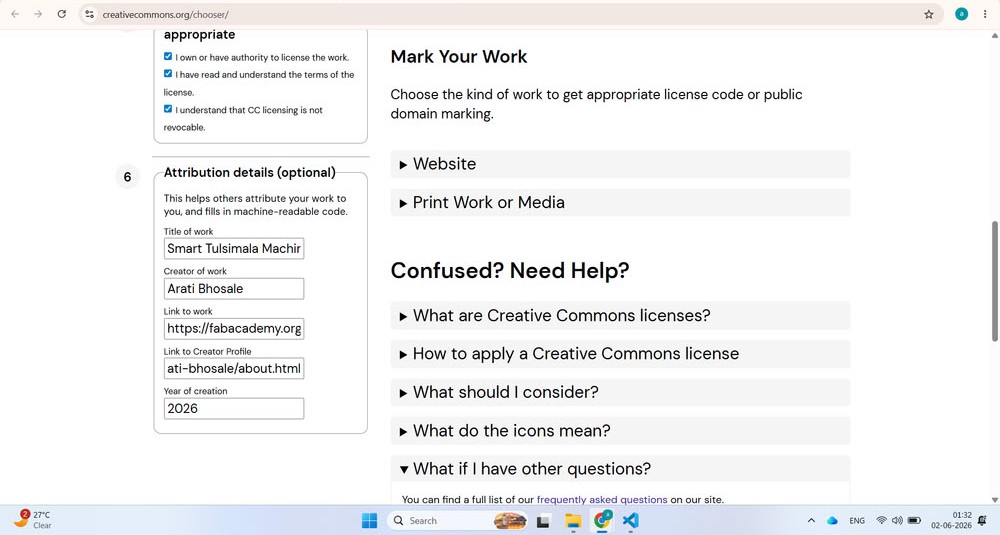
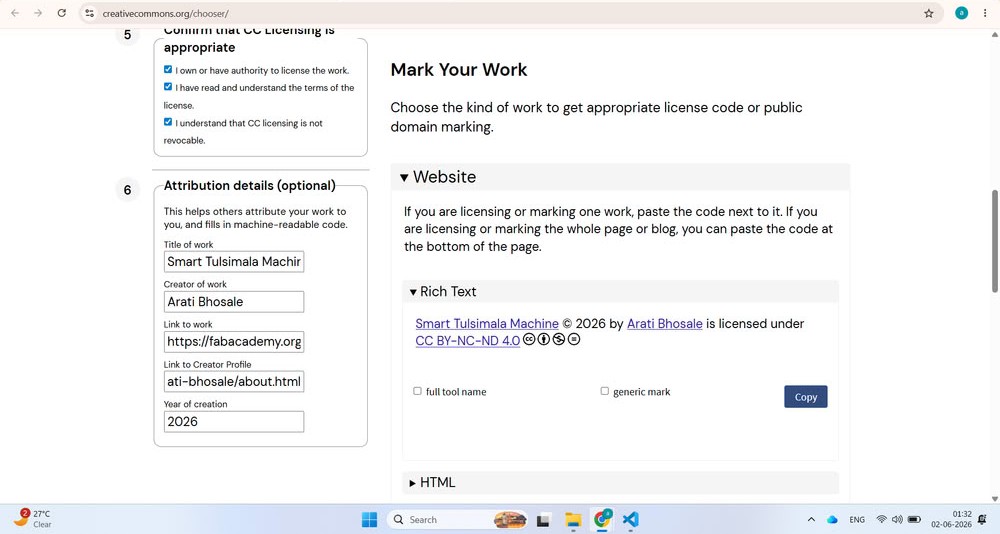
On the right side of the page, Creative Commons provided different formats for using the license. By selecting the "Rich Text" option, I was able to view and copy the generated license text.
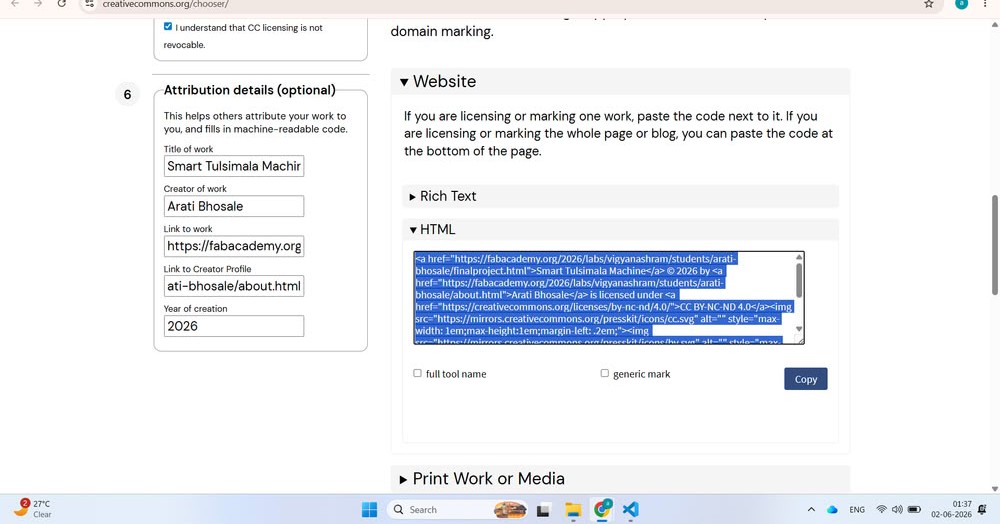
Below the Rich Text option, I also found an HTML option. Clicking on it displayed the HTML code associated with the selected license. I copied this code so that it could be embedded directly into my project website.
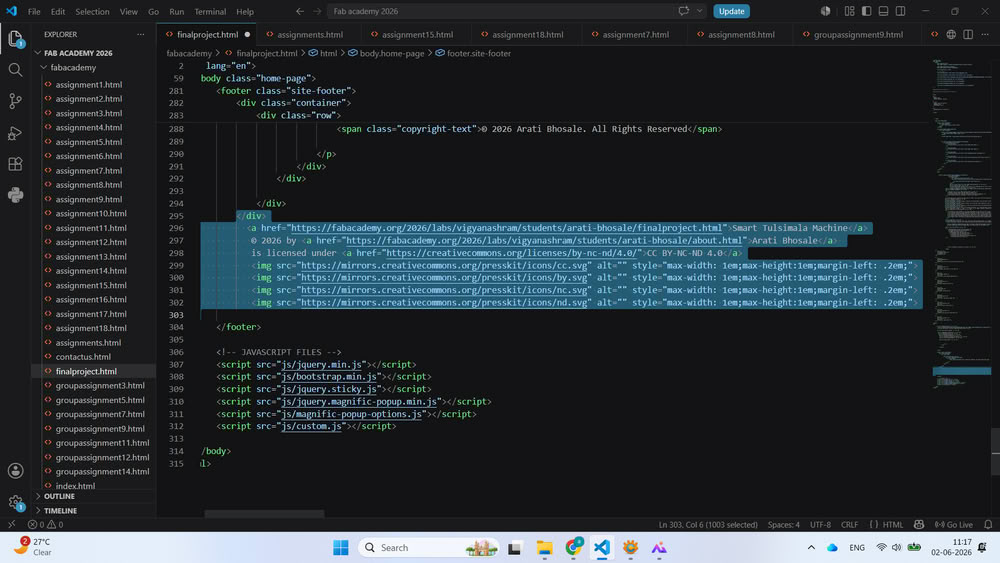
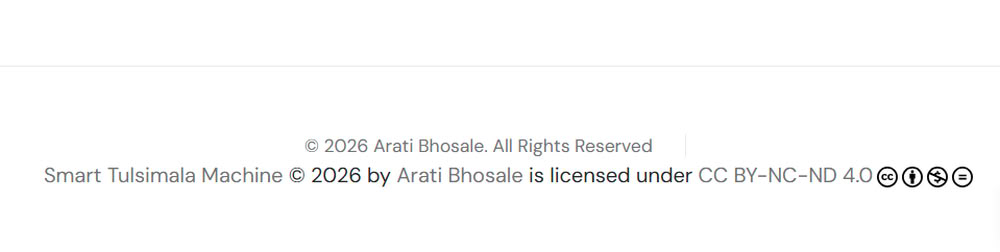
I paste the html code in footer section of final project page.
Once the license HTML code is added to website HTML file, the license will appear on website—as you can see in the image.
Income Opportunities and Commercial Potential:-
The Tulsi Mala Bead Counting Machine has the potential to generate value for artisans and small businesses involved in bead production.Possible income opportunities include:
- Manufacturing and selling completed machines
- Providing customized versions for different users
- Offering maintenance and support services
- Conducting training workshops
By improving productivity and reducing manual counting errors, the machine can contribute to more efficient production processes.