Project Overview
Final Project
The final project developed during Fab Academy is called
FAB Encloser, an intelligent filament drying and
storage chamber designed for FDM 3D printing materials.
The system combines environmental monitoring, temperature control,
remote supervision, and safety functions inside a compact enclosure.
The objective is to maintain filament in optimal conditions before
and during printing processes.
Many thermoplastic materials such as PLA, PETG, Nylon, TPU, and ABS
absorb moisture from the environment. This humidity can negatively
affect print quality, causing bubbling, poor layer adhesion,
inconsistent extrusion, and dimensional inaccuracies.
FAB Encloser was designed to solve this problem by providing a
controlled environment where temperature and humidity can be monitored
and regulated automatically.
Target Users
Who Benefits?
The system is intended for a wide variety of users involved in additive
manufacturing and digital fabrication.
- Fab Academy students.
- Makers and hobbyists.
- Educational institutions.
- Research laboratories.
- Professional prototyping workshops.
- Small-scale manufacturing businesses.
- 3D printing service providers.
Any user working with hygroscopic materials can benefit from
maintaining filament under controlled environmental conditions.
Applications
Use Cases
FAB Encloser can be used in multiple scenarios where filament quality
is critical.
Filament Drying
The primary application is the removal of absorbed moisture from
thermoplastic filaments before printing.
Long-Term Storage
The enclosure provides a controlled environment that helps preserve
filament properties during long storage periods.
Print Preparation
Users can prepare materials before starting a print, ensuring better
extrusion consistency and reducing printing defects.
Remote Monitoring
Through the Raspberry Pi 5 and custom interface, environmental
conditions can be monitored remotely from a computer.
Educational Tool
The project can also be used as a teaching platform to demonstrate
embedded systems, sensors, user interfaces, IoT concepts, and digital
fabrication workflows.
Innovation
Unique Features
Several commercial filament dryers already exist; however, most of
them provide limited functionality and little flexibility.
FAB Encloser introduces several additional capabilities:
- Custom fabricated enclosure.
- Real-time temperature monitoring.
- Real-time humidity monitoring.
- Automatic heater control.
- Automatic ventilation control.
- Integrated OLED display.
- Live camera monitoring.
- Remote control interface.
- Emergency stop function.
- Open-source hardware and software.
These characteristics transform the project from a simple filament
dryer into a complete environmental management system.
Estimated Cost
Budget
| Component |
Estimated Cost (USD) |
Where did i get it |
| Raspberry Pi 5 |
$80 |
Amazon MX |
| Camera Module |
$25 |
Amazon MX |
| Custom PCB |
$10 |
Made in Lab |
| SHT31 Sensor |
$8 |
Amazon MX |
| OLED Display |
$8 |
Amazon MX |
| Power Supply |
$20 |
Amazon MX |
| Heating Element |
$15 |
Amazon MX |
| Ventilation System |
$12 |
Amazon MX |
| Metal Structure |
$50 |
Local supplier |
| Acrylic |
$30 |
Local supplier |
| Total |
~$258 USD |
|
Sustainability
Environmental Impact
One of the indirect benefits of FAB Encloser is the reduction of
material waste generated by failed prints.
Moist filament often causes printing defects that require parts to be
discarded and reprinted. By improving filament quality, the system
contributes to reducing unnecessary plastic consumption.
The enclosure was also designed using durable materials such as
galvanized steel and acrylic, increasing its service life and reducing
replacement frequency.
Limitations
Current Challenges
Although the system successfully achieves its main objectives, some
limitations remain.
- Temperature uniformity can still be improved.
- Humidity control is currently based on ventilation only.
- The system is designed for a limited chamber volume.
- Energy consumption depends on operating temperature.
- The interface currently runs on a local network.
These limitations provide opportunities for future iterations and
continued development.
Future Improvements
Next Steps
Several enhancements could be incorporated into future versions of
the project.
- Cloud connectivity.
- Mobile application support.
- Automatic humidity regulation.
- Multiple temperature profiles.
- Machine learning-based prediction of drying time.
- Energy consumption monitoring.
- Automatic filament identification.
- Integration with 3D printers.
These improvements would transform FAB Encloser into a complete smart
filament management ecosystem.
Reflection
This project integrates knowledge acquired throughout Fab Academy,
including computer-aided design, electronics production, embedded
programming, networking, interface development, mechanical design,
molding and casting, and system integration.
Beyond solving a practical problem in additive manufacturing, FAB
Encloser demonstrates how digital fabrication can be used to create
custom products that combine hardware, software, and manufacturing
into a single functional system.
The project also establishes a solid foundation for future commercial
development and continued technical improvement.
Assignment Checklist
Questions Answered
The Applications and Implications assignment requires answering a set of
guiding questions about the final project. Each question is addressed
below, with links to the relevant sections of the
final project page.
What will it do?
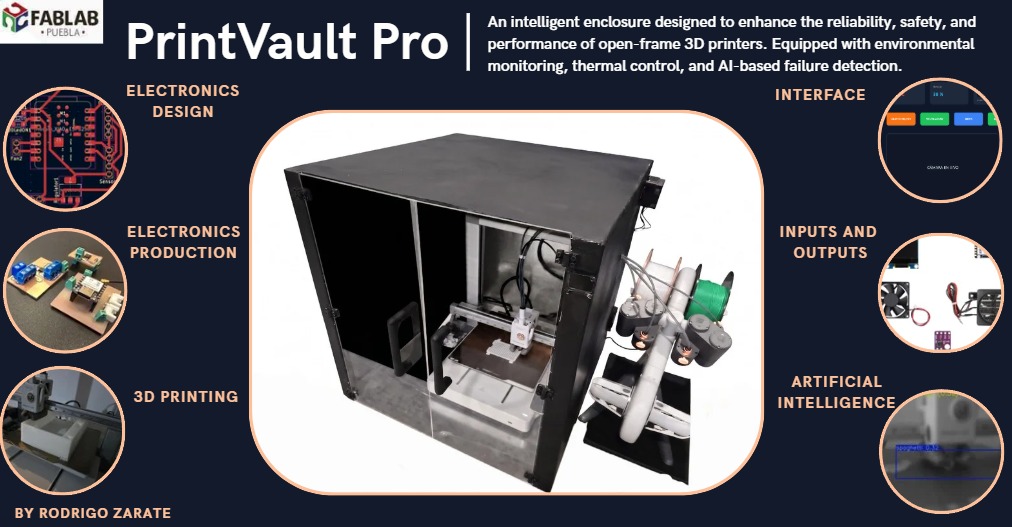
PrintVault Pro is a temperature-controlled 3D printer enclosure that
keeps the chamber at the right temperature for each material using
closed-loop heating, while a camera and a YOLO AI model watch the print
in real time and detect "spaghetti" failures within seconds, sending
alerts to a desktop app and to the user's phone. See
Project overview and
Solution.
Who has done what beforehand?
Commercial heated enclosures and filament dryers already exist (for
example Bambu Lab and Creality enclosures, and brands such as PolyDryer
or SUNLU filament dryers), and open print-failure detection projects
exist too, most notably The Spaghetti Detective /
Obico, an open-source AI print-monitoring system. PrintVault Pro differs
by combining both ideas — closed-loop chamber heating and edge
AI failure detection — in a single, custom-fabricated, fully local
(no-cloud) device. See
AI print monitoring.
What sources will you use?
The project draws on Ultralytics YOLO documentation for the detection
model, the Adafruit SHT31 and SH110X libraries for the sensor and
display, the Bleak and ESP32 BLE documentation for the communication
layer, the PyQt6 and qasync documentation for the desktop app, material
datasheets and manufacturer guidance for the chamber temperatures (glass
transition of ABS, PC, etc.), and the Fab Academy class material for the
fabrication and electronics processes.
What will you design?
I designed the sheet-metal chassis, the laser-cut acrylic doors, the
3D-printed ABS hinges, handles and electronics cases, the custom KiCad
PCB integrating the XIAO ESP32-S3 and the MOSFET driver stages, the
embedded firmware, the Raspberry Pi gateway software, and the PyQt6
desktop interface. See
How it was made and
Mechanical design.
What materials and components will be used?
The main components are a Raspberry Pi 5, a Seeed Studio XIAO ESP32-S3,
a CSI camera, an SHT31 sensor, an SH1106 OLED, a 100 W 12 V PTC heater,
a 12 V fan, a 12 V LED strip, three logic-level MOSFETs, a custom PCB,
sheet metal, acrylic and 3D-printed ABS parts. The full list is in the
Bill of Materials.
Where will they come from?
Electronic modules (Raspberry Pi 5, XIAO ESP32-S3, camera, SHT31, OLED,
MOSFETs, PTC heater, fan) are sourced from electronics distributors and
the maker market; the sheet metal and acrylic are sourced locally and
cut/bent at the FabLab; the 3D-printed parts and the custom PCB are
produced in-house at the FabLab.
How much will they cost?
The estimated prototype cost is around $238 USD, broken
down by component in the Estimated Cost table
above and consistent with the Bill of Materials on the final project page.
What parts and systems will be made?
Made in-house: the bent sheet-metal chassis, the laser-cut acrylic
doors, the 3D-printed ABS hinges, handles, PCB case and Raspberry Pi
case, the custom PCB, the XIAO firmware, the Pi gateway service, and the
desktop application. Bought as components: the Pi, the XIAO, the camera,
the sensor, the OLED, the heater, the fan and the power supply.
What processes will be used?
Sheet-metal cutting and bending, laser cutting, 3D printing (FDM in ABS),
PCB design and in-house production, electronics assembly and soldering,
embedded programming (C++/Arduino), Python application and gateway
programming, BLE/WiFi networking, and AI model training and edge
inference.
What questions need to be answered?
Can the chamber reach and hold each material's setpoint within the ±2 °C
hysteresis band? Does the safety logic (over-temperature cutoff, sensor
watchdog, connection-loss policy) reliably keep the heater safe? Is the
YOLO model accurate enough — with few false positives — to be trusted to
alert on real failures? Does the system recover automatically after a
power cycle or a dropped connection?
How will it be evaluated?
Through the testing described in
Testing & validation:
verifying the thermal loop holds the setpoint and that the 65 °C hard
cutoff fires; disconnecting the sensor to confirm the watchdog cuts the
heater within 5 s; provoking real spaghetti failures to confirm the
3-second confirmation suppresses false alerts; and power-cycling each
device to confirm automatic recovery.
Deliverables
Slide · Video · Schedule
The required presentation deliverables for the final project: