Week 18: Invention, Intellectual Property and Income
Dissemination Plan
After completing Fab Academy, I plan to share the development of my project on social media platforms such as YouTube, Instagram, and TikTok. My posts will include highlights of the design and fabrication process, links to the Fab Academy website and my project documentation, and regular updates on the project's progress and results. By sharing this content, I hope to increase awareness of the project, showcase what I learned throughout the program, and receive valuable feedback from the community that can help improve future iterations of the design.
Important
Future development
⦿ The project, which I named B.R.I.S. (Boxing Reaction Interface System), already fulfills its purpose of measuring reaction time and using an interface to select combinations, review training results, and view an estimate of the force applied. In the future, we plan to add more combinations, expand the circuit, track performance during training, and improve the system’s structure.
Short-Term Goals
1. In the short term, I would like to add ATtiny microcontrollers to the sensor boards so that the signal can be processed and stored immediately after detection. This would reduce the system’s dependence on capacitance effects and parasitic signals, improving the reliability, accuracy, and consistency of the sensor readings. Additionally, integrating local processing on each sensor board could simplify signal transmission and make the overall system more robust.
Medium-Term Goals
2. In the medium term, I would like to redesign the entire structure and incorporate higher-density foam to improve the durability and overall quality of the product. I am also interested in exploring alternative materials for the main frame.
Long-Term Goals
3. In the long term, I would like to expand the project by adding more pads and target zones, allowing users to practice a wider variety of punches beyond hooks and jabs. For example, the system could incorporate body-shot targets and even a dodging feature, enabling users to train both offensive combinations and defensive movements. This would create a more complete and realistic boxing training experience. I am also interested in enhancing the user interface with additional training metrics, progress tracking, and customization options. Eventually, I would like to build a small community within the application, similar to the fitness app HEVY, where users could share their results, compare performance, participate in challenges, and stay motivated through social interaction.
What tasks have been completed, and what tasks remain?
COMPLETED
‣ Sensor detection.
‣ Interface.
‣ ESP32 code.
‣ PCBs.
‣ Integration design.
REMAIN
‣ Laser cut the Integration design.
‣ Integrate all the parts.
‣ Presentation Video.
What's working? what's not?
⦿ The interface and signal detection system perform reliably, and the Neopixels respond as expected, providing clear visual feedback during operation. However, one aspect that did not fully meet my expectations is the density of the pads. While they function correctly, I feel that they could benefit from increased stiffness to provide a more realistic striking experience and improve overall durability. Exploring denser foam materials or alternative pad constructions could help enhance the feel and performance of the system in future iterations.
What questions need to be resolved?
‣ The sensors will last for many rounds without breaking?
‣ Will it stay securely attached to the wall?
‣ Won't the pads lose their volume over time?
‣ Will everything stay in place when we hit it?
‣ The structure will hold up ?
What have you learned?
⦿
I have learned a great deal throughout the development of this project. One of the most important lessons was the need to carefully design electronic systems to protect components and minimize interference. In particular, I learned that cable length plays a significant role when working with step-response sensors, as longer cables can introduce considerable noise and affect signal quality. Managing these factors is essential to obtaining reliable and consistent sensor readings.
I also gained valuable experience with MQTT communication and was impressed by how efficiently and quickly data can be transmitted between devices and the user interface. On the software side, I learned how to establish communication through MQTT, integrate external libraries, and design a user-friendly mobile interface with both functionality and aesthetics in mind.
From a mechanical and system-integration perspective, I learned the importance of separating components so that each subsystem can perform its intended function without negatively affecting the others. More broadly, this project taught me to think beyond individual parts and consider the practical implications of my design decisions, including usability, maintainability, and the real-world value of the final product.
Creative Commons
Copyright is a fundamental form of intellectual property protection that automatically grants creators exclusive legal rights over their original works from the moment they are created and fixed in a tangible form. These rights include the authority to reproduce, distribute, display, publish, modify, and license the work, as well as to determine how others may use it. Copyright not only protects the economic interests of creators by preventing unauthorized use or reproduction, but also recognizes their ownership and creative contribution. In the context of digital projects, copyright plays a crucial role in safeguarding software, documentation, designs, images, videos, and other creative assets, while clearly defining the permissions, restrictions, and responsibilities associated with their use, sharing, and distribution. It serves as an essential framework for encouraging innovation, protecting intellectual effort, and ensuring that creators receive appropriate credit and control over their work.
Creative Commons is an international non-profit organization that provides free legal tools in the form of standardized licenses. These licenses allow creators to share their work with the public under clearly defined conditions, giving others permission to use, distribute, modify, or build upon the work while respecting the creator’s chosen restrictions. By offering a range of licensing options, Creative Commons creates a flexible middle ground between the traditional “all rights reserved” approach of copyright and the unrestricted use of works in the public domain. This framework promotes collaboration, knowledge sharing, and innovation while enabling creators to retain control over how their work is used and credited.
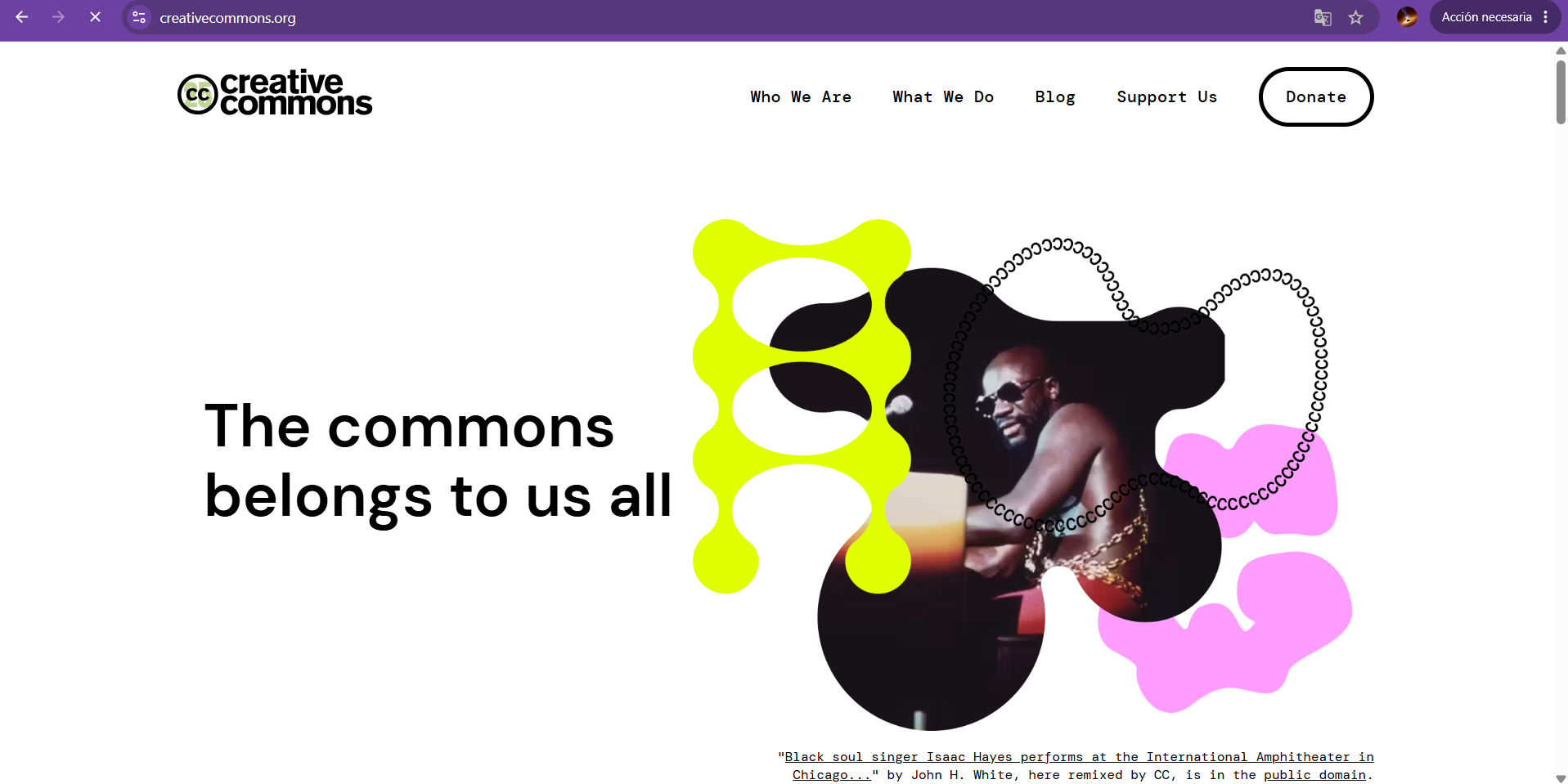
Then we have to go to the Chooser. When accessing the License Chooser section, the following menu is displayed. This tool guides users through a series of questions and options designed to help them select the license that best matches their project's goals and sharing preferences.
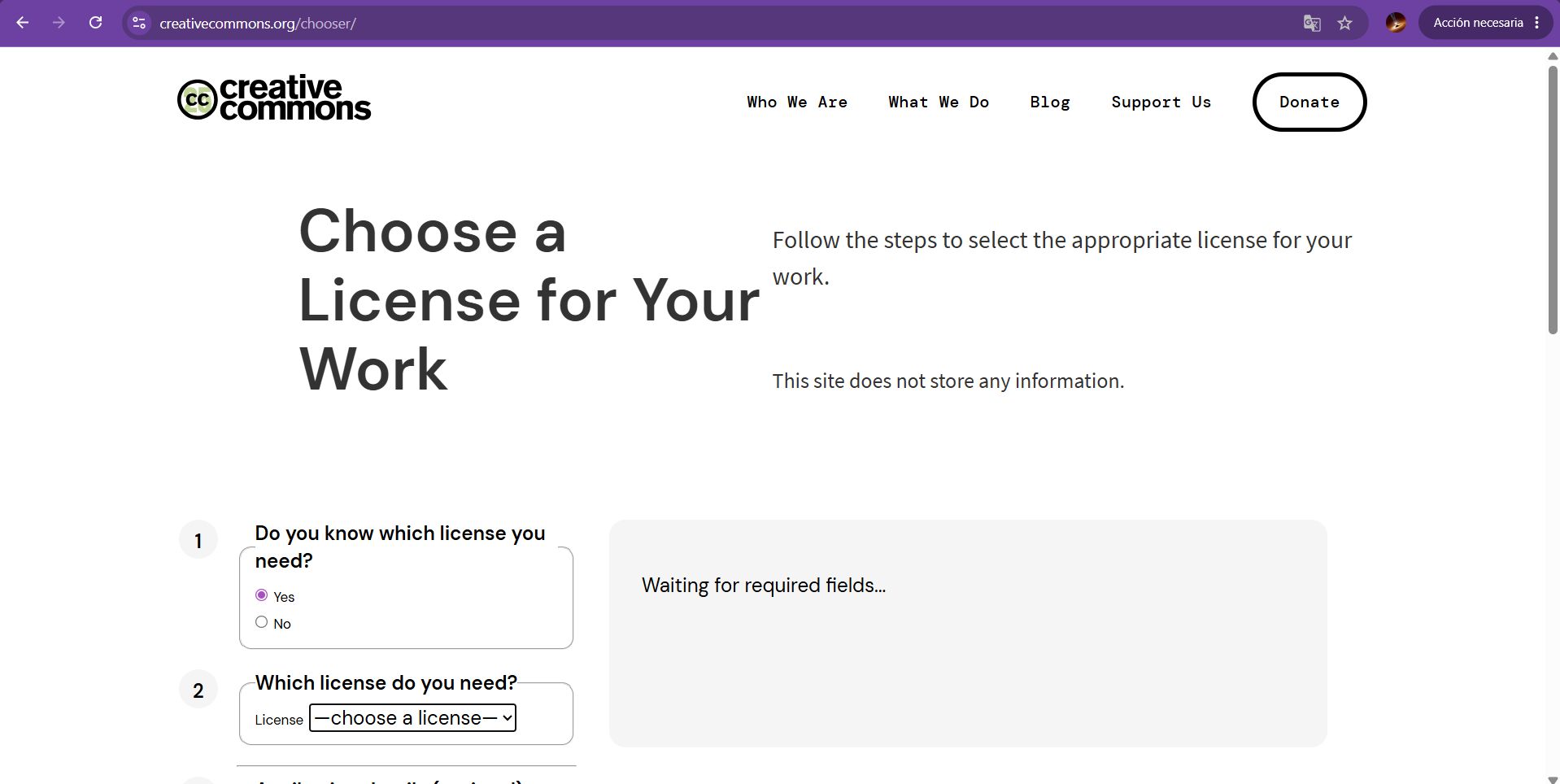
Once in the Chooser, we should pass through 3 Steps: Answer if we know the type of licence we want, which licence do we need and our project information. If we don't know the type of licence we need, there is no problem, by clicking no the second step will dissapear and instead 5 questions will appear to help us to choose the licence.
If we know
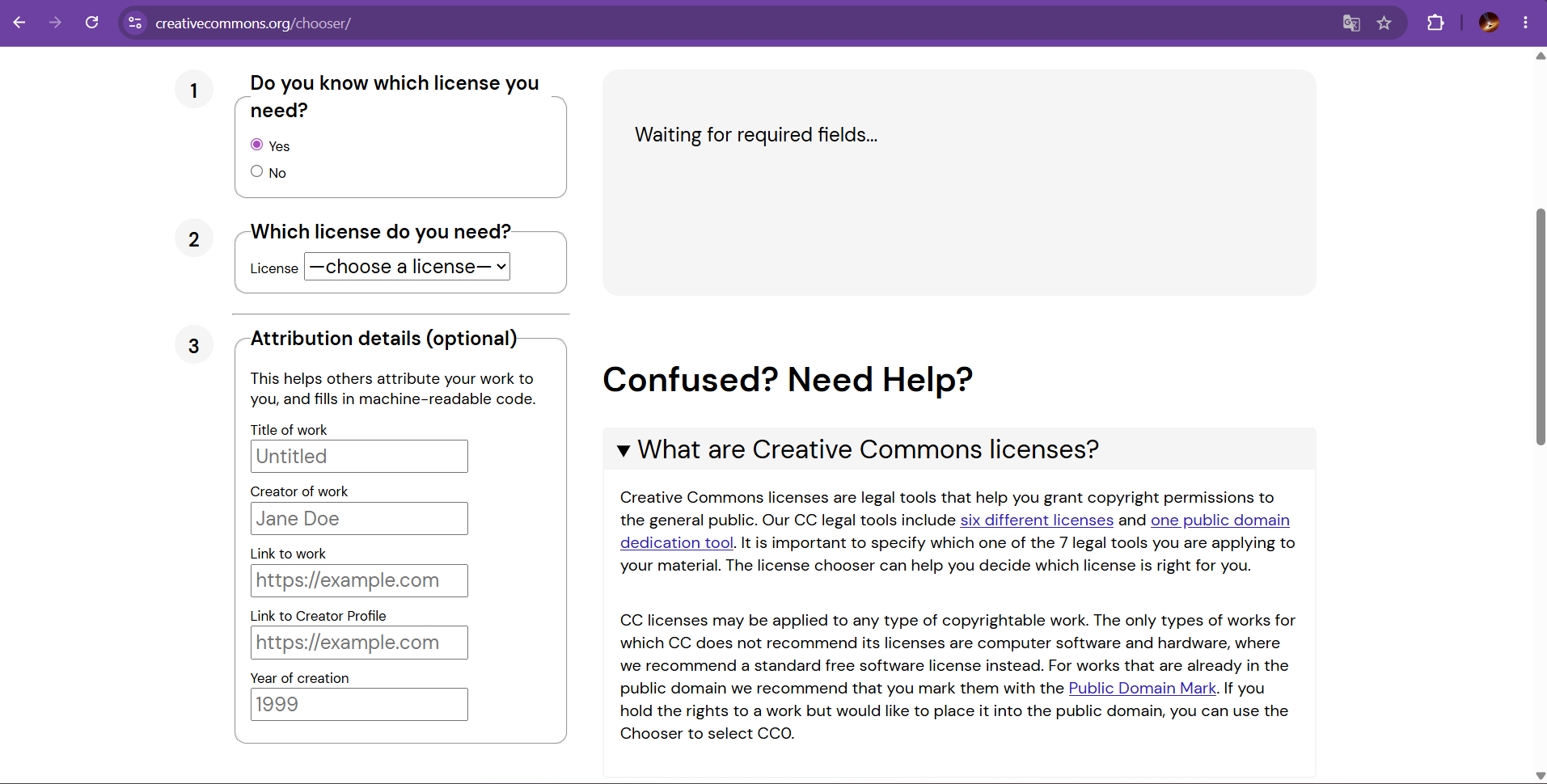
If we don't know
After answering the questions, the recommended licence is CC BY-NC-SA 4.0 so I selected it.
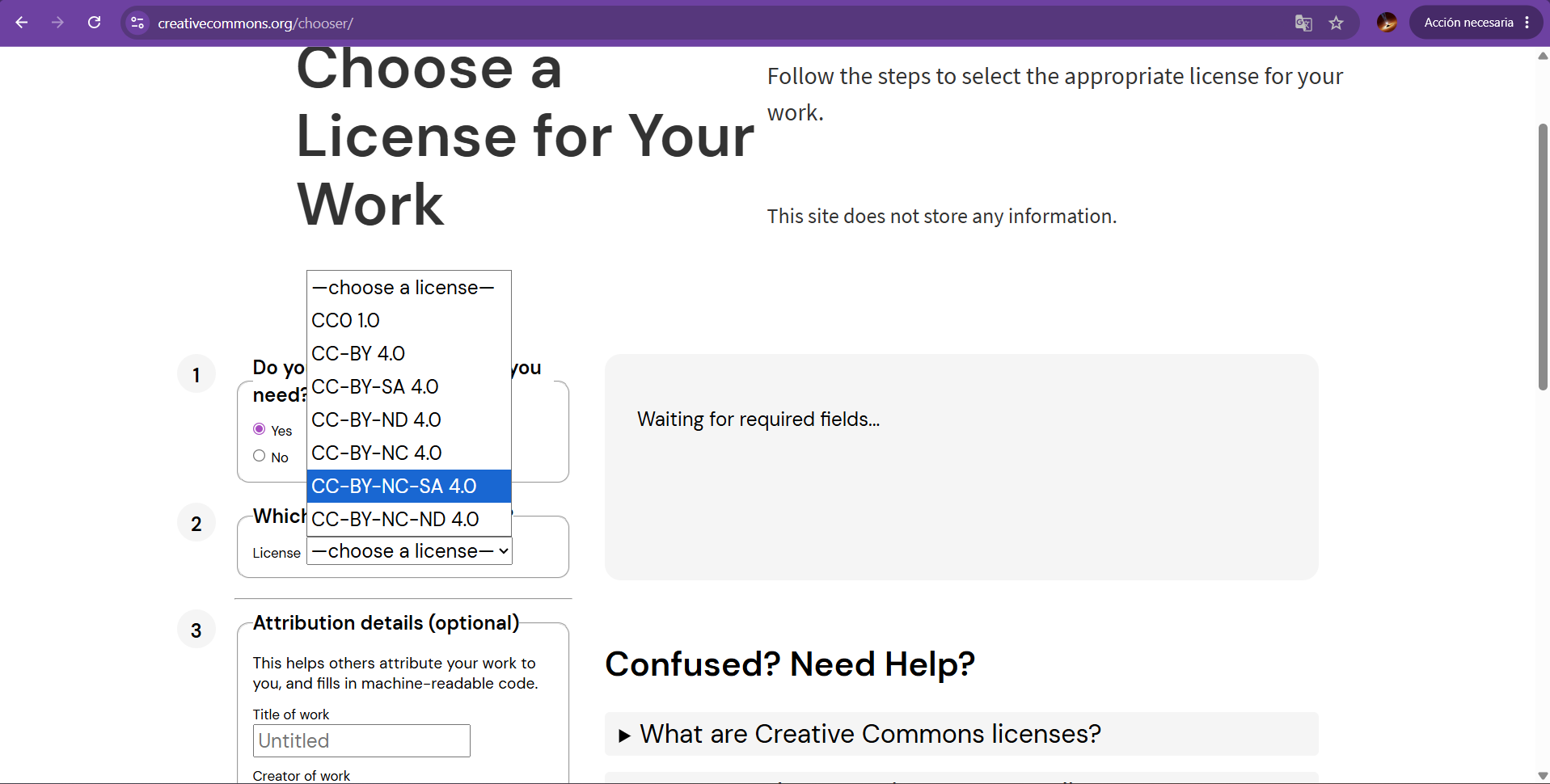
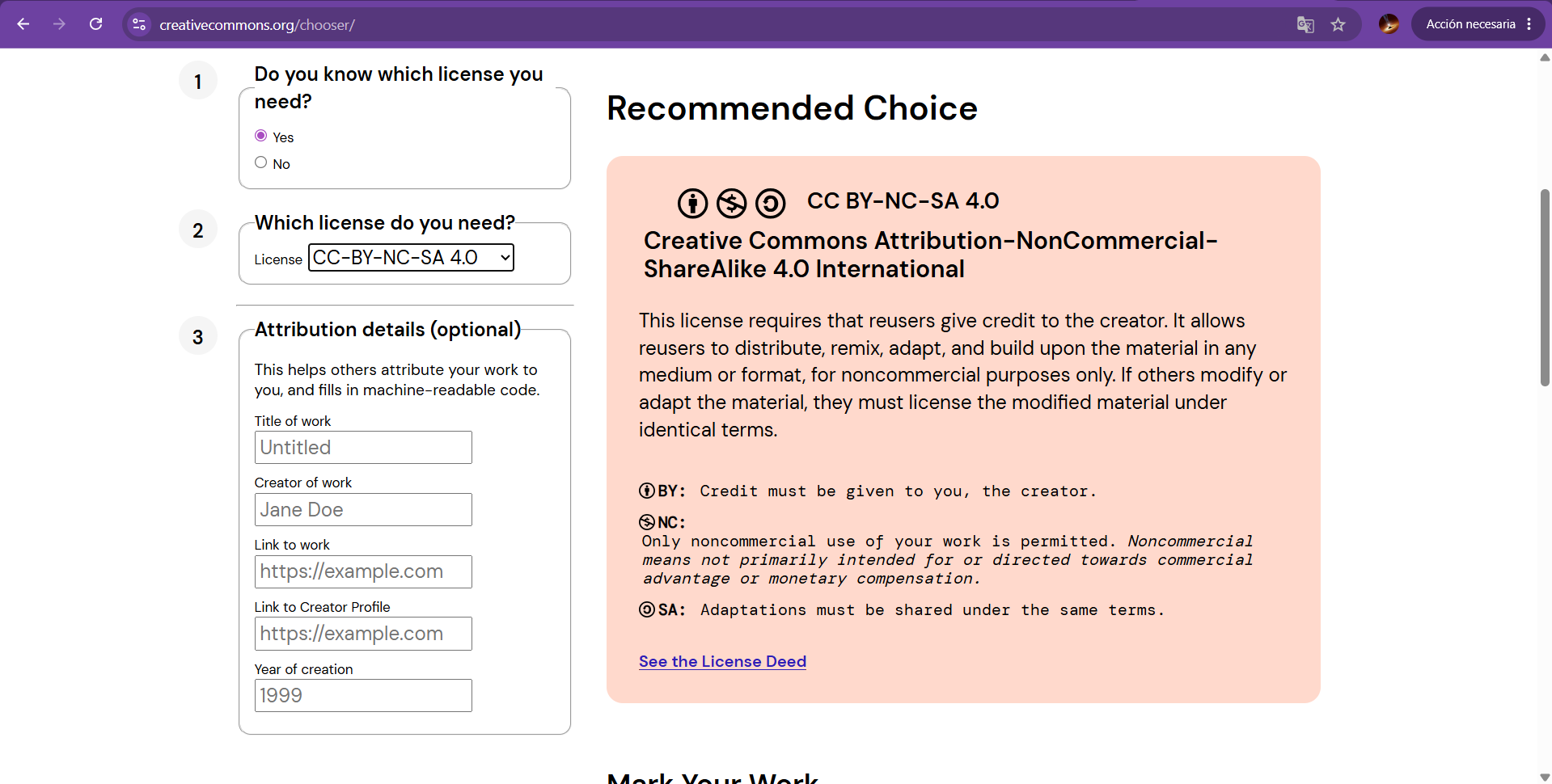
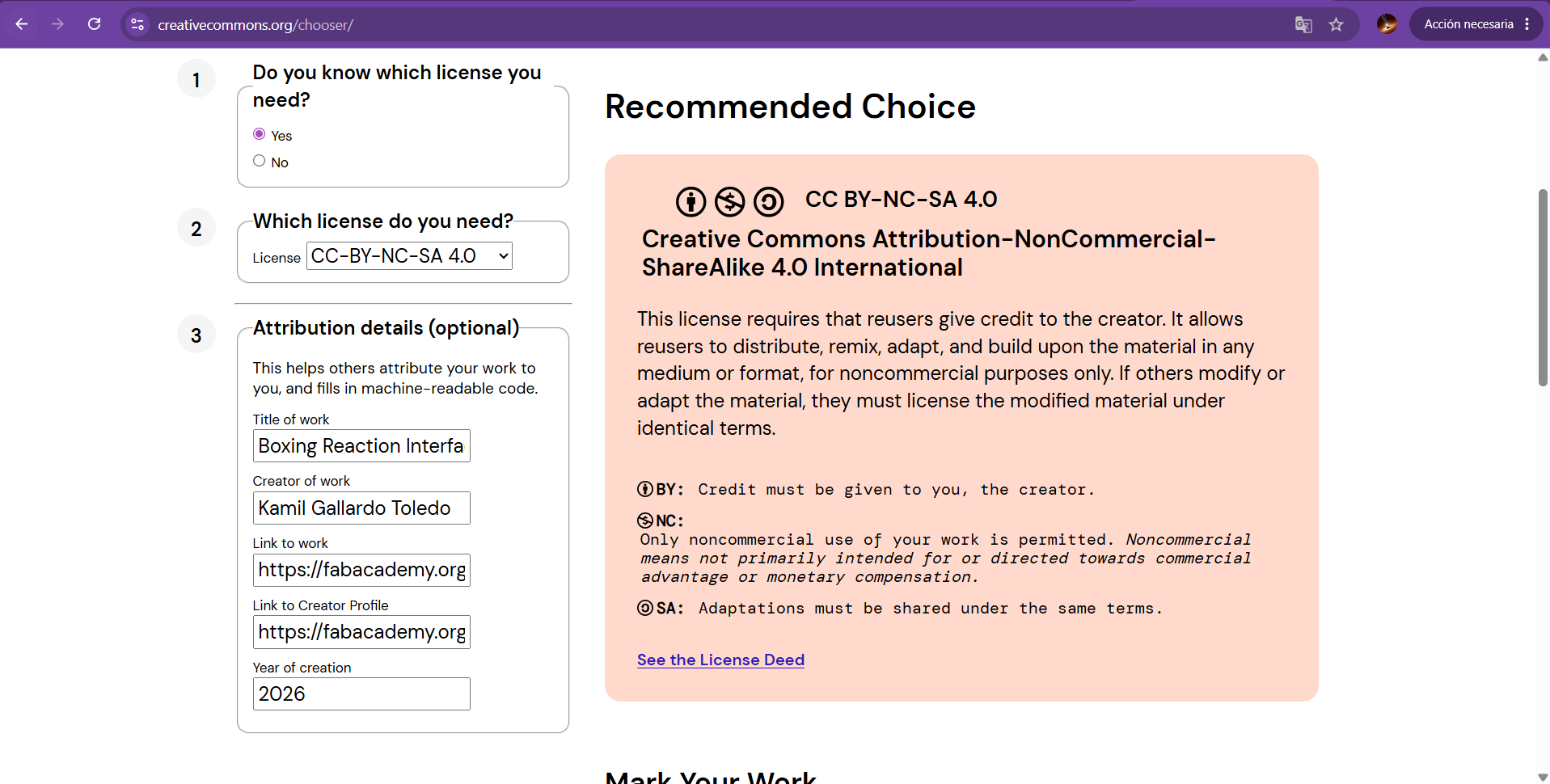
Then, I filled the information of my project. First I wrote the name (Boxing Reaction Interface System), then my name (Kamil Gallardo Toledo), then the link of my final project page link(https://fabacademy.org/2026/labs/puebla/students/kamil-gallardo/final-project.html), Subsequently the link to my about me (https://fabacademy.org/2026/labs/puebla/students/kamil-gallardo/about.html). Finally i wrote the year of invention, which is 2026.
Then, the page will show you two ways to paste your licence, for our page, we must select HTML.
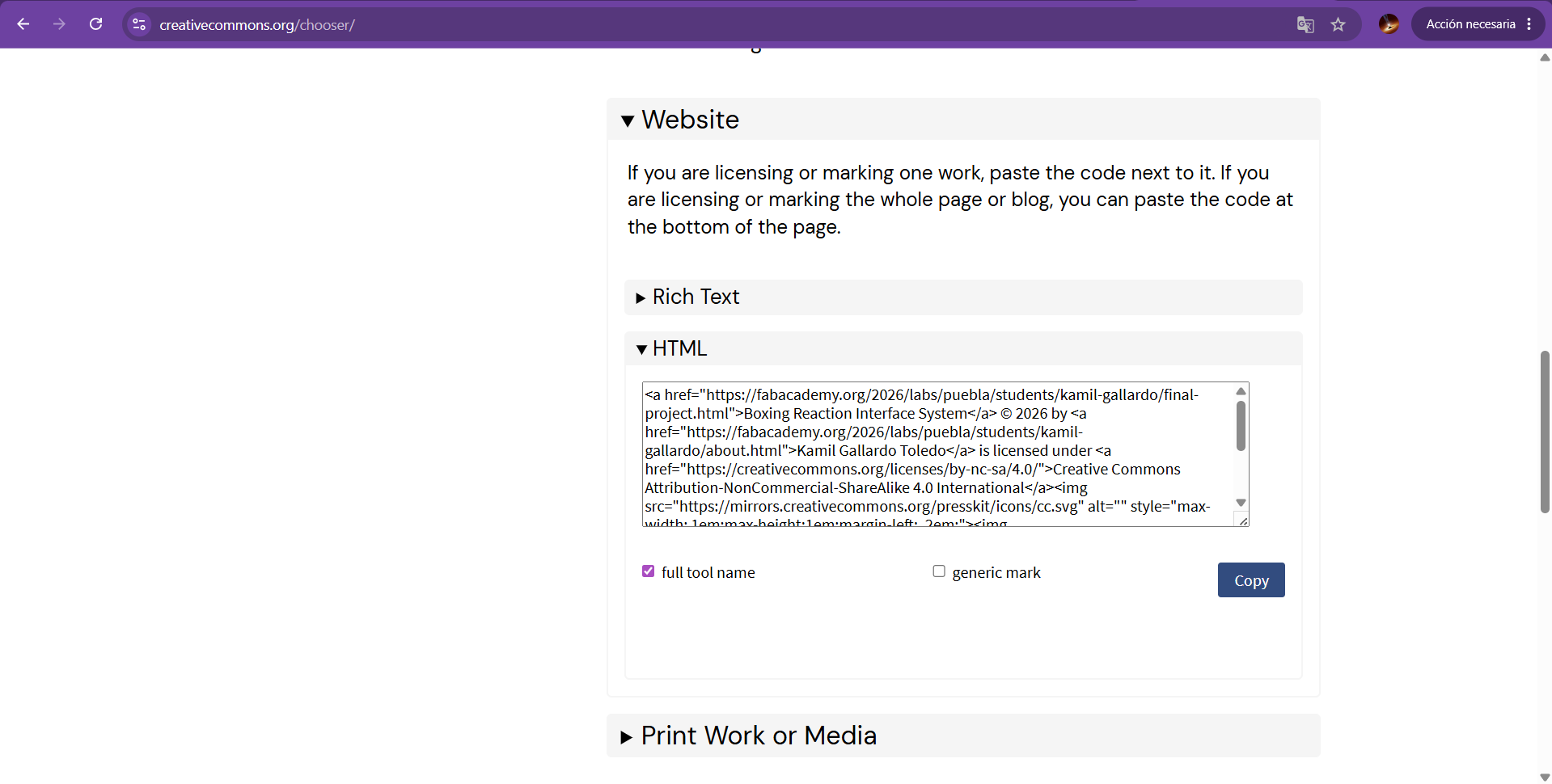
Finally, we have to copy and paste the code in the footer of our final project page.

Learning outcomes
This week, I defined the short-, medium-, and long-term plans for my project, which helped me better understand both the areas that need improvement and the aspects that have already proven to be reliable and functional. This reflection allowed me to establish a clearer roadmap for future development and identify opportunities to enhance the overall design, performance, and user experience.
Regarding licensing, I was previously unfamiliar with the process of creating licenses and the benefits associated with copyright protection. Through this week's work, I learned how copyright helps establish ownership of a project and grants creators legal rights over their work. I also gained an understanding of how licenses can be used to define the conditions under which others may use, modify, or distribute a creation. As a result, I now know how to generate licenses and take appropriate steps to protect my intellectual property while clearly communicating how my work can be shared and reused.