What will it do?
1. What Will It Do?
The cut crystal assembly machine will automate the manual assembly process of the crystals used to "dress" the imperial chandeliers of Lámparas y Candiles de Oaxaca. The process currently carried out by hand — picking staple by staple with yellow pliers to join the crystals — took approximately one full week per chandelier (around 3,500 crystals assembled into strips of different sizes).
The machine will receive raw material (cut crystals and aluminum staples), organize them, assemble them, and count them automatically. The operator will configure from an MQTT dashboard the number of crystals per series and the number of series to produce, and will be able to monitor progress in real time from any device with a browser.
Who has done what beforehand?
2. Who Has Done What Beforehand?
The idea for the staple dispensing system is based on screw-sorting systems using vibration, as shown in the following YouTube video:
The idea for the crystal dispensing system is based on the following videos:
MVI 4370 cap sorter
Alphamation Ltd High Speed Cap Feeder
The press-fit assembly system is based on:
However, none of these projects is specifically oriented toward assembling cut crystals for chandeliers, nor do they combine all of these subsystems (dispensing, orientation, assembly, bending, counting, and remote control) in a single machine. Furthermore, after extensive research, no commercial product was found that performs this task — similar industrial systems are almost certainly protected. This project is a solution completely adapted to the specific needs of the family business.
What sources will you use?
3. What Sources Will Be Used?
- YouTube videos referenced on the final project page (vibration-based sorting systems, press-fit assembly, small-part dispensing).
- Datasheets for the NEMA 17 stepper motor (model 17HS4401) and the DRV8825 driver.
- Official documentation for the Raspberry Pi Pico 2W and the XIAO ESP32-S3.
- AccelStepper library for Arduino IDE (stepper motor control).
- PubSubClient and ArduinoJson libraries for MQTT communication on the ESP32.
- HiveMQ public broker documentation for MQTT over WebSocket.
- Fab Academy reference: Weeks 3, 9, 10, 12, 14, and 15 of my own documentation.
What will you design?
4. What Will Be Designed?
- Mechanical structure: 3mm MDF box (laser-cut) housing all subsystems.
- 3D-printed components: Staple and crystal orientation rails, staple bending mold, conveyor belt components, and power supply housing.
- Electronics: Modular PCB for controlling 4 NEMA 17 motors with DRV8825 drivers, designed in KiCad and fabricated at the FabLab (documented in Week 12, in collaboration with Joseph Alavez).
- Firmware: Code in Arduino IDE for the Raspberry Pi Pico 2W, controlling the stepper motors and communicating with the dashboard via MQTT.
- Interface: MQTT web dashboard (HTML + CSS + JavaScript) for configuring and monitoring the assembly line in real time (documented in Week 14).
What materials and components will be used? / Where will they come from? / How much will they cost?
5, 6 & 7. Materials, Sources and Costs
Note: USD prices are calculated using the exchange rate of $17.56 MXN per USD, which was the rate on June 23, 2026.
Conveyor Belt & Organizers
| Material | Quantity | Unit Cost (MXN) | Total Cost (MXN) | Total Cost (USD) | Where to Find It |
|---|---|---|---|---|---|
| Stepper motor (NEMA 17) | 3 | $250 | $750 | $42.71 | Electronics store |
| Driver DRV8825 (stepper motor controller) | 3 | $60 | $180 | $10.25 | Electronics store |
| 3D PLA filament | 1 kg | $300 | $300 | $17.08 | Amazon |
| Rubber strip (1.8 mm × 3.5 mm) | 3 m | $33 | $99 | $5.64 | Rubber supply store |
| Raspberry Pi Pico 2W | 1 | $300 | $300 | $17.08 | Amazon / Electronics store |
| External power supply 12V 5A | 1 | $185 | $185 | $10.53 | Amazon |
| Plug and electrician's cable | 1 plug + 1.5 m cable | $50 | $50 | $2.85 | Electronics store |
| Copper plates (PCB) | 3 | $30 | $90 | $5.12 | Fab Academy materials |
| Hexagonal bolt M8 | 2 | $5 | $10 | $0.57 | Hardware store |
| M8 nut | 8 | $1 | $8 | $0.46 | Hardware store |
| Washer | 10 | $1 | $10 | $0.57 | Hardware store |
| Self-tapping screw 8 × 3/8 combo head | 30 | $0.50 | $15 | $0.85 | Hardware store |
| 3/8 washer | 70 | $0.50 | $35 | $1.99 | Hardware store |
| Terminal block (clema) | 1 | $20 | $20 | $1.14 | Hardware store |
Packaging Box
| Material | Quantity | Unit Cost (MXN) | Total Cost (MXN) | Total Cost (USD) | Where to Find It |
|---|---|---|---|---|---|
| MDF sheet | 1 | $70 | $70 | $3.98 | Hardware store |
| Acrylic sheet (50 × 50 cm) | 1 | $350 | $350 | $19.93 | Hardware store |
| Hinge | 2 | $30 | $60 | $3.42 | Hardware store |
Approximate total project cost: $2,532 MXN / $144.19 USD
What parts and systems will be made?
8. What Parts and Systems Will Be Made?
- 3D-printed parts: raw material containers, orientation rails, and bending mold.
- Laser-cut MDF packaging box with the company logo engraved.
- PCB for stepper motor control (milled at the FabLab).
- Circuit for the crystal counting camera.
- MQTT dashboard as the operating interface.
- Firmware code for the Raspberry Pi Pico 2W.
What processes will be used?
9. What Processes Will Be Used?
- 3D design (SolidWorks).
- 3D printing (additive manufacturing).
- Laser cutting (subtractive manufacturing).
- Electronics design (KiCad).
- PCB fabrication by CNC milling (MonoFab SRM-20).
- Embedded programming (Arduino IDE).
- Wireless communication (MQTT over Wi-Fi).
- Web interface design and programming (HTML, CSS, JavaScript).
What questions need to be answered?
10. What Questions Need to Be Answered?
- Will the rail orientation system ensure that 100% of the staples fall at the correct angle, or will there be a rejection percentage that needs to be handled?
- Will the conveyor belt speeds be sufficiently synchronized so that the assembly is carried out correctly without the crystals or staples jamming?
- Will the bending mold generate consistent force on all staples, or will there be variation depending on the exact position of the piece?
- Will the Raspberry Pi Pico 2W have enough processing capacity to control all 4 stepper motors simultaneously and smoothly?
How will it be evaluated?
11. How Will It Be Evaluated?
The project will be considered successful if it meets the following criteria:
| Criterion | Description |
|---|---|
| Functionality | The machine correctly assembles cut crystals with aluminum staples automatically, without manual intervention during the process. |
| Reduced Production Time | The assembly time per crystal is significantly lower than the manual process (reference: currently one full week for 3,500 crystals). |
| Remote Control | The operator can configure a batch, start, and stop production from the MQTT dashboard without physically intervening in the machine. |
| Finish | The MDF box gives the machine the appearance of a finished product, ready to be delivered and used at Lámparas y Candiles de Oaxaca. |
Presentation Slide & Video
Presentation Slide & Video
Both the summary slide and the presentation video are already available and linked from the Final Project page. They are also linked directly below:
- Summary Slide (1920×1080): presentation.png
- Presentation Video: presentation.mp4
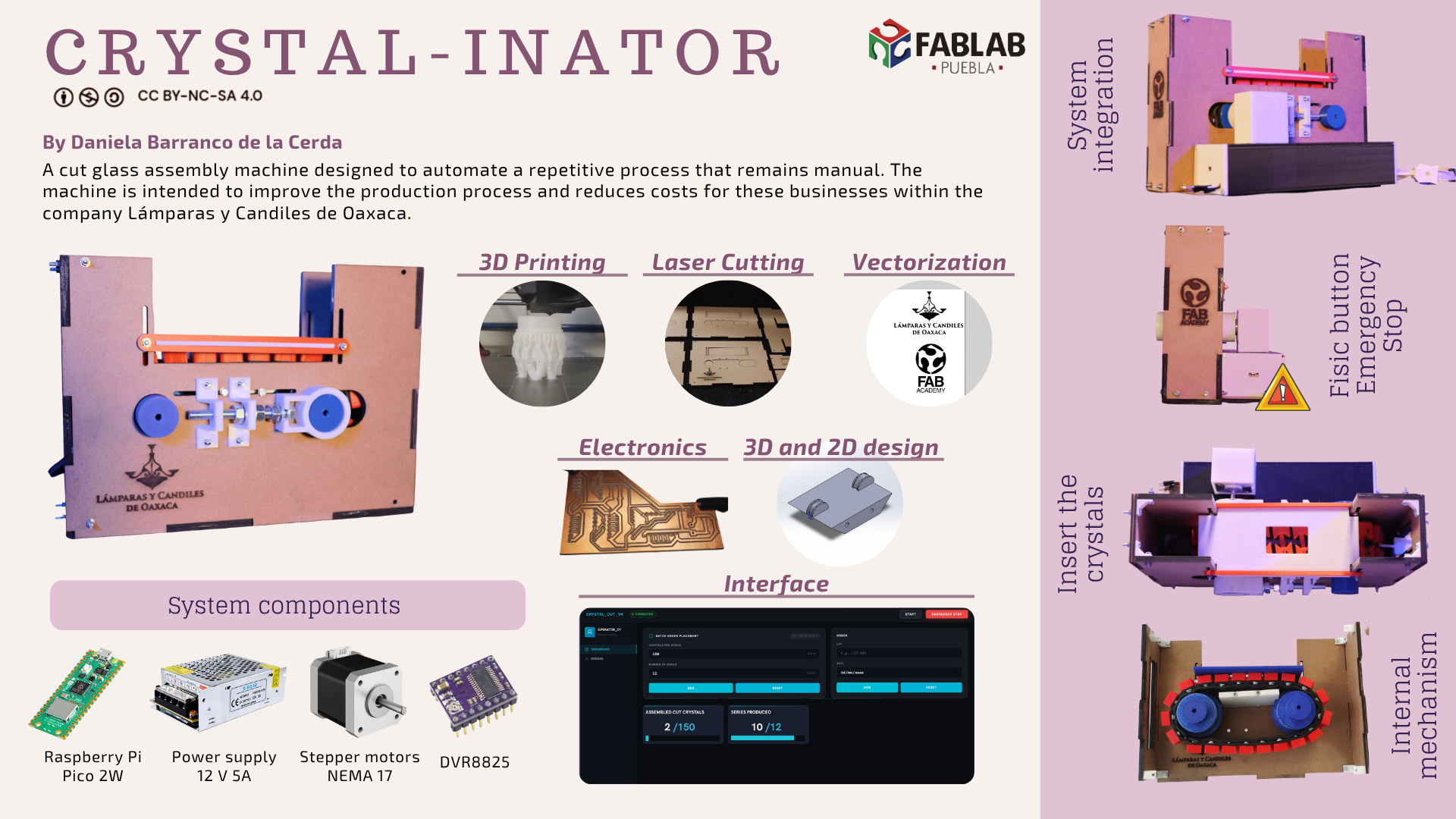
Summary slide — click to open full resolution.
Presentation video.
Presentation Timeline
Presentation Timeline
Both the slide and the video are already contemplated and linked in this documentation. Below is the schedule for their completion and final upload:
| Date | Task | Status |
|---|---|---|
| May 26 | Create first draft of the summary slide and presentation video. | ✔ Done |
| June 6 – 7 | Review and correct both the slide and the video based on feedback. | ⏳ Pending |
| June 8 | Upload the corrected slide and video to the final repository. | ⏳ Pending |