
Week 19 | Invention, Intellectual Property and Income
1. Intellectual Property
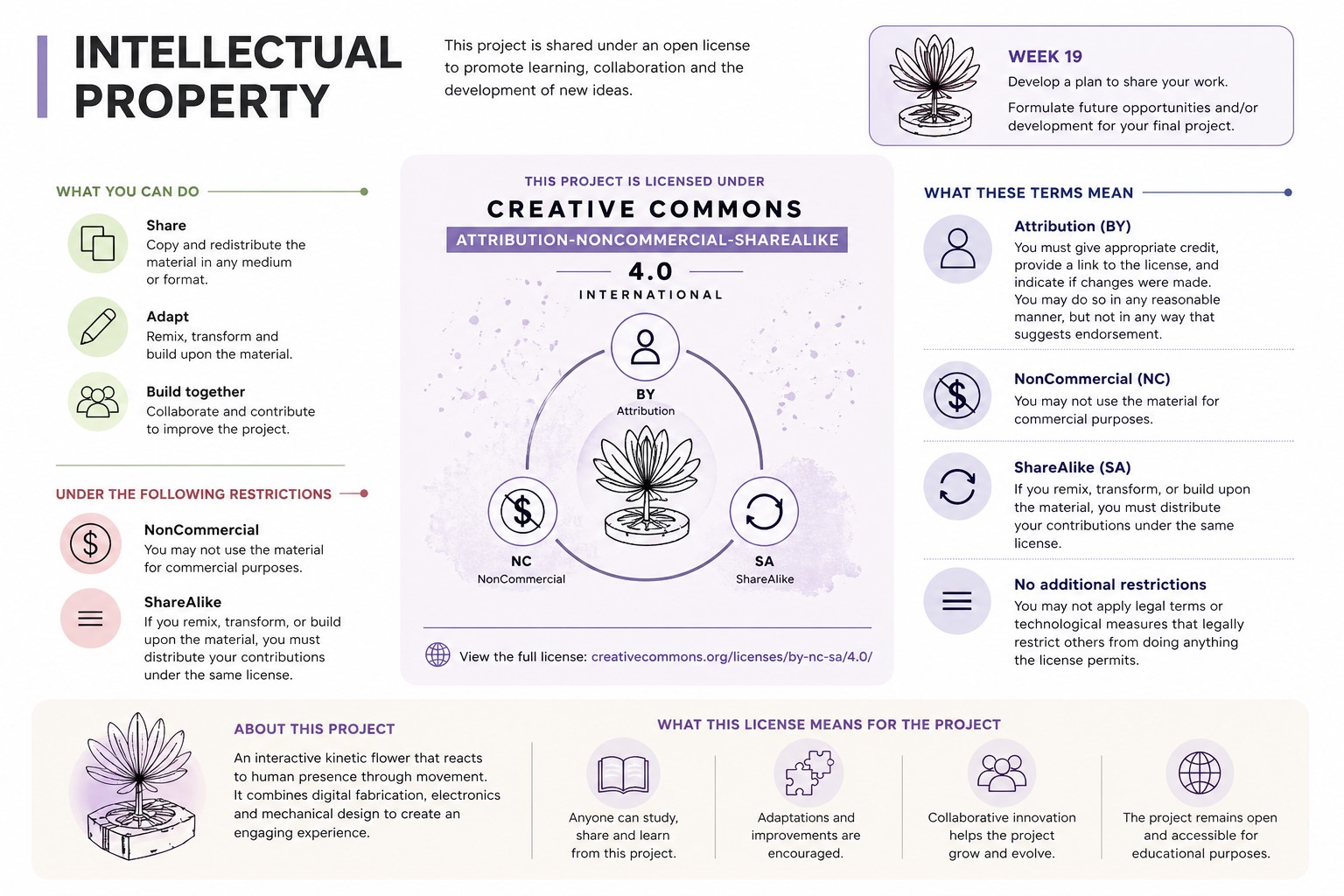
This project is shared under a Creative Commons license to promote learning, experimentation, and collaboration within the digital fabrication community.
A. License
This work is licensed under a Creative Commons Attribution-NonCommercial-ShareAlike 4.0 International License (CC BY-NC-SA 4.0).
This means that:
- Attribution (BY): Others must give appropriate credit when using or referencing this project.
- NonCommercial (NC): The project cannot be used for commercial purposes without permission.
- ShareAlike (SA): Any modifications or derivative works must be shared under the same license.
B. Permissions
Under this license, others are allowed to:
- Share the project (copy and redistribute the material in any medium or format).
- Adapt the project (remix, transform, and build upon the material).
C. Restrictions
The following restrictions apply:
- The project cannot be used for commercial purposes.
- Proper credit must always be given to the original author.
- Any derivative work must be distributed under the same license.
D. License Reference
For more details about this license, visit:
https://creativecommons.org/licenses/by-nc-sa/4.0/
E. Author Statement
This project combines digital fabrication, electronics, and mechanical design to create an interactive kinetic system. The intention of sharing this work is to contribute to open knowledge while maintaining recognition of authorship and limiting commercial exploitation without consent.
2. Dissemination Plan
The key message of this project is to explore the intersection between art, design, and technology through interactive objects that respond to human presence. The project transforms static forms into dynamic systems, generating an emotional and sensory experience.
The main goal is to communicate how digital fabrication and embedded electronics can be used not only for functional purposes, but also as a medium for creative expression and interaction.
- Highlight the integration of mechanical design, electronics, and digital fabrication.
- Communicate the value of interaction and responsiveness in physical objects.
- Share the project as an open and replicable system.
- Position the project as part of the Artifice platform.
A. Target Audience
- Designers and artists: interested in interactive and kinetic objects.
- Digital fabrication community: students, makers, and Fab Lab users.
- Educators and researchers: working at the intersection of engineering and design.
- Creative technologists: focused on interactive installations.
B. Channels
- Fab Academy Website: full technical documentation.
- Artifice platform: curated presentation of projects.
- Social media: short videos showing interaction and movement.
- Exhibitions: physical presentation as an installation.
C. Content
- Project documentation: design, fabrication, electronics, and integration.
- Process documentation: images and videos of development.
- Promotional video: showcasing interaction.
- Project summary slide: visual synthesis.
3. Future Opportunities and Development
The current prototype represents a first functional version of the system. Future development will focus on improving performance, scalability, and user experience.
- Refinement of the mechanical system to achieve smoother and more precise movement.
- Integration of more advanced sensors for richer interaction.
- Exploration of different materials and finishes for aesthetic variation.
- Development of modular systems that can be scaled or combined.
- Creation of larger interactive installations.
In the long term, the project could evolve into a series of interactive objects or installations that combine art, design, and digital fabrication.
Artifice Platform
This project also serves as an initial step toward the development of Artifice, a platform focused on the intersection of art, technology, design, and digital fabrication within the Latin American context.
The initiative aims to create a space for the development, documentation, and visibility of projects that combine creative expression with emerging technologies, particularly those related to digital manufacturing, interactive systems, kinetic objects, and experimental fabrication processes.
Artifice seeks to promote and connect artistic and technological practices developed in Peru and Latin America, encouraging interdisciplinary exploration between artists, designers, makers, engineers, and digital fabrication communities.
Through future projects, the platform intends to expand the exploration of responsive objects, interactive installations, material experimentation, and digitally fabricated artworks that merge cultural identity, technology, and contemporary creative practices.
4. Project Status
At this stage, the core functionality of the project has been successfully completed. The mechanical system, electronics, programming, and system integration have been tested and validated through multiple iterations.
| Completed Tasks | Remaining Tasks |
|---|---|
| Mechanical design and fabrication of the flower structure | Final documentation review |
| Design and fabrication of custom electronic board | Final documentation review |
| Integration of PIR sensor, servo motor, LED and switch | Final documentation review |
| Assembly and testing of the complete system | Final video editing |
5. Evaluation of the Development Process
What worked well?
- The modular design approach allowed components to be redesigned and replaced without affecting the entire system.
- The integration between the PIR sensor, servo motor, LED, and control board achieved the intended interactive behavior.
- Digital fabrication technologies enabled rapid prototyping and multiple design iterations throughout the project.
- The final assembly successfully combined mechanical design, electronics, programming, and fabrication into a fully functional prototype.
- The automatic opening and closing sequence responded reliably to user presence under normal operating conditions.
What did not work as expected?
- The movement was not always completely smooth due to friction between several 3D printed components.
- The first versions of the mechanism required multiple redesigns before achieving a reliable opening and closing motion.
- Some structural areas experienced small fractures despite the addition of fillets and reinforcements.
- The rigidity of PLA limited the design of the pivot joints and required careful adjustment of clearances to prevent breakage.
- The mechanism occasionally became misaligned or stuck because of fabrication tolerances and mechanical interference.
What could be improved?
- Explore alternative mechanisms to create a smoother and more natural movement.
- Reduce friction between moving parts through design optimization and improved tolerances.
- Further reinforce critical structural areas subjected to repeated stress.
- Evaluate alternative materials with greater flexibility and durability for moving connections.
- Investigate additional sensors and interaction methods to expand the user experience.
- Adapt the mechanism for vertical installations where gravity would influence the movement differently.
6. What questions need to be resolved?
- How can the mechanism achieve a smoother and more organic movement while maintaining reliability?
- What alternative materials could improve the durability and flexibility of the moving joints?
- How can friction between the printed components be further reduced?
- How would the mechanism behave if the flower were installed vertically instead of horizontally?
- Which sensors could provide a richer and more responsive user interaction?
- How can the design be optimized for long-term operation and repeated use?
7. Planned: What will happen when?
- Short term: Complete the final documentation, organize the project files, and prepare the final presentation and video.
- Next iteration: Test alternative mechanisms to make the petal movement smoother and reduce friction between moving parts.
- Future development: Explore new materials for the pivot joints and structural components to improve durability and flexibility.
- Further exploration: Evaluate other sensors and interaction methods to make the flower respond in more expressive ways.
- Long term: Develop the project as part of the Artifice platform, creating new interactive objects that combine art, design, and digital fabrication.
8. What have I learned?
This project reinforced the importance of iterative development and system integration. Although each subsystem could work independently, achieving reliable performance required continuous adjustments between the mechanical design, electronics, programming, and fabrication processes.
I learned that gravity, friction, material properties, and fabrication tolerances have a significant impact on the behavior of kinetic systems. The shape and weight of the petals directly influenced the opening and closing movement, requiring several design modifications and manual adjustments.
I also learned that material selection is critical when designing moving mechanisms. While PLA is suitable for prototyping, its rigidity introduces limitations in joints and flexible connections, making tolerance design especially important.
Finally, this project demonstrated that testing the complete integrated system is as important as testing individual components. Many challenges only became visible once all mechanical, electronic, and software elements were assembled and operating together.