WEEK 19
Invention, Intellectual Property and Income
Assignment scope
- Create a dissemination plan for the final project and define how the work will be shared.
- Describe intellectual property criteria, licensing, and the project position regarding future income or scaling.
- Track final project progress, identifying completed tasks, pending tasks, open questions, timeline, and lessons learned.
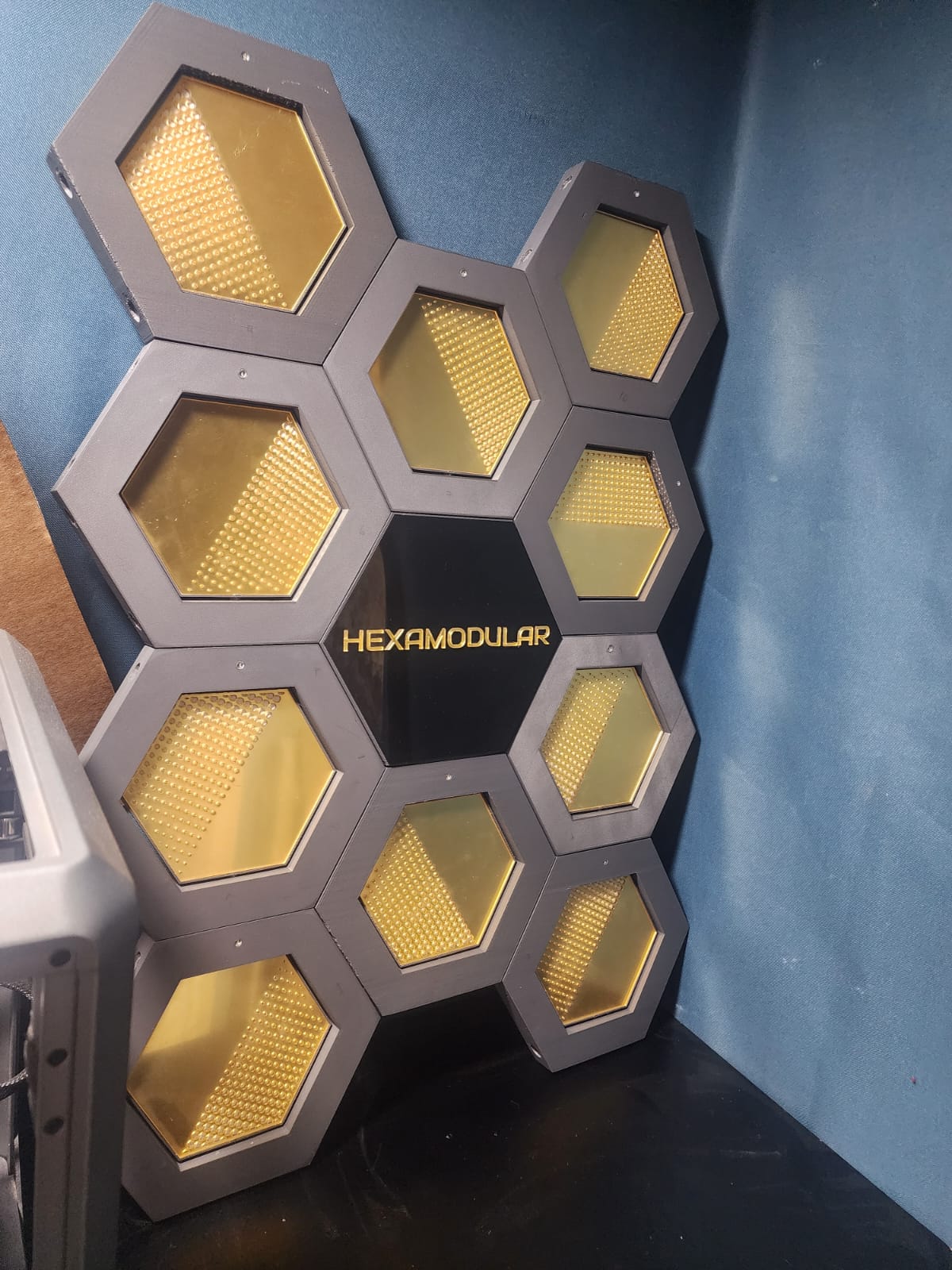
My final project, the Hexamodular Kinetic System, is a modular responsive facade panel designed to improve thermal comfort and visual quality in architectural envelopes. The project is conceived as part of the search for a living architecture in the facades of Lima homes and the pursuit of thermal comfort, making it potentially replicable at a domestic scale as well. The system combines parametric geometry, fabricated mechanical parts, custom electronics, and embedded control so each module can react to environmental conditions and modify the amount of light entering the space.
1) Intellectual property
I want this project to remain accessible for academic use, Fab Lab replication, and design experimentation, while still protecting authorship and avoiding uncontrolled commercial exploitation before the system is fully validated at architectural scale. For that reason, I am documenting the project under a Creative Commons Attribution-NonCommercial-ShareAlike 4.0 International license.
| Aspect | Decision for this project |
|---|---|
| License | CC BY-NC-SA 4.0 for the documentation, visual content, and shared design approach. |
| Permissions | Others may study, replicate, adapt, and improve the project for educational and non-commercial purposes. |
| Restrictions | Attribution is required, commercial use needs permission, and derivative work must keep the same license. |
| Reason | The project should circulate within the Fab community, but future scaling and architectural implementation still require technical validation, investment, and author control. |
License reference: CC BY-NC-SA 4.0.
2) Dissemination plan
The purpose of dissemination is not only to show the final prototype, but to position the Hexamodular Kinetic System as a replicable response to climate-adaptive architecture in Peru. The key message is that digital fabrication can produce responsive facade systems that are locally prototyped, technically documented, and later scaled into architectural applications.
| Topic | Plan |
|---|---|
| Target audience | Fab Labs, architecture students, facade designers, digital fabrication researchers, and institutions interested in climate-responsive envelopes. |
| Main channels | Fab Academy documentation site, final presentation, short project video, social media clips, and local academic or Fab Lab exhibitions. |
| Content to publish | Concept summary, fabrication workflow, electronics integration, testing results, downloadable files, and prototype operation video. |
| Value proposition | A modular system that joins environmental response, digital fabrication, and architectural expression in one demonstrable prototype. |
| Funding and income vision | At this stage the project is academic and experimental. Future income could come from commissioned prototypes, research collaborations, facade consultancy, or grant-funded scaling after technical validation. |
3) Future opportunities and how to make them probable
- Scale from one functional module to a connected facade array with shared structural and electrical logic.
- Integrate light and temperature sensing so the system responds to real environmental data instead of manual triggering.
- Develop a more robust actuation strategy that improves synchronization, durability, and maintenance.
- Test materials better suited for repeated movement and outdoor exposure.
- Translate the academic prototype into a validated architectural demonstrator through pilot installation and performance measurement.
To turn these opportunities into real probabilities, the next step is to move from proof of concept to measurable validation: repeated cycle testing, improved assembly tolerances, sensor-based automation, and a small panel mock-up that can be shown to labs, schools, or collaborators as a pre-scaling demonstrator.
4) Project status: completed tasks and remaining tasks
| Completed ✓ | Still pending ! |
|---|---|
|
|
Note: Pending tasks will be resolved during the week before Week 20.
5) What is working and what is not
| What is working | What is not yet working as intended |
|---|---|
|
|
6) What questions still need to be resolved?
- What is the most reliable mechanism-to-actuator relationship for repetitive opening and closing?
- How should the modules be linked so a larger panel remains simple to assemble and maintain?
- Which material combination offers the best balance between rigidity, low friction, and durability?
- How much real daylight regulation can the prototype demonstrate in a measurable way?
- What level of structural support would be needed to move from prototype scale to facade mock-up scale?
7) Planned: what will happen when?
| Time frame | Planned action |
|---|---|
| Immediate | Complete documentation cleanup, update this page, and organize the final media assets. |
| Short term | Calibrate the mechanism, test control behavior, and improve assembly precision. |
| Next iteration | Build a better connected group of modules and evaluate its architectural behavior as a panel. |
| Future development | Seek partnerships, grants, or institutional support to test the system at a larger scale. |
8) What have I learned?
This project taught me that a responsive architectural prototype only works when design, fabrication, electronics, and control are developed as one system rather than as separate parts. Small tolerances in the mechanism strongly affect the final behavior, so physical iteration is as important as digital modeling.
I also learned that documenting decisions is part of the engineering process. Defining the license, dissemination strategy, and next steps forced me to clarify who the project is for, what value it offers, and what evidence is still needed before it can move from academic prototype to real architectural application.