Week 18 – Applications and Implications
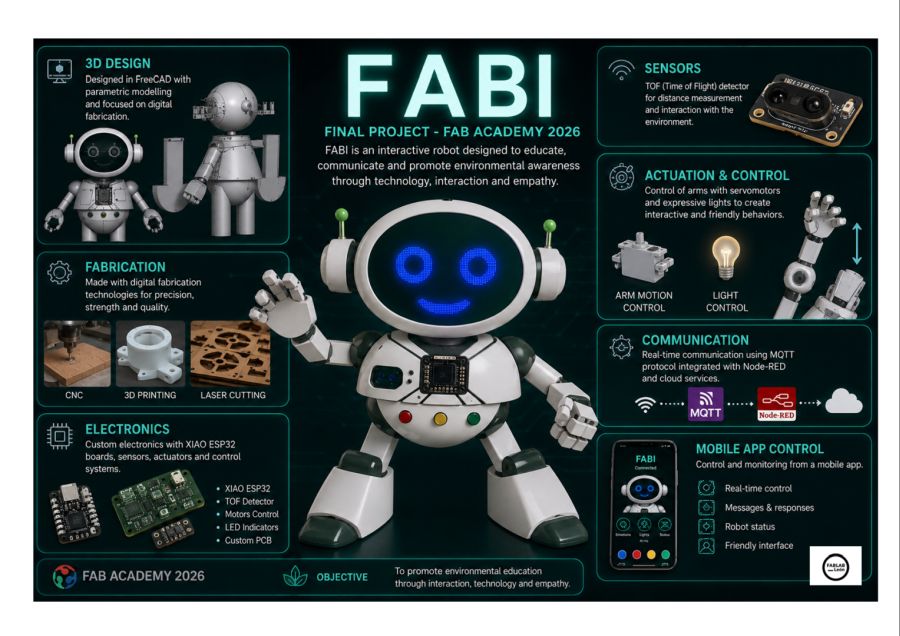
This week is focused on Applications and Implications and the development planning of the final project.
My final project is called FABI, a friendly interactive robot designed to attract children to the Fab Lab and encourage positive environmental behaviour through interaction, lights, movement and emotional communication.
FABI combines digital fabrication, electronics, embedded programming, MQTT communication and mechanical systems into a complete integrated project.
On this page I document:
- The scope and objectives of my final project.
- The systems integrated into the robot.
- The materials and components used.
- The fabrication processes involved.
- The development schedule.
- The Bill Of Materials (BOM).
- The evaluation criteria for the project.
- The current development status.
Assignment and Learning Outcomes
The weekly assignment is:
- Plan a final project masterpiece that integrates the range of units covered.
Learning Outcomes
- Define the scope of a project.
- Develop a project plan including a schedule and a bill of materials.
- Track the progress of the project.
- Summarise and communicate the project development.
Checklist
- Defined the project scope.
- Created a development schedule.
- Prepared a Bill Of Materials.
- Defined fabrication processes.
- Explained how the project will be evaluated.
- Prepared placeholder presentation slide.
- Prepared placeholder presentation video.
Official Fab Academy page: Applications and Implications
What Will FABI Do?
FABI is a social robot designed to interact with children in a playful and emotional way.
The objective is to create a robot capable of detecting nearby people, reacting with light and movement and encouraging children to participate in environmental activities such as collecting trash.
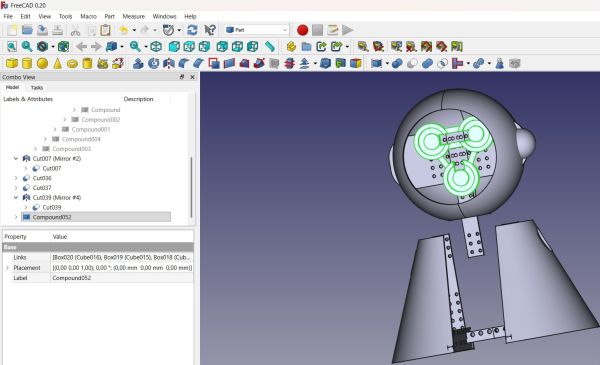
Main Features
- Detection of nearby people using ToF sensors.
- Interactive RGB light animations.
- Moving robotic arms.
- MQTT communication with Node-RED.
- Embedded ESP32 control system.
- Friendly visual appearance.
- Integrated digital fabrication structure.
Who's Done What Beforehand?
Before starting the development of FABI, I researched different social, educational and interactive robots that combine movement, lights and emotional communication.
Many existing robots are designed to interact with children using expressions, sounds and movement to create emotional responses and playful experiences. Some projects are focused on education, while others are designed for social interaction or environmental awareness.
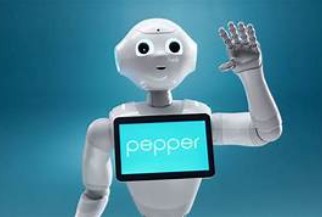
Pepper robot – social interaction and communication.
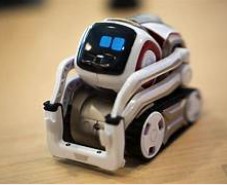
Cozmo robot – emotional interaction and playful behaviour.
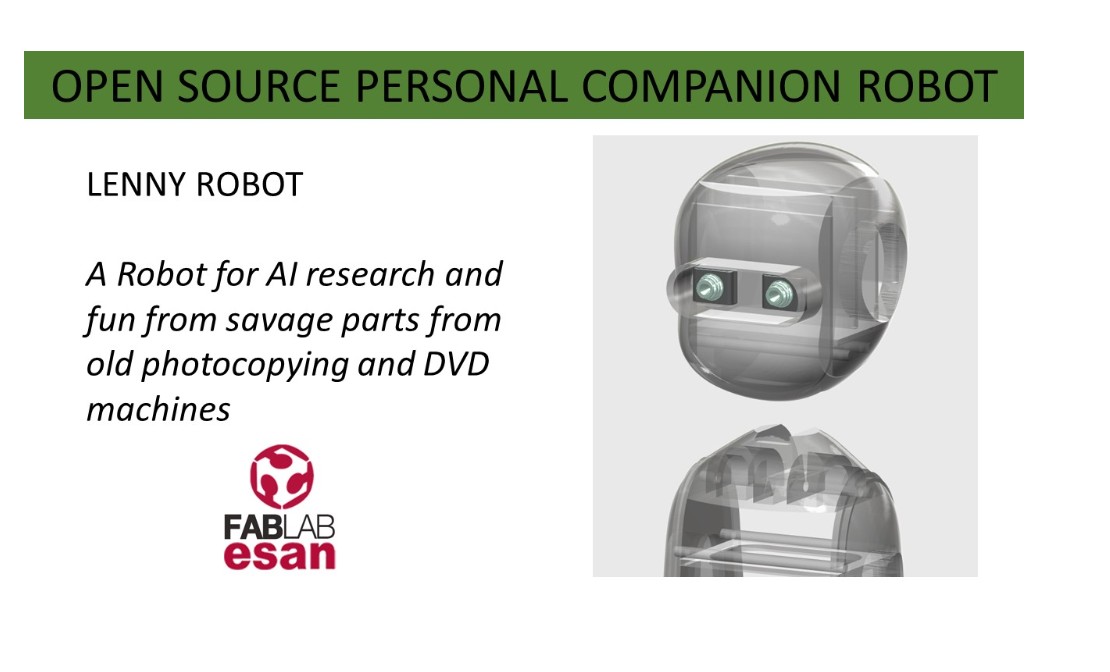
LENNY robot – FABACADEMY ESAN . Fab Academy Robot Projects
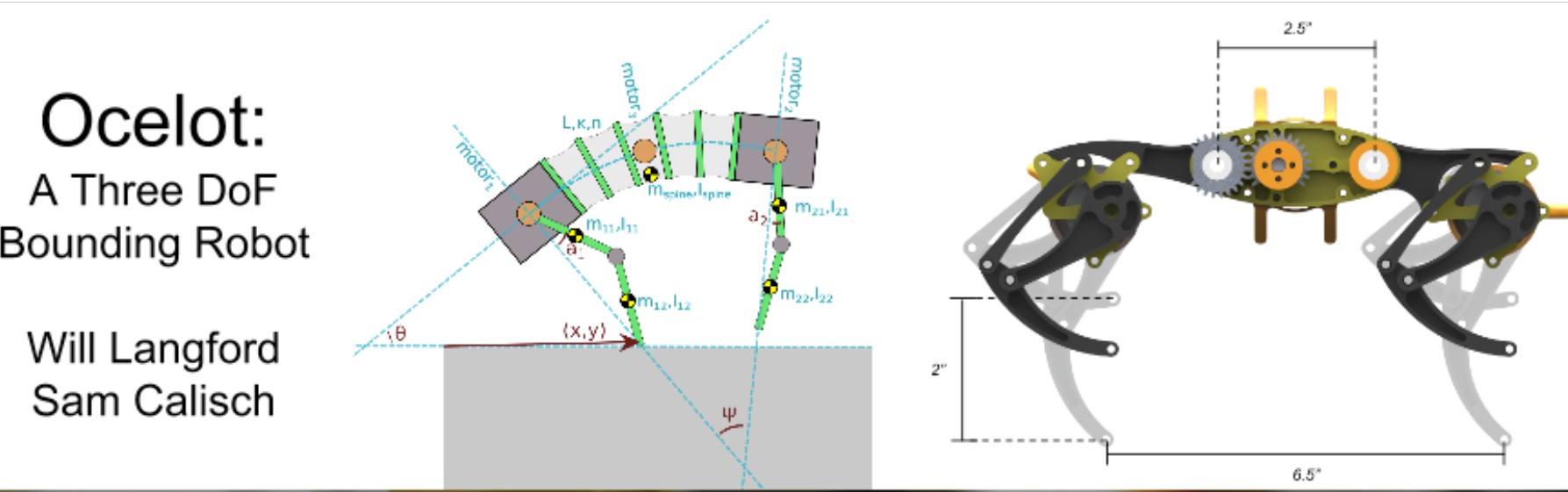
OCELOT robot – FABACADEMY WILL LANGFORD SAN CALISH . Fab Academy Robot Projects
Inspirations and References
| Robot / Project | Main Idea | Relation With FABI |
|---|---|---|
| Pepper | Human interaction and emotional communication. | Inspired the idea of friendly interaction. |
| Cozmo | Small robot with expressive behaviour. | Inspired emotional reactions using lights and movement. |
| LENNY | Fab Academy interactive robotic project. | Inspired the integration of fabrication and personality. |
| OCELOT | Experimental Fab Academy robot platform. | Inspired robotic aesthetics and system integration. |
| Educational Maker Robots | Robotics learning through interaction. | Inspired the educational aspect of FABI. |
| Environmental Interactive Installations | Encourage environmental awareness. | Inspired the ecological message of the project. |
What Makes FABI Different?
FABI is not intended to be a commercial robot. Instead, it is a completely personal Fab Academy project developed using digital fabrication, electronics, embedded programming and MQTT communication.
Unlike many existing robots, FABI combines emotional interaction with an environmental message. The objective is to create a friendly robot that encourages children to interact with technology while promoting positive environmental behaviour.
- Custom-designed and fabricated structure.
- MQTT communication developed during Fab Academy.
- Integrated ToF sensing system.
- Interactive RGB light expressions.
- Mechanical moving arms.
- Environmental and educational purpose.
What Will You Design?
For my final project I will design the main parts of FABI instead of using a ready-made robot kit. The objective is to demonstrate that the robot is a custom project developed through the Fab Academy process.
The design work includes the external appearance of the robot, the mechanical structure, the electronic integration and the interaction logic.
Main Elements I Will Design
| Element | Description | Design Tool / Process |
|---|---|---|
| Robot Body | White external structure that gives FABI its final appearance. | 3D design, CNC fabrication and 3D printing. |
| Face Panel | Dark green front face with space for expressive lights. | 2D design, laser cutting or CNC cutting. |
| Arms | Mechanical arms designed to create a friendly hug-like movement. | 3D design, 3D printing and mechanical assembly. |
| Electronics Mounting | Internal supports to hold the ESP32, drivers, cables and sensors. | 3D printing and packaging design. |
| Sensor Integration | Support and position for the ToF sensor to detect people approaching. | 3D design and embedded programming. |
| Light System | RGB LED rings used to create visual expressions. | Embedded programming and physical integration. |
| MQTT Communication | Communication between FABI, Node-RED and the user interface. | Arduino programming, MQTT and Node-RED. |
Design Goal
The main design goal is to make FABI look like a finished and friendly robot, not only a prototype with visible wires and separate parts. The final robot must integrate the structure, sensors, lights, motors and electronics in a clean and understandable way.
- Design a friendly robot appearance.
- Create a stable mechanical structure.
- Integrate the electronics inside the body.
- Place the ToF sensor in a useful position.
- Use lights to express different states.
- Design the arms for safe movement.
- Prepare the system for final presentation and demonstration.
🤖 FABI Development Workflow
1. Concept Design
Define robot appearance and interaction.
2. 3D Design
Create body and mechanical systems in CAD.
3. Fabrication
3D printing and CNC fabrication of parts.
4. Electronics
Integrate LEDs, sensors and motors.
5. MQTT Communication
Connect the robot using Node-RED and MQTT.
6. Final Integration
Assemble and test the complete robot.
Systems Integrated Into FABI
| System | Description |
|---|---|
| Mechanical System | Robot body, arms and structure. |
| Electronics | ESP32, LED rings, sensors and drivers. |
| Embedded Programming | Control firmware for interaction and communication. |
| Networking | MQTT communication with Node-RED. |
| Packaging | Integration and protection of all components. |
Materials and Components
| Component | Use | Estimated Cost |
|---|---|---|
| XIAO ESP32-S3 | Main microcontroller | 10 € |
| VL53L0X ToF Sensor | Distance detection | 8 € |
| RGB LED Rings | Facial expressions and lighting | 15 € |
| Stepper Motors | Arm movement | 40 € |
| Motor Drivers | Motor control | 20 € |
| 3D Printing Material | Robot structure | 30 € |
| Cables and Connectors | Electrical connections | 15 € |
Estimated total project cost: approximately 150 €.
Bill of Materials (BOM)
| Part | Material / Component | Weight (g) | Print Time (h) | Cost (€) | Link |
|---|---|---|---|---|---|
| Head | PLA | 490 | 12 | 9.80 | View product |
| Body | PLA | 506 | 14 | 10.12 | View product |
| Lower Body | PLA | 400 | 11 | 8.00 | View product |
| Controls | 2 × XIAO ESP32-S3 | - | - | 28.00 | View product |
| Controls | Wires | - | - | 10.98 | View product |
| Power System | 24 V Power Supply | - | - | 26.30 | View product |
| Arms | 2 × NEMA 17 Gearbox Motors | - | - | 62.24 | View product |
| Arms | Stepper Controller | - | - | 36.36 | View product |
| Arms | Mechanical Coupler | - | - | 8.59 | View product |
| Face | 3 × LED Rings | - | - | 14.90 | View product |
| Detector | VL53L0X ToF Sensor | - | - | 11.99 | View product |
| Assembly | Mechanical and Electrical Assembly | - | 40 | - | - |
Fabrication Processes
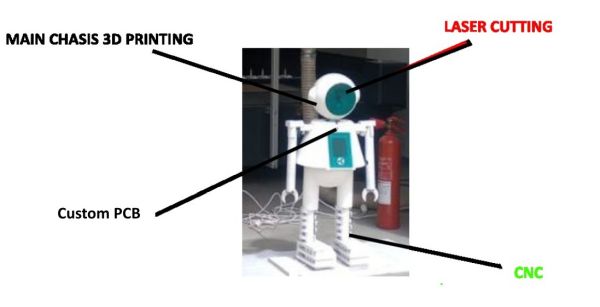
The following table summarizes the manufacturing process used for each major component of the FABI robot. This provides a clear overview of how the different fabrication techniques introduced during Fab Academy were applied throughout the project.
| Robot Component | Manufacturing Process | Material | Fab Academy Week |
|---|---|---|---|
| Main chassis | 3D printing | PLA | Week 10 – Output Devices |
| Arms and joints | 3D printing | PLA | Week 10 – Output Devices |
| Decorative panels | Laser cutting | Acrylic / MDF | Week 8 – Computer-Controlled Cutting |
| Electronic enclosure | 3D printing | PLA | Week 10 – Output Devices |
| Custom PCB | PCB milling and soldering | FR-1 | Week 6 – Electronics Production |
| Mechanical supports | CNC machining | Plywood | Week 7 – Computer-Controlled Machining |
| User interface housing | 3D printing | PLA | Week 15 – Interface and Application Programming |
The diagram below maps each robot subsystem to its corresponding fabrication process.
Questions That Need To Be Answered
- How to simplify the mechanical system?
- How to improve the robot interaction?
- How to make the packaging cleaner?
- How to optimize power consumption?
- How to improve reliability for the final presentation?
How Will FABI Be Evaluated?
The project will be considered successful if:
- The robot detects nearby people.
- The lights react correctly.
- The arms move correctly.
- The MQTT communication works reliably.
- The robot structure is stable.
- The electronics are integrated safely.
- The final appearance looks like a finished product.
Presentation Drafts and Cost File
Placeholder files for the final presentation and the project cost spreadsheet have already been prepared.
| File | Description | Link |
|---|---|---|
| presentation.png | Final project summary slide. | Open presentation image |
| presentation.mp4 | Final project presentation video. | Watch presentation video |
| coste.xlsx | Project cost calculation spreadsheet. | Open cost spreadsheet |
Summary and Reflection
This week helped me organize the final development of FABI as a complete integrated system. The project combines many skills learned during Fab Academy, including electronics, embedded programming, digital fabrication and networking.
The biggest challenge now is achieving a reliable and visually attractive integration between all systems while keeping the robot simple enough to finish on time.
FABI is evolving from an initial idea into a complete prototype that combines technology, creativity and interaction.
Credits and Acknowledgements
- Project design and development: Oscar Cela Cobo.
- Fab Lab support: Fab Lab León / Fab Lab Ponferrada.
- MQTT and Node-RED integration tests developed during Fab Academy assignments.
- English translation and documentation support were assisted with ChatGPT.
- All fabrication, tests and integration work were reviewed and adapted by me.