WEEK 18 APPLICATIONS AND IMPLICATIONS / PROJECT DEVELOPMENT
At this stage of the course, this week's assignment is fully focused on the final project.
The goal for this week is to provide the following information about it:
Plan a final project masterpiece that integrates the range of units covered, answering:
What will it do?
Once installed, my project is designed to prevent the daily water waste that occurs at every hot water tap while waiting for the water to actually come out hot after opening the valve.
Who's done what beforehand?
Yes, there are already similar systems on the market, such as Grundfos, that use cold water pipes for temporary DHW (Domestic Hot Water) recirculation. The difference is that they usually consist of large pumps and semi-manual setups. My system aims to be more compact, completely plug-and-play, and features an electronic control that allows the user to operate it much more efficiently.
What sources will you use?
My main inspiration comes from the Domestic Hot Water (DHW) recirculation systems already in use worldwide, but modified so that it can be retrofitted into an existing plumbing installation without any structural changes.
What will you design?
Except for the standard hydraulic components, which I will purchase and assemble myself, the entire system is my own design. This includes the electronics, the support bracket and enclosure, the remote control, and the protective covers to seal everything.
What materials and components will be used?
The main enclosure will be 3D printed using PLA filament, the remote control will be crafted from wood, and the protective covers will be laser-cut from acrylic (plexiglass).
The electronic components used are:
- Microcontroller: 1x Seeed Studio XIAO RP2040
- Motor Drivers: 2x Toshiba TB67H451FNG,EL
- Voltage Regulator: 1x 5V / 1A LM2940CT-5.0/NOPB
- Power Connector: 1x CONN PWR Jack 2.5X5.5MM Solder
- Sensor: 1x NTC Thermistor (10kΩ, 3750K, 1206 package)
- Display: 1x 0.96 Inch OLED Display Module SSD1306 I2C
- Button: 1x Button PBS-110 NO
- Passives & Hardware: Assorted connectors, capacitors, and resistors
The hydraulic components used are:
- 24V DC Circulation Pump
- 24V DC Electric Water Valve
Where will they come from?
The standard plumbing parts will be sourced from Saltoki supply warehouses. The water pump and the valve will be purchased from Amazon.
How much will they cost?
The hydraulic assembly is the most expensive part of the system, while the custom electronics and control components are highly cost-effective. Below is the detailed breakdown:
1. Hydraulic & Plumbing Components
| Item | Description | Source | Cost |
|---|---|---|---|
| Water Pump | 24V DC Circulation Pump | Amazon | €30.49 |
| Solenoid Valve | 24V DC Electric Water Valve | Amazon | €29.99 |
| Plumbing Hardware | Assorted fittings, adapters, and hoses | Saltoki | €19.35 |
| Subtotal: | €79.83 | ||
2. Electronic Components
| Item | Description | Source / Link | Cost |
|---|---|---|---|
| Seeed Studio XIAO RP2040 | Main Microcontroller Board | AliExpress | €4.99 (*) |
| NTC Thermistor | Temperature Probe Sensors | Mouser Electronics | €0.09 |
| CONN PWR Jack 2.5X5.5MM Solder | Power Barrel Connector Jack 2.50mm ID (0.098"), 5.50mm OD (0.217") Through Hole, Right Angle | Digikey | €0.83 |
| Driver Toshiba TB67H451FNG,EL | 2 x Motor/Motion/Ignition Controllers & Drivers 50V/3A Brush Mtr Drv | Mouser Electronics | €2.28 |
| Regulator LM2940IMPX-5.0/NOPB | Linear Voltage Regulator IC Positive Fixed 1 Output 1A SOT-223-4 | Digikey | €1.61 |
| 0.96 Inch OLED Display Module SSD1306 I2C | 0.96 Inch OLED Display Module SSD1306 I2C IIC SPI Serial 128X64 GND VCC SCL SDA LCD Screen Board | AliExpress | €0.92 |
| Button PBS-110 NO | 5PCS Small Round Button Switch PBS-110 NO PBS-111 NC 2Pin Self-resetting Button Switch 7MM Miniature | AliExpress | €0.40 |
| TOTAL COST: | €11.12 | ||
(*) Note on Component Sourcing and Shipping Costs: While I personally acquired the Seeed Studio XIAO via AliExpress with free shipping to optimize development costs, the official benchmark price should consider the official Seeed Studio Store. When purchasing a single unit from their store, international shipping fees to Spain practically double the total acquisition cost of the microcontroller (increasing from ~€5 to around €11-€12). For a realistic and official replication of this project, these shipping constraints must be taken into account.
Total Estimated Project Cost: ~ €100.95 (adding €10 for 3D printing and raw wood/acrylic materials sourced directly from the FabLab inventory).
What parts and systems will be made?
I will design and manufacture the entire electronic control board and all structural components, including the main enclosure, protective covers, and supports. The only parts that will be purchased off-the-shelf are the standard plumbing and hydraulic components.
What processes will be used?
The manufacturing of the project will involve several digital fabrication processes:
- 3D Printing (Additive Manufacturing): The main enclosure and internal mounting brackets will be 3D printed using PLA filament.
- CNC Milling (Subtractive Manufacturing): The remote control housing will be precision-milled from wood.
- Laser Cutting: The protective covers will be laser-cut from acrylic (plexiglass) sheets.
- PCB Fabrication & Assembly: The custom electronic control board will be CNC-milled (isolation routing), followed by manual component soldering (SMD and through-hole).
What questions need to be answered?
The primary questions and critical challenges that need to be answered and tested during development are:
- Form Factor and Integration: Can all components be successfully integrated into a relatively small space while remaining accessible?
- Hydraulic Integrity: Are the custom-assembled plumbing connections completely secure and free of water leaks under operational pressure?
- Electronic Reliability: Does the custom control board, along with the sensors and drivers, function correctly and execute the recirculation logic as intended?
How will it be evaluated?
The success of the project will be evaluated based on the following milestones:
- Electronic Validation: The custom control board must power up safely and the microcontroller must execute the firmware code without stability issues.
- Interface and Remote Control: The remote control unit must reliably communicate with the main system and accurately trigger its corresponding functions.
- Hydraulic and Thermal Performance: The system must successfully drive the water flow through the plumbing loop, and the temperature sensor must accurately detect the heat rise to stop the pump when the water is hot.
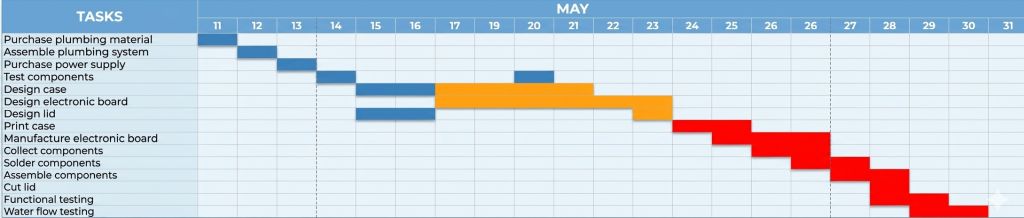
Gantt chart
Initial slide draft + video storyboard
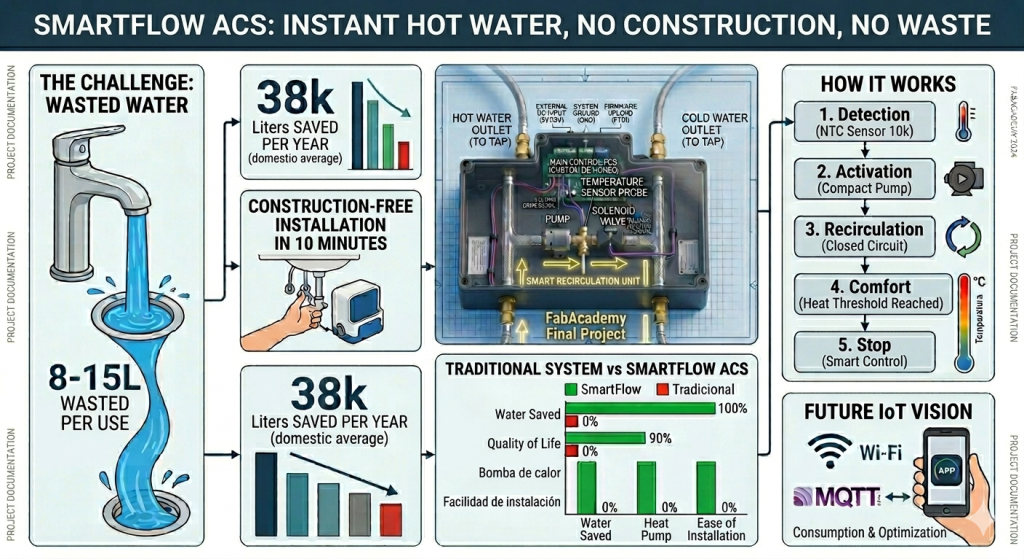
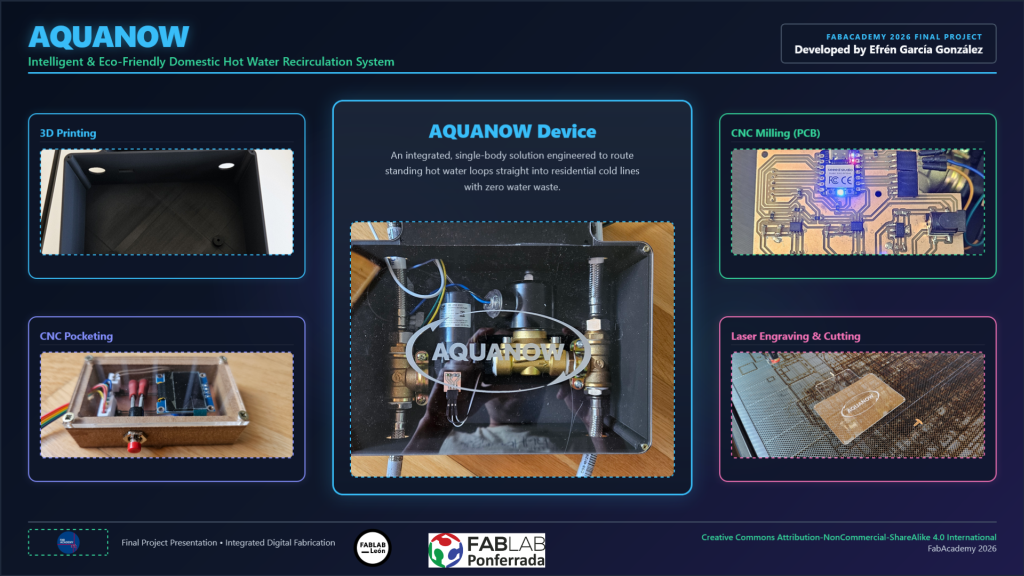
The slides were created with the help of Gemini.
The first version was 100% AI-generated, while the second version incorporated real project images.
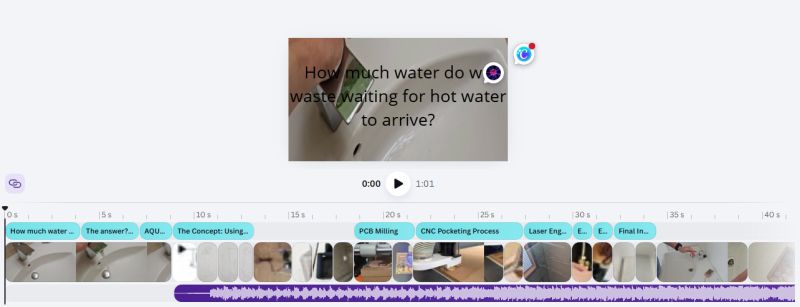
Similarly, the initial video was generated by Gemini, but the final video was put together using Canva with real photos and video footage.
Initial slide
Final slide
Initial video