What I did in Week 14
This week, we will apply molding and casting techniques to create a decorative Christmas tree-shaped candle. We will design a mold using 3D printing, manufacture a silicone mold, and cast paraffin to obtain the final product.
Group page
Group page linkIntroduction
The molding and casting process consists of manufacturing parts through the fabrication of molds and the pouring of materials that subsequently solidify.
This technique is widely used in prototyping, manufacturing, and decorative product fabrication, as it enables the accurate reproduction of specific geometries.
In this practice, a decorative candle in the shape of a Christmas tree was produced. To achieve this, a silicone mold was previously designed and fabricated from a 3D-printed model.
Additionally, a PLA counter-mold was used to provide structural support during the casting process. Finally, the mold was utilized to cast molten paraffin wax and obtain the final piece.
Materials
- Christmas tree design
- 3D printer
- PLA filament
- Fine-grit sandpaper
- Silicone rubber
- Catalyst
- Vacuum pump
- PLA-printed counter-mold
- Paraffin wax
- Green dye
- Wick
- Metallic container
- Heat source
- Protective gloves
Development
- The Christmas tree design was selected, and the file was prepared for 3D printing.
- The figure was printed, and its surface was inspected and sanded to improve the finish and remove imperfections. Three different grits of sandpaper were used: 100, 400, and 1200, ensuring a smooth surface.
- A PLA counter-mold was designed and printed to support the mold during the process.
- The silicone rubber mixture was prepared with its corresponding catalyst.
- The printed figure was aligned inside the counter-mold.
- The silicone mixture was poured, completely covering the piece.
- The assembly was placed in a vacuum pump chamber to remove air bubbles.
- The mold was left to cure until complete solidification was achieved.
- The figure was demolded, obtaining the flexible mold.
- The paraffin wax was melted in a metallic container.
- Green dye was added and mixed uniformly.
- The wick was positioned at the center of the mold.
- The liquid paraffin was poured into the mold and left to cool.
- Finally, the finished candle was removed from the mold.

Results
A functional silicone mold was successfully obtained for the reproduction of the piece.
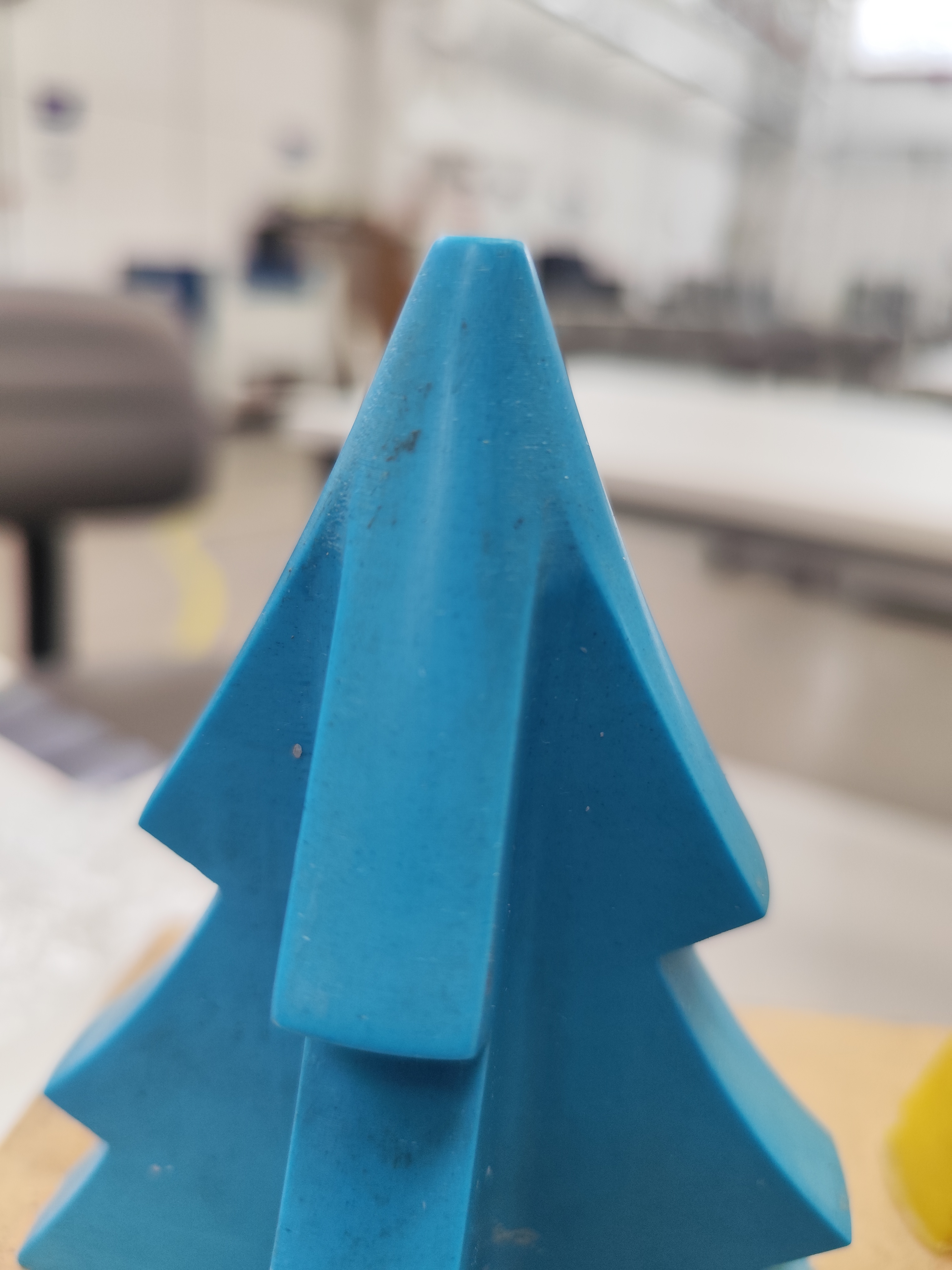
The manufactured candle presented a well-defined Christmas tree shape, a uniform green color, and an appropriate surface finish, accurately preserving the details of the original design.

Conclusions
This practice provided a practical understanding of the molding and casting process through the fabrication of a decorative candle with customized geometry.
The use of 3D printing facilitated the accurate manufacturing of both the master model and the counter-mold, while the silicone material enabled the production of a flexible, durable, and reusable mold.
Furthermore, the paraffin wax successfully reproduced the details of the original design, resulting in a functional candle with an appropriate surface finish and decorative characteristics.
← Main Page