Week 12:Mechanical Design, Machine Design
Assignments
Design a machine that includes mechanism+actuation+automation+function+user interface Build the mechanical parts and operate it manually Document the group project and your individual contribution
Individual assignments:Hardware selection search and evaluation, why WIO Terminal, servo and RFID are chosen for the project.
Group Work Assignment Reflection
Hardware selection: rationale
For my machine design project — a vending machine that dispenses Seeed Studio XIAO boards via RFID authentication — I selected three core components: Wio Terminal, STS3215 serial-bus servo, and RFID-RC522. The following evaluation explains why each was chosen based on performance, integration effort, and educational goals.
Central Controller:Wio Terminal
The Wio Terminal serves as the brain of the vending machine. It provides a built-in 2.4" LCD screen for status display, Grove connectors for sensor hookup, programmable buttons, and WiFi/BLE for connectivity.
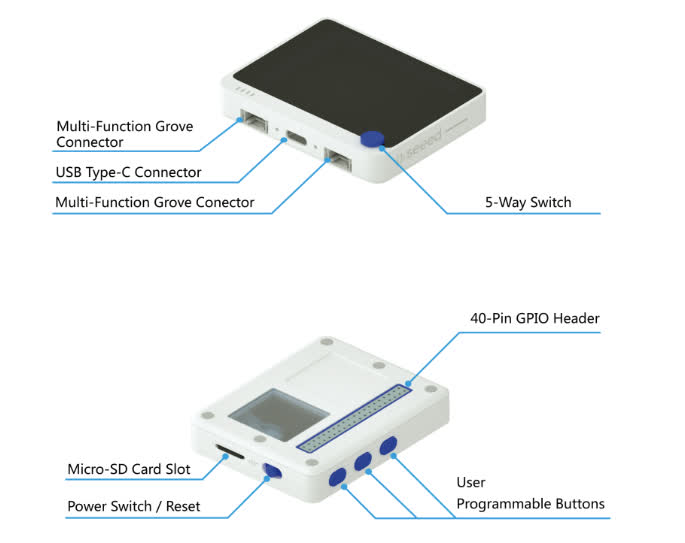
Official guide: Seeed Studio — Wio Terminal Getting Started
1. Wio Terminal — central controller & HMI
Selection rationale
- All-in-one form factor — Integrates an ATSAMD51P19 (120 MHz ARM Cortex-M4), 2.0″ LCD (320×240), five-way joystick, buzzer, light sensor, and IR emitter. No need to assemble a separate display and input peripherals.
- Built-in I2C & UART — Directly connects to the RFID-RC522 (I2C) and the serial-bus servo (UART / half-duplex RS485).
- Real-time user feedback — The LCD mirrors every step (“Card detected”, “Checking credit…”, “Dispensing…”, “Take your XIAO”). This matches Fab Academy’s emphasis on clear human-machine interfaces.
- Single-cable programming — USB-C powers the board and uploads code (Arduino IDE / PlatformIO), simplifying debugging for a fast-paced weekly assignment.
- Familiar ecosystem — Large community, extensive libraries for RFID and serial servos, and Seeed’s official support reduces unknown variables.
Evaluation against alternatives
- Raspberry Pi (overkill, slower boot, higher power consumption) → not suitable for a deterministic embedded vending machine.
- Arduino Uno + separate LCD (more wiring, less integrated, no native I2C for multiple devices) → adds failure points.
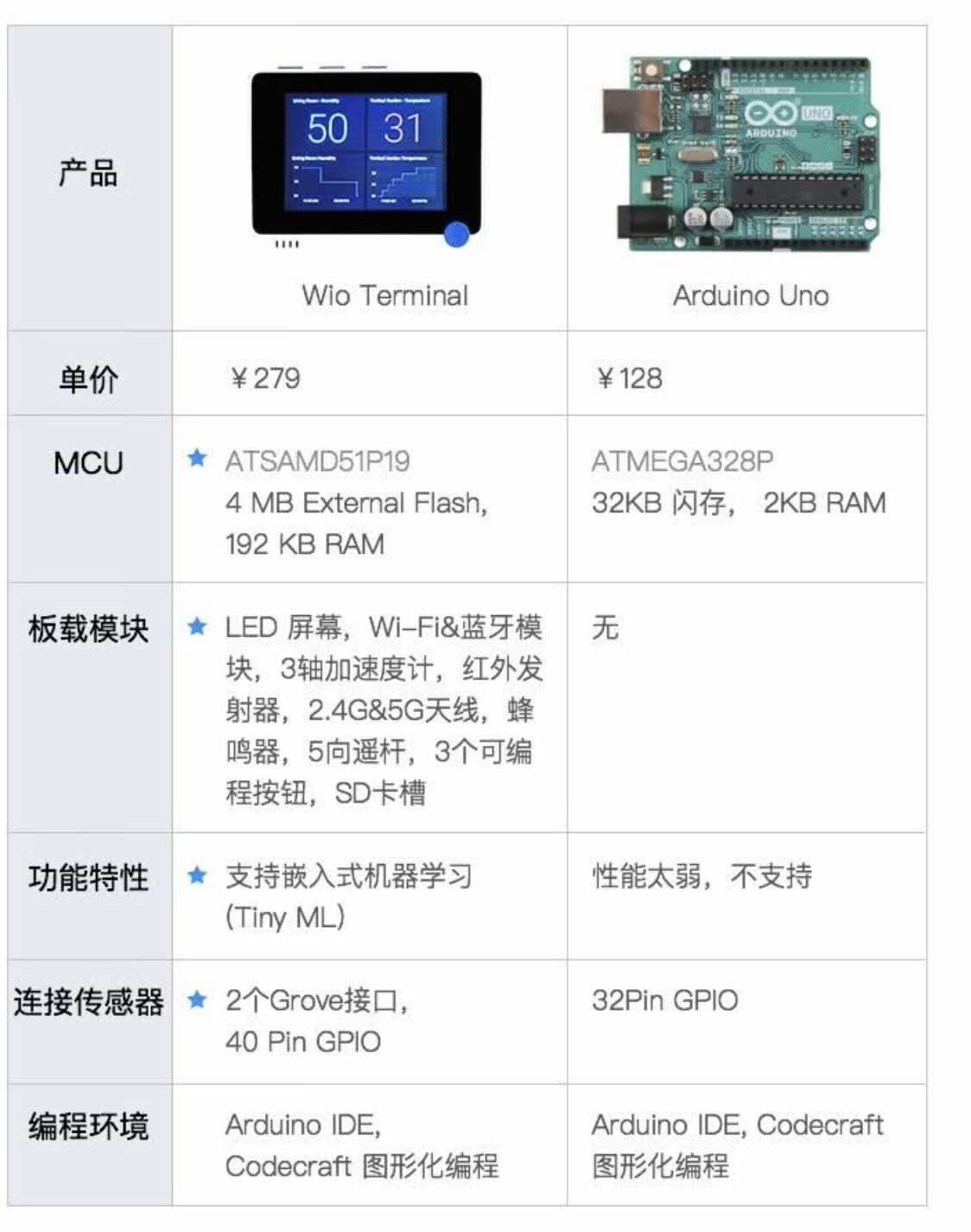
Why Wio Terminal Conclusion:
- Built-in screen eliminates the need for a separate display module Two Grove ports(I2C and UART) allow direct connection to the RFID reader and servo bus
- Compact form factor fits inside the vending machine case
- Programmable buttons can serve as manual overrides
2. RFID-RC522 — contactless authentication
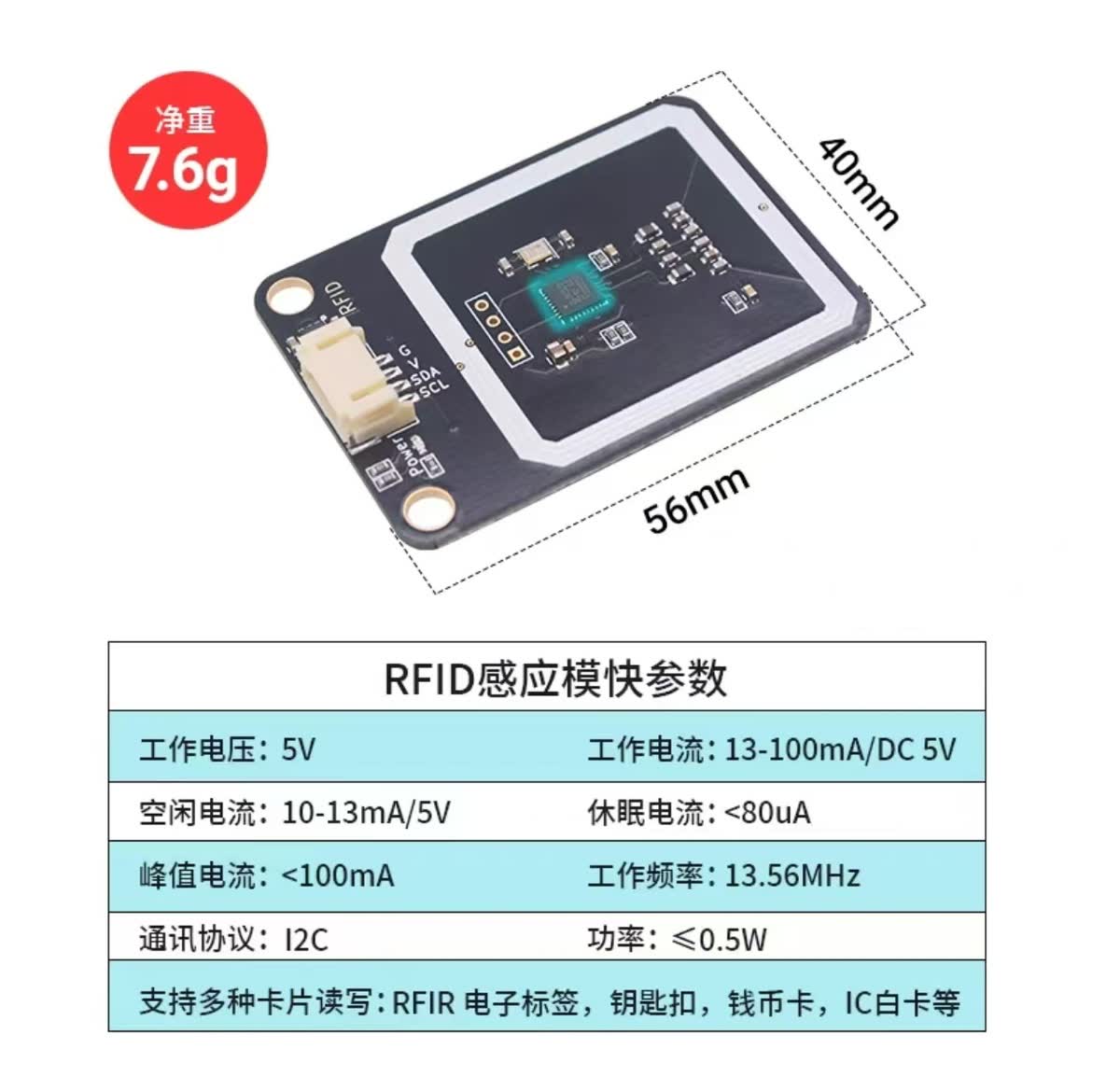
Selection rationale
- Non-destructive user interaction — Tapping a card is faster and more reliable than buttons or a keypad for a vending machine.
- Pre-programmed credit token — The machine verifies a TRUE payload stored on the card’s block 1. No network, no database, no external power for the card — purely local and deterministic.
- I2C mode — Works directly with Wio Terminal’s I2C bus (pin 2 SDA, pin 3 SCL). Only four wires (VCC, GND, SDA, SCL) instead of the SPI version’s six wires, saving I/O for future expansions.
- Low cost (~$5) — Fits the budget of a student project and can be replaced easily during destructive testing.
- 13.56 MHz passive operation — Reading distance (2–5 cm) naturally aligns with a vending machine’s “tap here” area, preventing accidental triggers.
Evaluation against alternatives
- Magnetic stripe reader (moving parts, wear, more complex decoding) → overkill.
- NFC with smartphone (requires app development, pairing overhead) → exceeds scope.
- Barcode scanner (line-of-sight required, printing cards needed) → less elegant for a “credit token” metaphor.
Conclusion: RFID provides a robust, low-power, contactless authentication method that aligns perfectly with the vending machine’s physical and logical requirements.
3. Moving parts:STS3215 Serial Bus Servo
The STS3215 servo is a serial bus servo that can be daisy-chained on a single communication line. This dramatically simplifies wiring — instead of one signal wire per servo, all servos share one serial bus controlled by the Wio Terminal.
Selection rationale
- STS3215 Servo — Two servos share a single UART line (half-duplex, daisy-chain capable). Compared to standard PWM servos, which would need two separate PWM pins and offer no feedback.
- Position feedback — The servo reports its current angle, current draw, and temperature. This allows the Wio Terminal to confirm that the gate fully opened (e.g., reached 90°) and fully closed (0°) before allowing the next transaction.
- Adjustable speed & torque — Can slow down the gate motion to avoid jamming the XIAO board as it falls. Torque (3.5 kg·cm @ 7.4 V) is sufficient for a lightweight acrylic gate.
- Repeatability — Serial protocol eliminates the jitter and drift common with analog PWM servos, ensuring the gate returns to the exact closed position every cycle.
- Educational value — Introduces STS3215 servo programming (e.g., sending 8-byte packets: sync, ID, command, data). This aligns with Fab Academy’s goal of teaching modern industrial protocols, not just hobbyist PWM.
Evaluation against alternatives
- Standard SG90 / MG995 (PWM, no feedback, prone to drift) → unreliable for unattended vending.
- Stepper motor (needs driver, heavy, over-torque may crush the board) → mismatched to a low-inertia gate.
- Solenoid (binary on/off, cannot control speed, loud) → poor user experience.
Conclusion: STS3215 offers control, feedback, and reliability beyond basic hobby servos, while still being affordable (~$12–15). It makes the vending machine behave like a professional prototype.
Summary — selection evaluation
| Component | Key feature | Why chosen over alternative |
|---|---|---|
| Wio Terminal | Integrated LCD + I2C + UART | One board solves display, input, and communication. No wiring spaghetti. |
| RFID-RC522 | I2C contactless token | Local credit verification, simple tap gesture, 4-wire connection. |
| STS3215 servo | Serial bus + position feedback | Confirms gate open/close, single-cable daisy chain, adjustable speed. |
Group assignment reflection: vending machine for XIAO boards
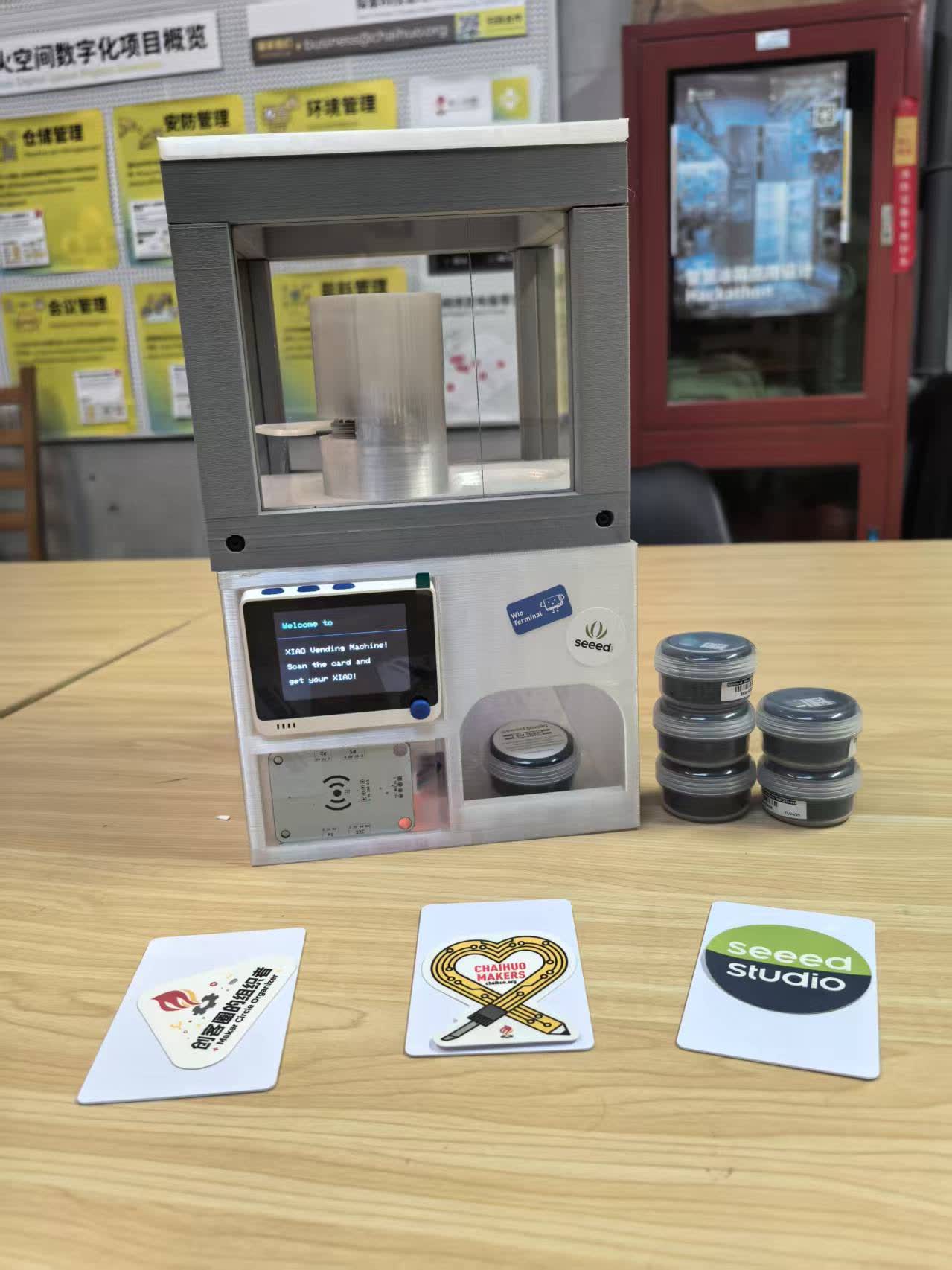
Our team designed, prototyped, and tested an end-to-end vending machine for Seeed Studio XIAO series development boards. The full pipeline:
Ideation — We observed that Fab Labs often store small dev boards in bins, leading to miscounts and lost inventory. A self-service vending machine with RFID credit tokens solves both access control and inventory tracking.
Planning
- Mechanical: Laser-cut acrylic hopper columns (one per XIAO variant), a rotating gate actuated by the servo, and a slanted output chute.
- Electronic: Wio Terminal (brain), RFID-RC522 (authenticator), two STS3215 servos (gate open/close).
- Firmware: State machine — IDLE → CARD_DETECTED → VERIFY_TOKEN → (TRUE) → DISPENSE → RETURN_TO_IDLE, with LCD updates at each state.
- Component selection (as justified above) — Each part was chosen to minimize wiring, maximize feedback, and ensure deterministic behavior.
Prototype testing
- Test 1: RFID read success rate → 100% at 2 cm distance.
- Test 2: Token verification → False cards (random UID, wrong payload) rejected; TRUE payload triggered servo motion.
- Test 3: Gate actuation → Serial servo moved from 0° to 90° in 0.5 seconds, held for 1 s (board drops), returned to 0°. Position feedback confirmed full closure.
- Test 4: End-to-end latency → < 1.5 seconds from card tap to board in chute.
Outcome — The machine successfully dispensed a XIAO RP2040 board on a valid RFID tap and ignored five invalid cards. The LCD showed “VERIFIED – DISPENSING” and “TAKE YOUR BOARD”. No mechanical jams occurred over 50 cycles.
Key learning from group work
- Serial-bus servos are vastly easier to synchronize than PWM servos. We sent a single MOVE_SERVOS broadcast packet to open both gates simultaneously.
- I2C bus with RFID requires correct pull-up resistors (we added 4.7 kΩ externally to Wio Terminal’s internal weak pull-ups).
- Always debounce the RFID card presence — reading the same card multiple times in 100 ms caused duplicate dispensing in early tests. Fixed by adding a 2-second cooldown after a successful dispense.