Assignment items

Group assignment

Individual assignment

Fab Academy Rubric — Have you?
The criteria evaluators look for this week (Mechanical Design).


Tools

The process

Group assignment — clay 3D printer


This week was about designing a machine. We had two weeks to complete it, and the main challenge remained being a remote student joining the team in Saudi Arabia from Kuwait. We split the work between us: I built the mechanical 3D-printing base and bed — which moves up / down via worm gears and rotates 360° — while my colleagues at the VujaDé Lab worked on the X / Y mechanics and the end-effector for the clay-printer head.

Full team write-up is here: Open the team's Group Assignment on Notion ↗

My contribution — printer bed: Z-axis + rotation


After consulting the FabLab instructors at Global Hours, I chose to contribute by adapting one of my previous projects — the multi-gear / worm-gear assembly shared on Week 02. The mechanism converts a single central motor into synchronised Z-axis motion on four corner pillars (so the bed stays level as it rises) plus a separate rotation drive (so the bed can spin 360° clockwise and counter-clockwise).
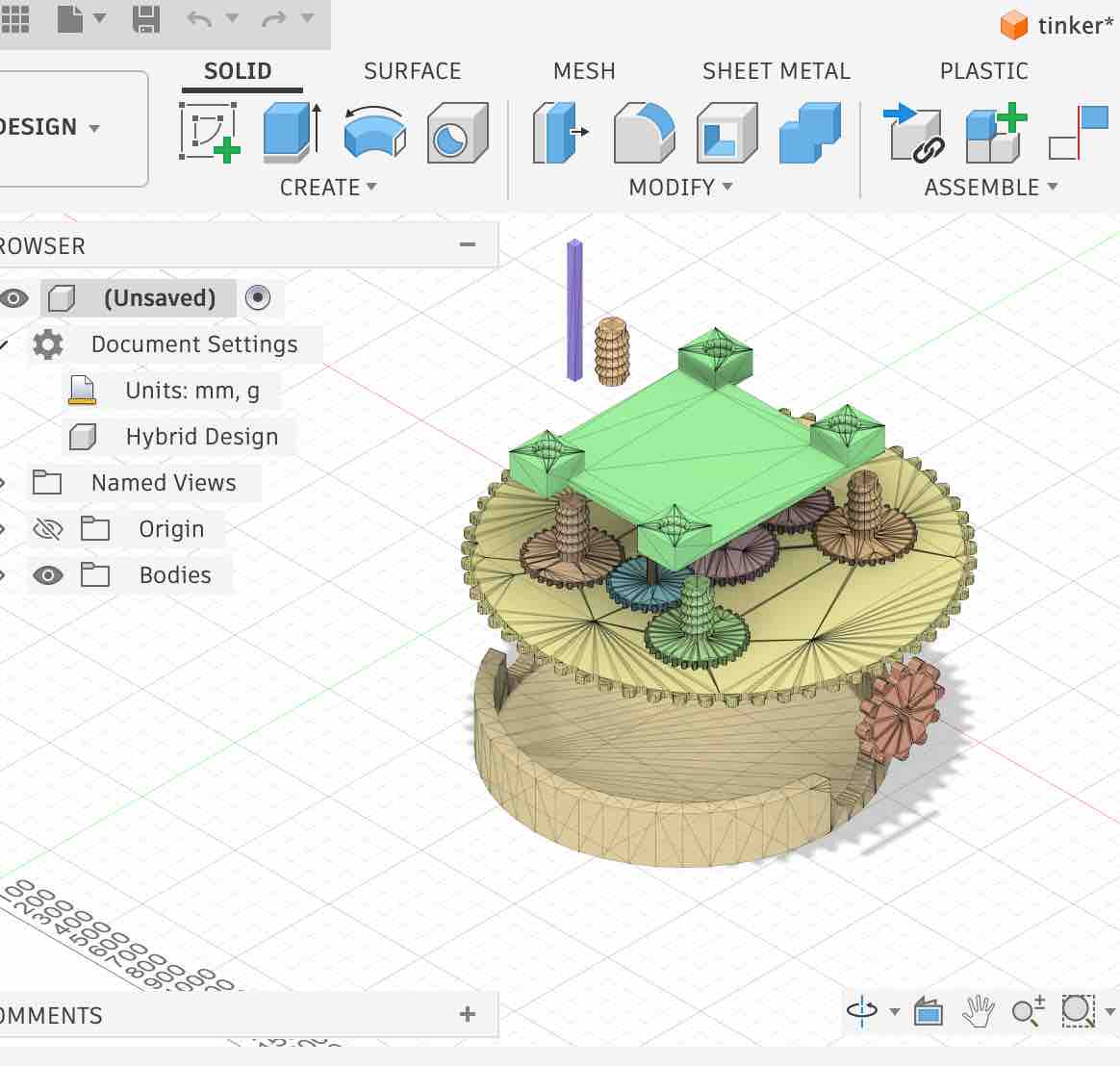
Original Fusion 360 multi-gear / worm-gear prototype

01 | This is the prototype I designed shared on Week 02 — Computer-Aided Design (original file: Gears.zip) with multiple gears and worm gears. I'm reusing it here as the basis for the printer-bed drive.
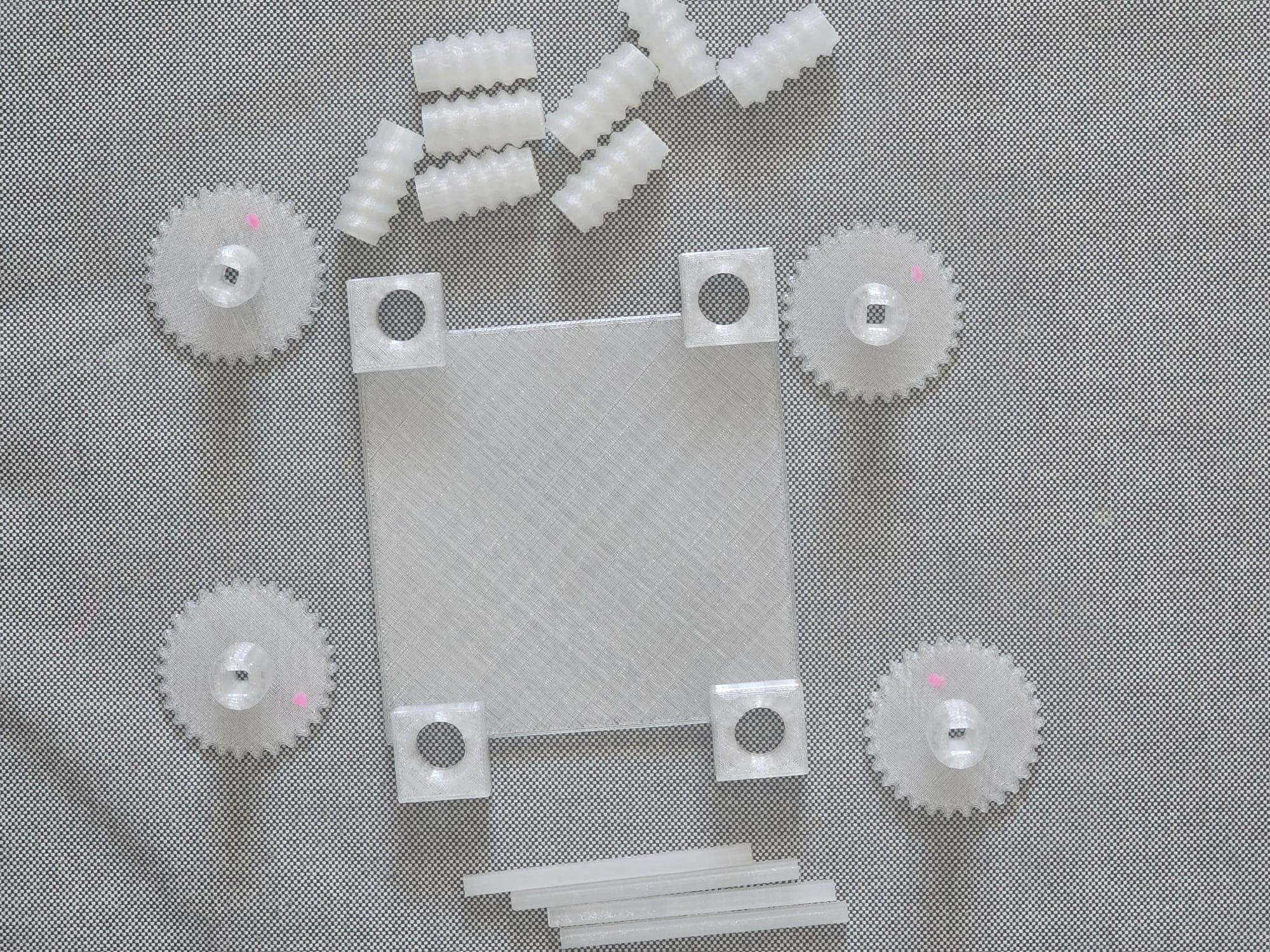
Worm gears, stabilising pillars and the bed plate

02 | These are the printer's worm gears, the four stabilising pillars, and the bed plate that will hold the print. The main reason for using worm gears is more precise vertical movement — although they could be even more precise with a tighter tooth pitch, the current pitch is enough for clay-print layer heights.
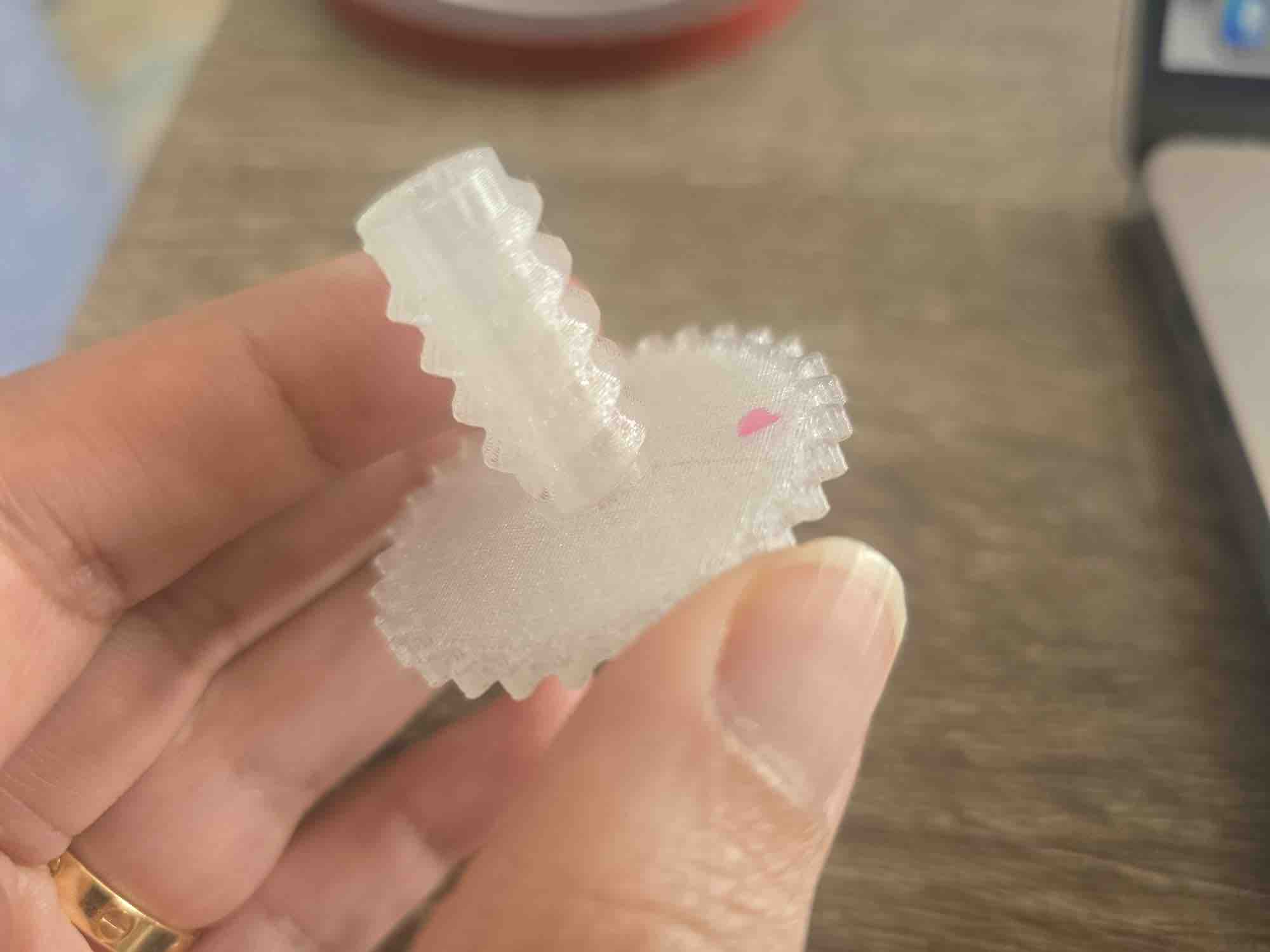
Worm gear attached to the pillar drive gear

03 | In the design phase, I attached one of the worm gears to the gear responsible for that pillar's movement, then duplicated the same assembly for all four pillars to guarantee identical motion — so the bed rises and lowers without tilting.
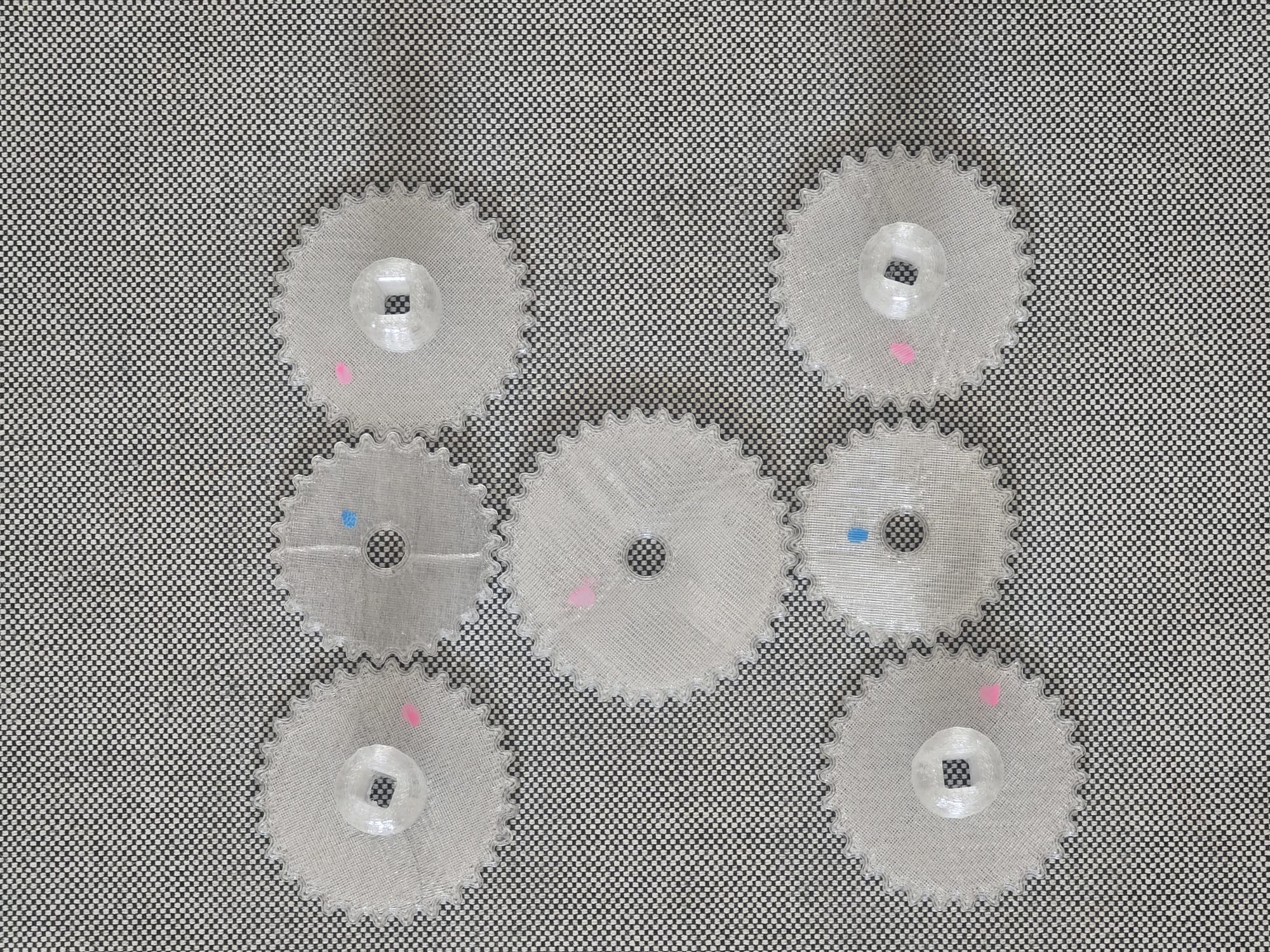
Main gear train driving the four pillar worm gears

04 | These are the main gears that turn the four pillar worm gears, raising and lowering the print bed together. I've marked the ones that rotate in the same direction in matching colours (pink, blue). The gear sizes are chosen so all four pillars turn in the same direction and at the same speed. The blue gears mainly act as idlers — they fill the spatial gap between the central motor-driven gear in the middle and the four outer pillar gears.
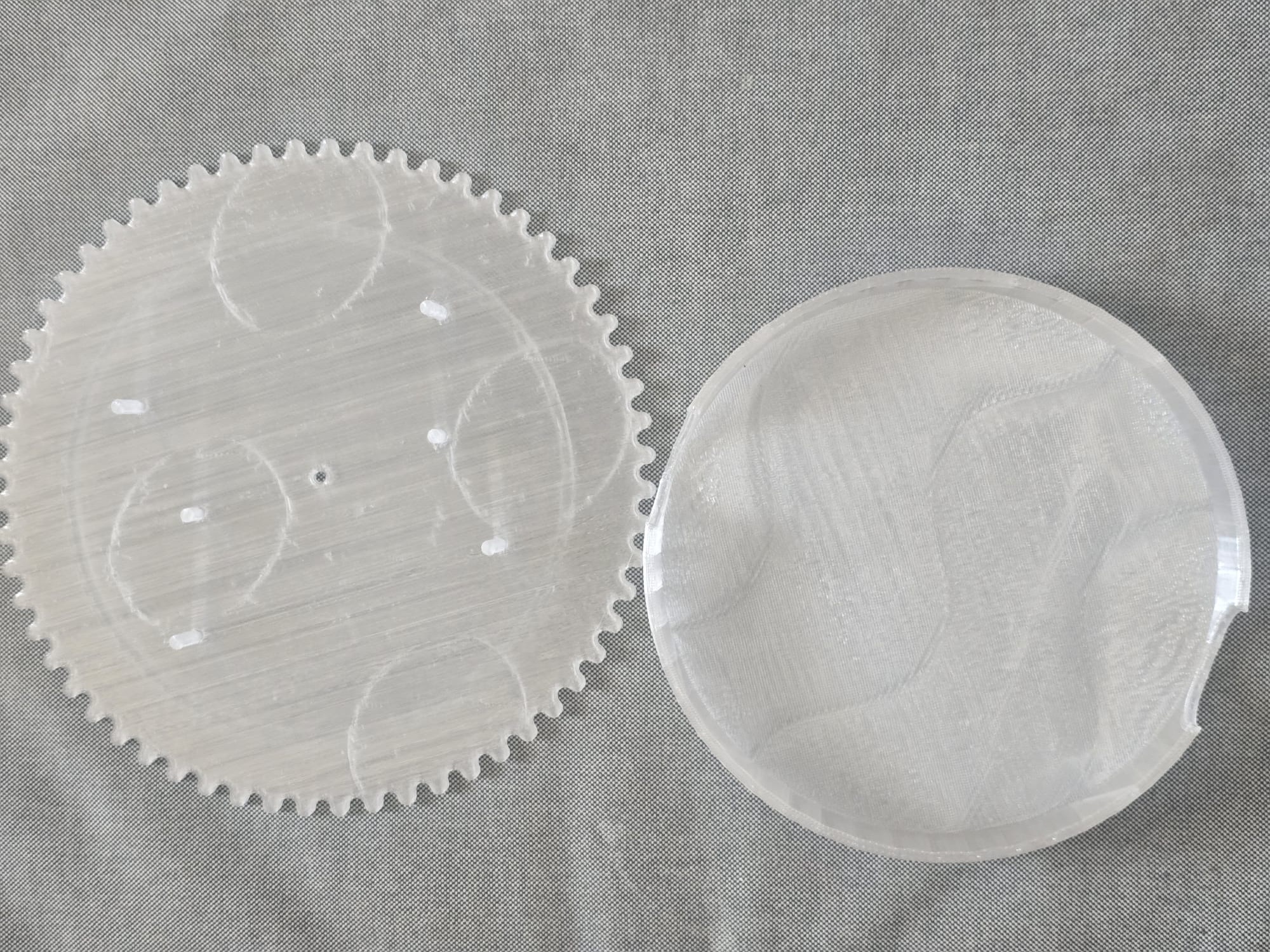
Base plate holding the motor, wires and main gears

05 | This is the base plate that holds the motor and the wires inside, plus the main gears that drive the bed up and down. The bed also has a ring gear on its side that connects to a second motor for 360° rotation — both clockwise and counter-clockwise.

What an achievement!
  • Feedback: It wasn't an easy week, but contributing a real mechanical sub-assembly — Z-axis drive + rotation — to a clay 3D printer that I couldn't physically touch. I learned a lot from how my VujaDé Lab colleagues handled the X / Y mechanics and the end-effector side.
  • Challenge: Being a virtual student to the lab is not easy — even when I joined online, the hands-on learning experience isn't the same as being on the bench. I'm looking forward to setting up my own lab in Kuwait so future remote weeks aren't this constrained.Musaed was not able to help with his part getting the motors on and programing them.

Reflection

What worked
  • Reusing the multi-gear / worm-gear assembly from W02 as the basis for the Z-axis drive — meant I could focus the week on mechanism integration instead of starting parametric CAD from scratch.
  • Splitting the machine cleanly between team members: I owned the Z-axis bed and rotation, my VujaDé Lab colleagues owned the X / Y motion and the end-effector. Clear interfaces made remote collaboration tractable.
  • Using four corner worm-gear pillars driven from one central motor for the Z-axis — synchronised motion keeps the bed level, which matters for clay-print layer adhesion.
  • Colour-coding gear rotation directions during design (pink / blue) made it visually obvious whether the gear train would turn the four pillars in the same direction and at the same speed.
What didn't
  • Being a remote student is the hardest part. I couldn't physically test how the printed gears mesh, how the worm-gear backlash feels, or whether the pillars stay level under real load — all of which would have been a quick bench-check in person.
  • Worm-gear precision could be tighter — a finer tooth pitch would give better Z-axis resolution for thin clay layers, but the print time grows with tooth count.
  • I didn't fully document the motor torque , that part should have been done by our college Musaed who due to his work obligations, he couldnt do complete.
What I'd do differently
  • Document the motor / gear-train torque calculations alongside the CAD, not after.
  • Set up a small local lab in Kuwait so future hands-on weeks don't depend on cross-border lab access.
Key learnings
  • Mechanical design is about interfaces. Splitting a clay printer into Z+rotation / XY / end-effector is only possible because each sub-assembly has a clear mechanical interface. Getting those interfaces right matters more than any individual part.
  • Worm gears trade speed for torque and precision — and they self-lock when the motor stops, which is useful for a Z-axis that has to hold position without continuous power.
  • Synchronised four-corner drive from a single motor is mechanically simpler (and electrically cheaper) than four independent motors with software-synchronised motion — at the cost of mechanical complexity in the gear train.
  • Reusing prior CAD is one of the most powerful design moves available. A library of small mechanisms compounds over time and shortens every later project.
  • Remote contribution to a hands-on machine project is feasible if interfaces are clean and someone in-lab can do the physical iteration — but it doubles the design overhead compared to being on the bench yourself.