Week 19 Progress Checklist
| Status | Task |
|---|---|
| ✓ | Created a dissemination plan for your final project |
| ✓ | Outlined future possibilities and described how to make them probabilities |
| ✓ | What tasks have been completed, and what tasks remain? |
| ✓ | What's working? what's not? |
| ✓ | What questions need to be resolved? |
| ✓ | Planned what will happen when? |
| ✓ | What have you learned? |
Invention, Intellectual Property and Income
Final Project slide
Final Project Video Clip
1. About the Final Project
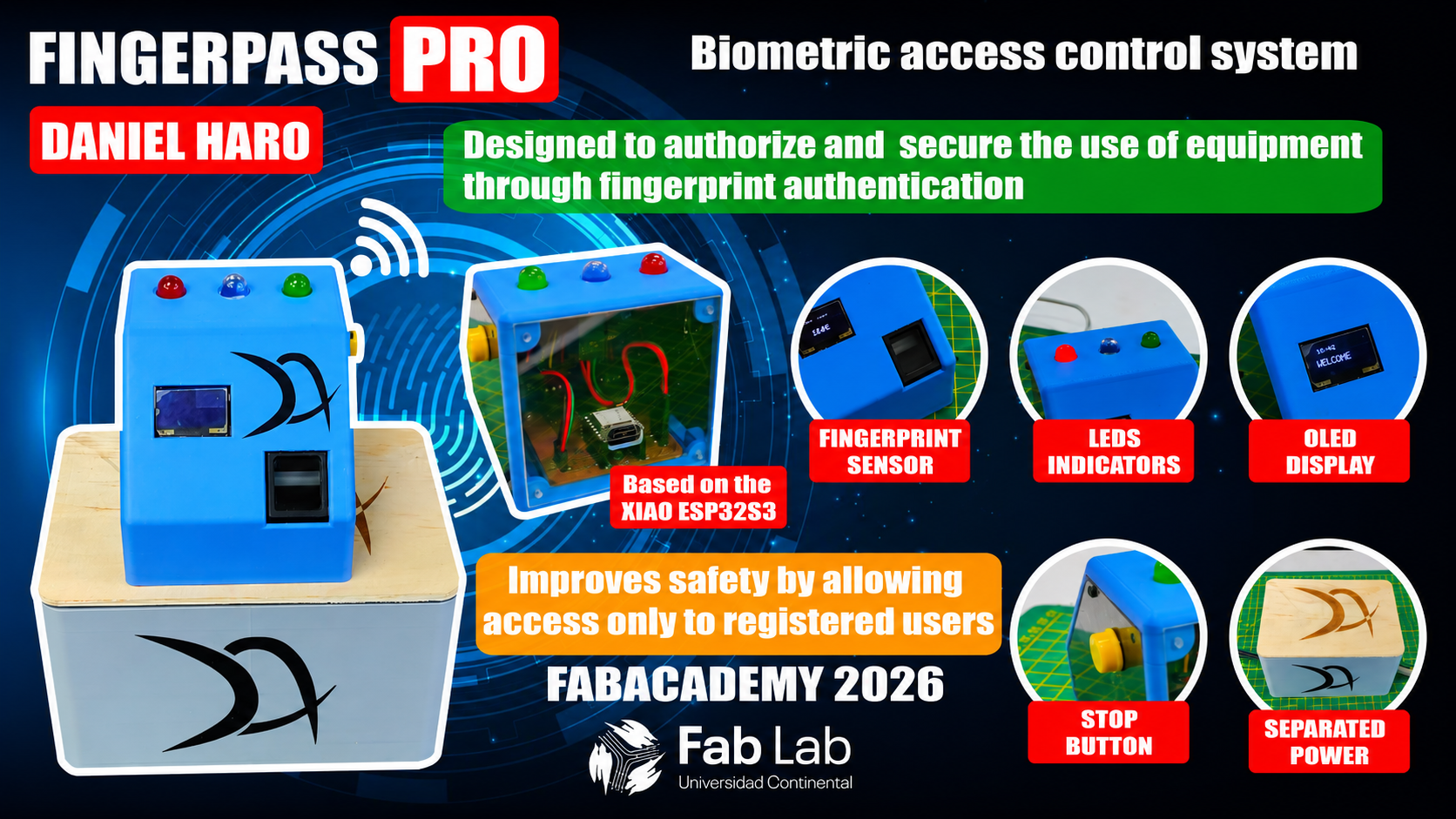
My main page contains detailed documentation about the entire project development process, including the 3D enclosure design, CNC machining process, electronic schematics, PCB production, embedded programming, wireless communication system, and final assembly of the laboratory equipment access control system.
All important files and technical information are provided so that other people can reproduce, study, or further develop the project. The purpose of this work is mainly educational, focusing on secure machine access using fingerprint authentication and wireless control with XIAO ESP32S3 modules. While I do not currently intend to expand the project into a larger product or platform, I believe the shared documentation can serve as a useful starting point for anyone interested in adapting or improving the system for their own applications.
2. Dissemination Plan
The purpose of this dissemination plan is to communicate the design, implementation, and benefits of the fingerprint-based laboratory equipment access control system to stakeholders who may benefit from improved equipment security, user accountability, and controlled access to laboratory resources.
2.1 Target Audience
- Laboratory managers and supervisors
- Engineering and technology faculty members
- Laboratory technicians
- Students and researchers
- University administrators
- Organizations interested in laboratory automation and security systems
2.2 The Plan to Disseminate
1. Implement the system in the FabLab UC
Deploy the prototype in the FabLab environment and evaluate its performance with real users. Gather feedback from laboratory staff and users to identify improvements.
2. Extend the system to additional equipment
Adapt the access control system for different laboratory machines that require controlled access. Evaluate compatibility with various types of equipment and operating conditions.
3. Conduct demonstrations for other departments
Organize presentations and live demonstrations for laboratories and departments that use critical or expensive equipment. Showcase the benefits of secure access control, equipment protection, and user accountability.
4. Present the project at academic events
Share the project at university exhibitions, engineering fairs, or research conferences. Prepare posters, presentations, and demonstration materials to reach a wider audience.
5. Publish project documentation
Make the technical report, user manual, and system architecture available to students, faculty, and laboratory managers. Facilitate future replication and improvement of the system.
6. Train laboratory personnel
Provide training sessions for technicians and administrators on system operation, user enrollment, and maintenance. Ensure successful long-term adoption of the technology.
7. Collect feedback and evaluate impact
Monitor system usage and gather user feedback after deployment. Use the results to guide future improvements and wider implementation.
2.3 Dissemination Plan Schedule
In order to complete the dissemination plan, a schedule was created to organize the activities and ensure that all tasks are completed effectively and on time.

3. Future Possibilities and How to Make Them Possible
These future developments would transform the current prototype into a more comprehensive laboratory equipment management system.
3.1 Web-Based User Management
Laboratory administrators could manage users and permissions through a web interface rather than directly accessing the hardware.
How to make it possible:
- Create a web application hosted on a local server or cloud platform.
- Connect the ESP32 modules to the database through secure APIs.
- Implement administrator authentication and access control features.
3.2 Access Logging and Usage Reports
The system could record who used each machine, when it was accessed, and for how long.
How to make it possible:
- Store access events in a local or cloud database.
- Synchronize timestamps using a network time server.
- Develop software to generate usage reports and statistics.
3.3 Mobile Monitoring and Notifications
Laboratory managers could monitor equipment access remotely and receive notifications about unauthorized access attempts.
How to make it possible:
- Develop a mobile application or web dashboard.
- Implement notification services through email or mobile alerts.
- Store and analyze system events in real time.
4. Licensing
This project, including the electronic designs, PCB layouts, embedded programming, 3D models, fabrication files, and documentation, is shared under the Creative Commons Attribution-NonCommercial-ShareAlike 4.0 International (CC BY-NC-SA 4.0) license.
The project may be copied, modified, adapted, and redistributed for educational and non-commercial purposes, provided that proper credit is given, any modifications are indicated, and derivative works are distributed under the same license. Commercial use of the project or any part of it is not permitted without permission.