Week 18 Progress Checklist
| Status | Task |
|---|---|
| ✓ | What will it do? |
| ✓ | Who has done what beforehand? |
| ✓ | What sources will you use? |
| ✓ | What will you design? |
| ✓ | What materials and components will be used? |
| ✓ | Where will they come from? |
| ✓ | How much will they cost? |
| ✓ | What parts and systems will be made? |
| ✓ | What processes will be used? |
| ✓ | What questions need to be answered? |
| ✓ | How will it be evaluated? |
| ✓ | Uploaded summary slide (placeholder) |
| ✓ | Uploaded video clip (placeholder) |
| ✓ | Checked they are linked in the final presentation schedule |
Applications and Implications, Project Development
1. What will it do?
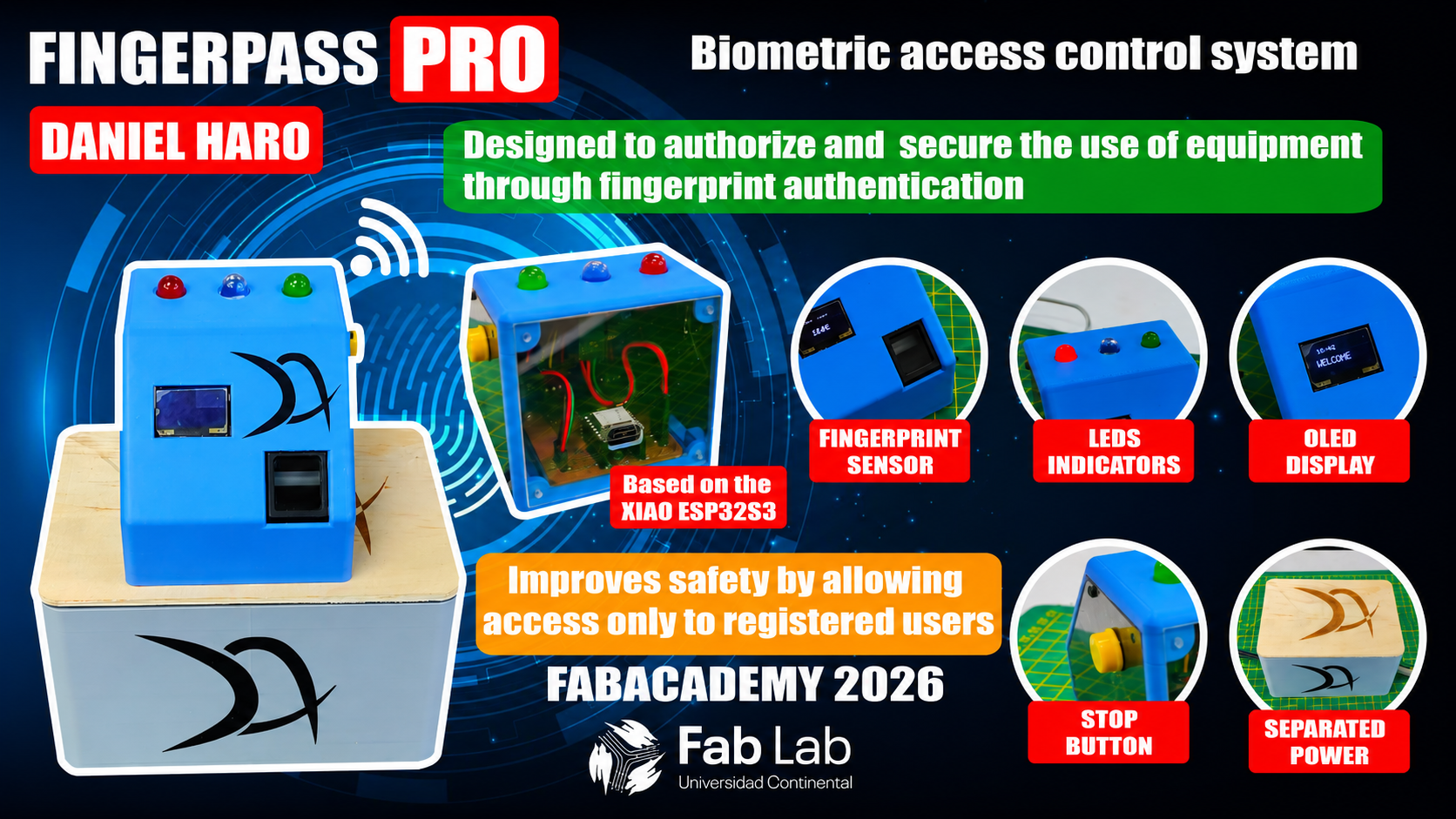
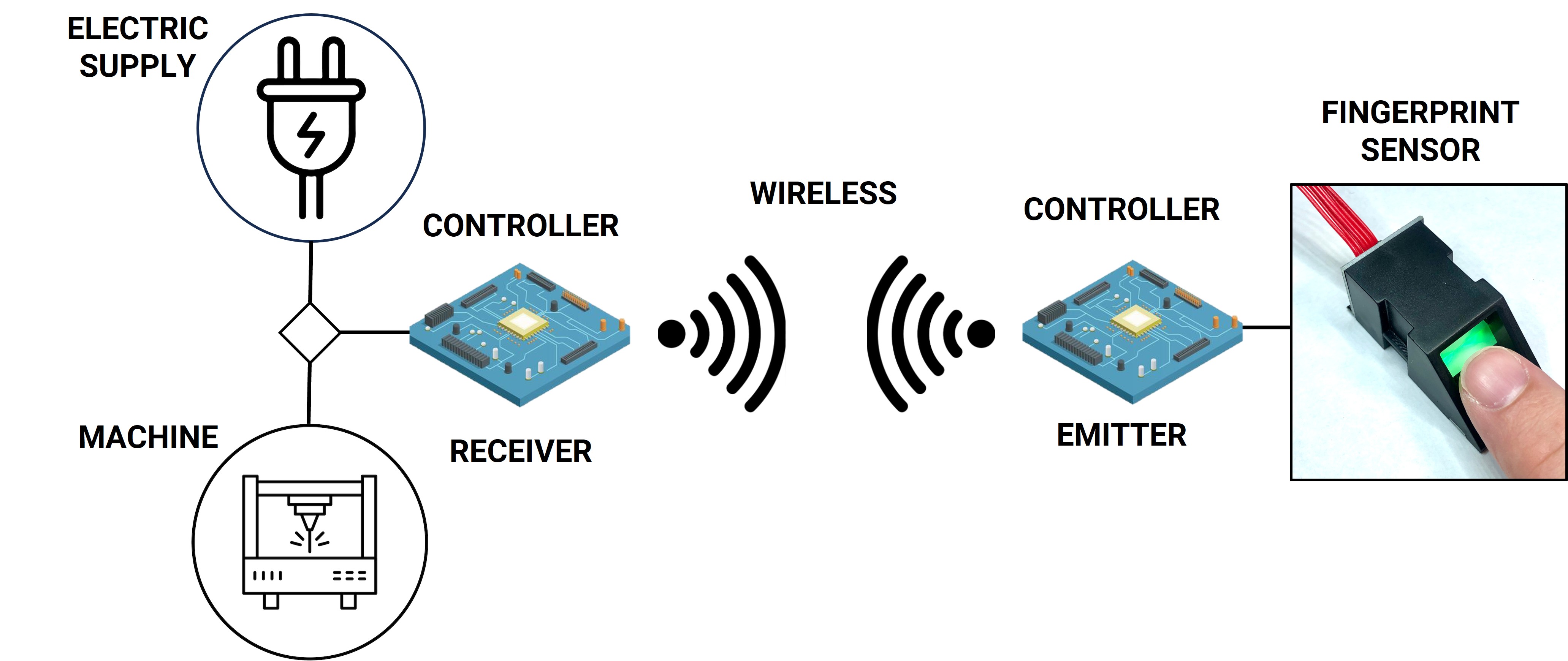
The system will control access to laboratory equipment by allowing only authorized users to operate specific machines. It uses a fingerprint sensor to identify users and verify whether they are permitted to use the equipment. If the fingerprint is recognized and authorized, the system enables the power supply of the machine through a solid-state relay. If the user is not authorized, the equipment remains turned off. The system is divided into two wireless modules based on the XIAO ESP32S3. The first module handles fingerprint detection and user authentication, while the second module controls the machine’s power supply. Both modules communicate through Wi-Fi to ensure secure and reliable operation of laboratory equipment.
2. Who has done what beforehand?
Many researchers, companies, and makers have previously developed access-control and safety systems for laboratories, industrial equipment, and secure facilities. Existing solutions commonly use technologies such as RFID cards, passwords, biometric authentication, and fingerprint sensors to restrict access to authorized users only.
3. What sources will you use?
The project will use several sources of information and technical resources to support the design and development process. These sources include datasheets, official documentation, and previous projects related to biometric authentication and wireless control systems.
Official documentation and examples for: XIAO ESP32S3 from Seeed Studio
Adafruit Fingerprint Sensor Library: Git Hub Repository
Previous Fab Academy projects and tutorials on biometric authentication and wireless control systems for reference and inspiration.
FabSafe — Biometric Machine Access Control: By Jhonatan Cortes
Access Control System for Fab Lab Machines: By Kone Zie Souleymane
Smart Tool Cabinet: By Nadec Biju
4. What will you design?
I designed a wireless access-control system for fabrication laboratory equipment. The system is intended to improve safety by ensuring that only authorized users can operate potentially dangerous machines. The design consists of two main modules based on the XIAO ESP32S3. The first module includes a fingerprint sensor used to identify and authenticate users. When a fingerprint is scanned, the system verifies whether the user is authorized to use the equipment. The second module controls the power supply of the machine through a solid-state relay. If the user is successfully authenticated, this module enables the power to the equipment. Otherwise, the machine remains turned off. Both modules communicate wirelessly using Wi-Fi, allowing the authentication system and the power-control system to work together securely and efficiently.
5. What materials and components were used?, Where did they come from?, and How much did they cost?
| Nro | Item | Buy Link | Qty | Cost(USD) | Total(USD) |
| 1 | Seeed XIAO ESP32-S3 | Seeed Studio | 2 | $7.50 | $15.00 |
| 2 | FingerPrint Sensor | AliExpress | 1 | $8.00 | $8.00 |
| 3 | OLED 128x64 Display (SSD1315) | AliExpress | 1 | $2.00 | $2.00 |
| 4 | Package Female-to-Female Jumper | Amazon | 1 | $7.00 | $7.00 |
| 5 | 330Ω Resistors | Digikey | 5 | $0.34 | $1.70 |
| 6 | 10kΩ Resistor | Digikey | 5 | $0.34 | $1.70 |
| 7 | 0Ω Resistor | Digikey | 5 | $0.34 | $1.70 |
| 8 | PLA Filament (Blue) | AliExpress | 1 | $25.00 | $25.00 |
| 9 | PLA Filament (Grey) | AliExpress | 1 | $25.00 | $25.00 |
| 10 | 2 mm Acrylic Sheet (Black) | AliExpress | 1 | $5.00 | $5.00 |
| 11 | 2 mm Acrylic Sheet (White) | AliExpress | 1 | $5.00 | $5.00 |
| 12 | 17 mm Plywood Sheet | AliExpress | 1 | $4.00 | $4.00 |
| 13 | Diode led Green | AliExpress | 1 | $0.30 | $0.30 |
| 14 | Diode led Blue | AliExpress | 1 | $0.30 | $0.30 |
| 15 | Diode led Red | AliExpress | 1 | $0.30 | $0.30 |
| 16 | Push Button | AliExpress | 1 | $1.00 | $1.00 |
| Total | $103.00 | ||||
8. What parts and systems will be made?
- Fingerprint-based user authentication system
- Wireless machine access control modules using XIAO ESP32S3
- Equipment power control using solid-state relay
- Wi-Fi communication system between modules
- Authorized user verification and permission management
- Laboratory equipment protection and access restriction system
- Embedded control logic for secure machine operation
- Integrated fingerprint detection and machine activation system
9. What processes will be used?
| Process | How It Is Covered in the Project |
| 2D and 3D Design | I designed the 3D case for the main board using Onshape, including mounting points for the OLED display and fingerprint sensor. The page layout and icons were designed in Illustrator. Circuit schematics and PCB layouts were created using Altium Designer. |
| Additive and Subtractive Fabrication | The project involved both additive and subtractive fabrication processes. Additive fabrication was used to produce the custom enclosure and mounting components through 3D printing, designed in Onshape to fit the OLED display, fingerprint sensor, and electronic modules. Subtractive fabrication techniques were used during PCB production and mechanical preparation of the structure. A CNC router was used to create pocketing features to securely hold the second control board and the solid-state relay inside the enclosure. The electronic circuits and PCB layouts were designed using Altium Designer to integrate the XIAO ESP32S3 modules, fingerprint sensor, OLED display, and solid-state relay into a compact and reliable system. |
| Electronics Design | The electronic system was designed using Altium Designer to create the schematics and PCB layouts for both wireless modules based on the XIAO ESP32S3. The first module integrates the fingerprint sensor and OLED display for user authentication and system feedback, while the second module controls the machine power supply through a solid-state relay. The design focused on reliable communication, compact integration, and safe operation of laboratory equipment through Wi-Fi-based authorization control. |
| Electronics Production | The PCBs were produced using a CNC router for precise milling and cutting of the circuit boards. After fabrication, the electronic components were soldered and assembled, including the XIAO ESP32S3 modules, fingerprint sensor, OLED display, and solid-state relay. The boards were then tested to ensure reliable communication and proper operation of the laboratory equipment access control system. |
| Embedded Programming | The embedded programming was developed for both XIAO ESP32S3 modules to manage user authentication and equipment control. The first module handles fingerprint detection, user verification, and OLED display feedback, while the second module controls the solid-state relay responsible for enabling or disabling the machine power supply. Communication between the modules was implemented through Wi-Fi to ensure secure and reliable operation of the laboratory equipment access control system. |
| System Integration and Packaging | The system was integrated by combining the two XIAO ESP32S3 wireless modules, fingerprint sensor, OLED display, solid-state relay, and custom PCB assemblies into a single functional access control system. All components were installed inside a custom enclosure designed in Onshape to provide protection, stable mounting, and organized cable management. The final assembly was tested to ensure reliable communication between modules, accurate user authentication, and safe control of laboratory equipment power access. |
10. What questions need to be answered?
- How reliable is the fingerprint authentication system in daily laboratory use?
- What is the maximum communication range between the two wireless modules?
- How secure is the Wi-Fi communication against unauthorized access?
- How quickly does the system respond when an authorized user is detected?
- Can the system support multiple users and different access permissions?
- How stable is the solid-state relay during continuous machine operation?
- What happens if the Wi-Fi connection is interrupted during equipment use?
- How durable is the enclosure and mounting system under laboratory conditions?
- Can the system be expanded to control multiple laboratory machines simultaneously?
- How can the system be improved for easier maintenance and future upgrades?
11. How will it be evaluated?
- Successful fingerprint recognition and user authentication
- Correct authorization of approved users only
- Reliable activation and deactivation of the machine power supply
- Stable Wi-Fi communication between both XIAO ESP32S3 modules
- Fast system response time during user verification
- Safe operation of the solid-state relay under continuous use
- Accurate OLED display feedback and system status indication
- Proper fitting and durability of the custom enclosure
- Reliable operation during repeated testing cycles
- Overall system stability and ease of use in laboratory conditions
12. Uploaded summary slide (placeholder)