Introduction
SpiruSense is an intelligent photobioreactor developed for the cultivation and monitoring of Limnospira platensis (spirulina). The project integrates digital fabrication, electronic design, embedded systems programming, Internet of Things (IoT), and system integration into a single device capable of monitoring and controlling critical cultivation variables in real time.
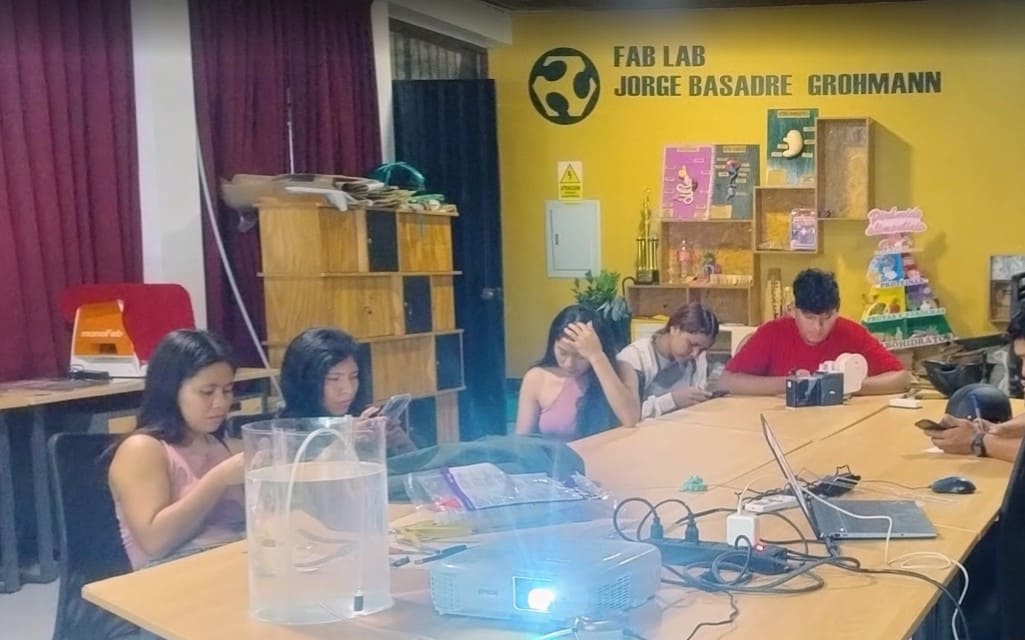
The project was developed as the final project of Fab Academy and seeks to offer an accessible and low-cost alternative for educational institutions, research laboratories, Fab Labs, and small spirulina producers.
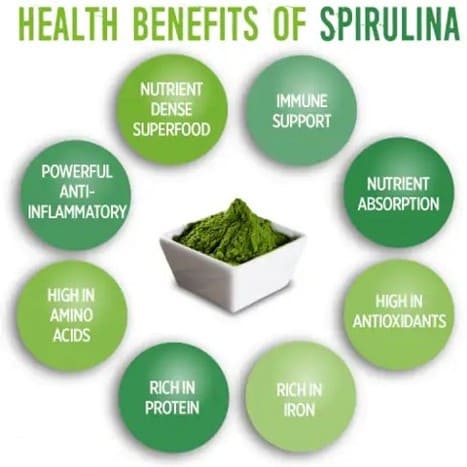
Img. 1: Properties of spirulina.
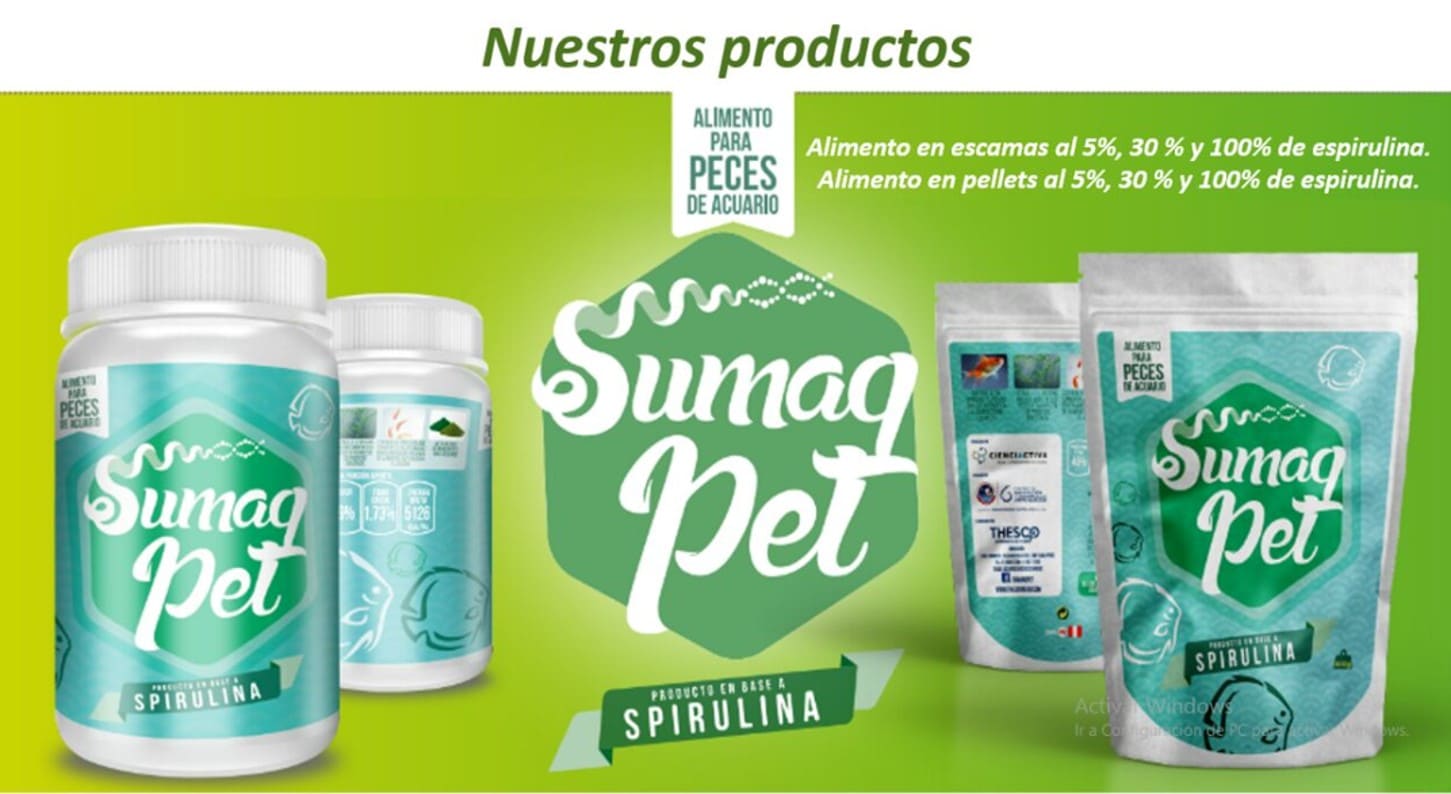
Img. 2: Balanced feed brand for fish developed by my entrepreneurship.
1) Dissemination Plan for the Final Project
Dissemination Plan
The objective of this plan is to present SpiruSense to potential users, collaborators, and institutions interested in microalgae cultivation, digital fabrication, and smart agriculture.
Target Audience
- Fab Labs and Makerspaces.
- Technical and university educational institutions.
- Research centers.
- Spirulina producers.
- Biotechnology researchers.
- Innovation and entrepreneurship programs.
Dissemination Strategies
| Activity | Objective |
|---|
| Publication on the Fab Academy page | Share the documentation and fabrication process. |
| Presentation at Fab Lab Jorge Basadre Grohmann | Show the operation of the system to students and visitors. |
| Social media posts | Increase project visibility. |
| Participation in innovation contests and events | Obtain feedback and growth opportunities. |
| Workshops and demonstrations | Promote the use of digital fabrication technologies applied to biotechnology. |
| Publication of open documentation | Facilitate replication and improvement of the project. |
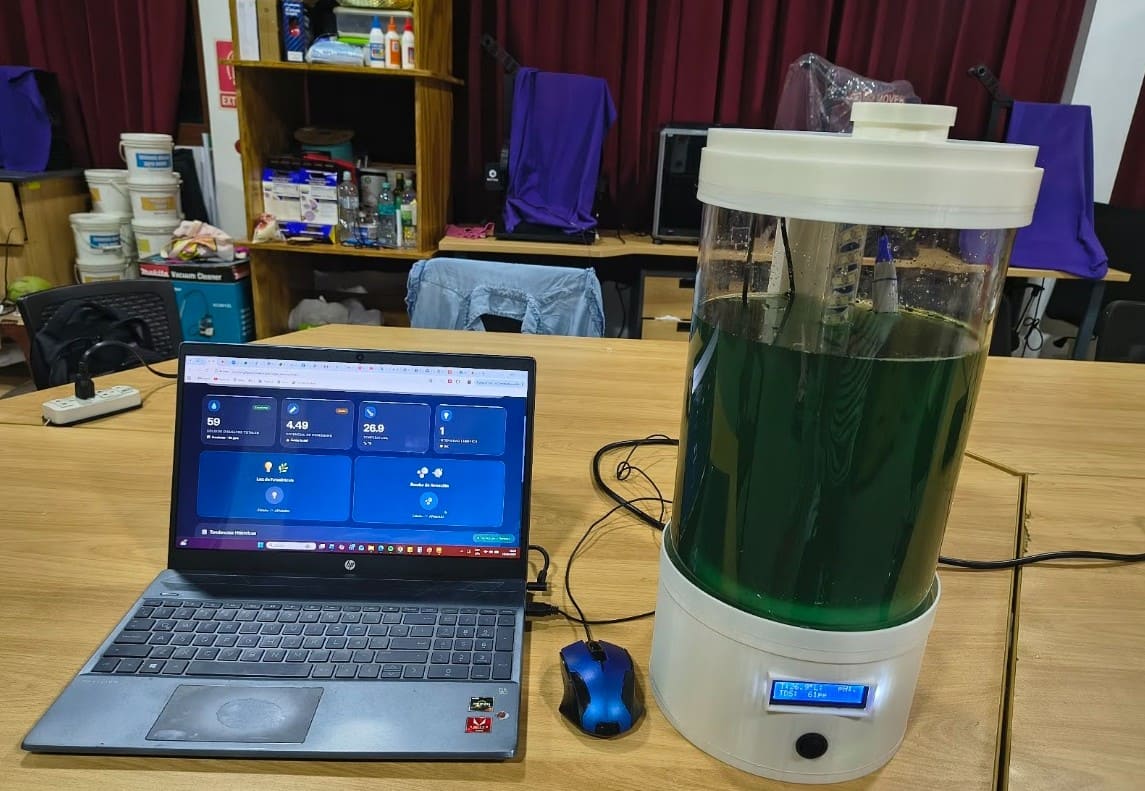
Img. 3: My final project is almost ready: an intelligent photobioreactor for spirulina cultivation.
Financing and Sustainability
The prototype was developed using Fab Lab resources and low-cost electronic components. In the future, the project could be strengthened through:
- Innovation funds.
- Incubation and acceleration programs.
- Agreements with research institutions.
- Alliances with spirulina producers.
- Commercialization of educational monitoring and cultivation kits.
2) Intellectual Property
The project is shared under an open knowledge philosophy, allowing other people to learn from the documentation and replicate the system, while always maintaining recognition of the original authorship.
Project License
SpiruSense will be shared under an open Creative Commons Attribution-NonCommercial-ShareAlike 4.0 International license (CC BY-NC-SA 4.0).
This license allows other people to study, use, adapt, and improve the project for educational and research purposes, as long as:
- Original authorship is recognized.
- It is not used for commercial purposes without authorization.
- Derivative works are shared under the same license.
In this way, collaboration, knowledge transfer, and open innovation are promoted within the maker, educational, and scientific community.
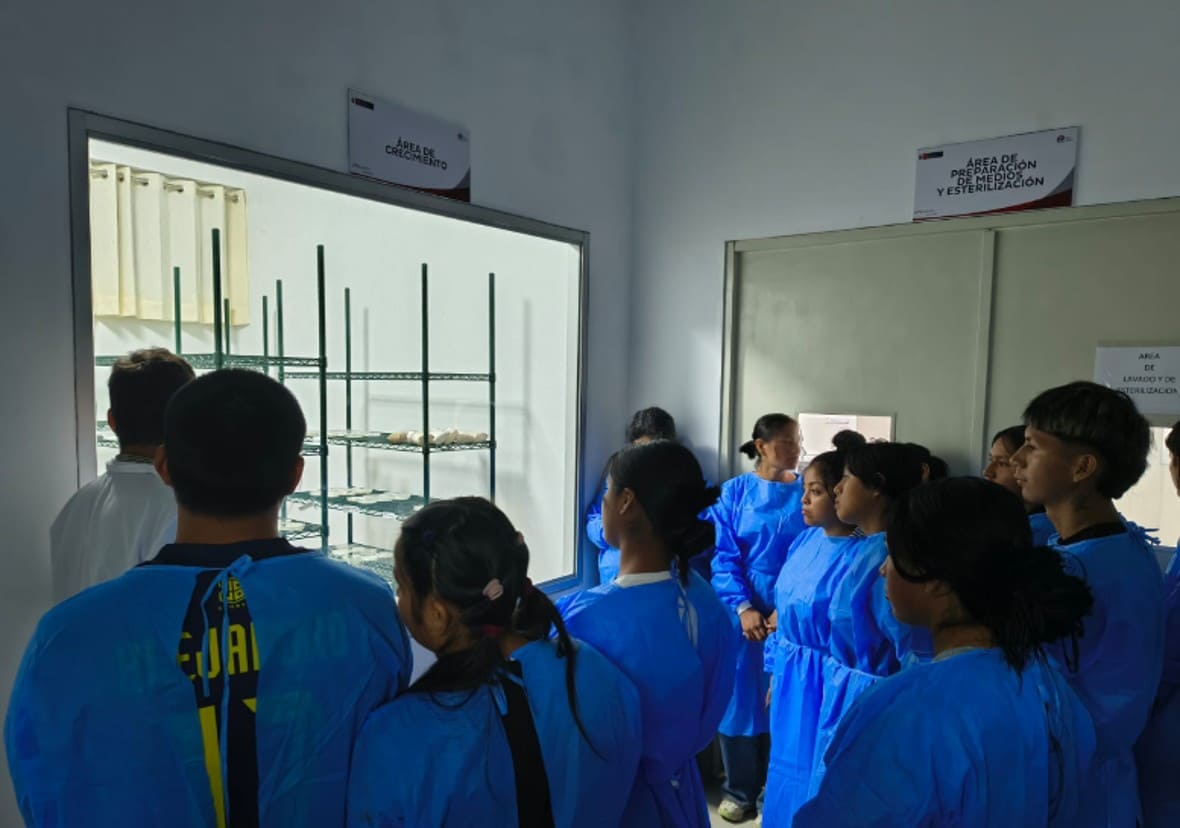
Img. 4: An alliance is planned with the biotechnology laboratory of CITE Productivo Madre de Dios.
Img. 5: An alliance is planned with Inti Pacha, the most recognized company in microalgae cultivation.
Open Source Nature
The documentation, CAD designs, electronic schematics, PCB, source code, and fabrication processes developed for SpiruSense may be shared for educational and research purposes.
The open source approach will allow other Fab Labs, educational institutions, and researchers to:
- Replicate the system.
- Adapt it to different types of cultures.
- Improve the hardware and software.
- Develop new functionalities.
- Generate derivative projects.
This model encourages international collaboration and facilitates the creation of new solutions based on digital fabrication technologies and the Internet of Things.
3) Future Possibilities and How to Make Them Real
Future Possibilities
Currently, SpiruSense allows monitoring of temperature, pH, TDS, and light intensity, as well as remote control of lighting and aeration.
Future improvements include:
- Automatic pH regulation.
- Automatic nutrient dosing.
- Dedicated mobile application.
- Growth prediction using artificial intelligence.
- Optical biomass estimation.
- Historical data analysis.
- Integration of multiple photobioreactors into a single platform.
How to Make Them Real
These possibilities can become real developments through:
- Continuous validation with real spirulina cultures.
- Collaboration with producers and researchers.
- Obtaining external funding.
- Development of new electronic and software versions.
- Data collection over long periods.
- Progressive scaling of the current prototype.
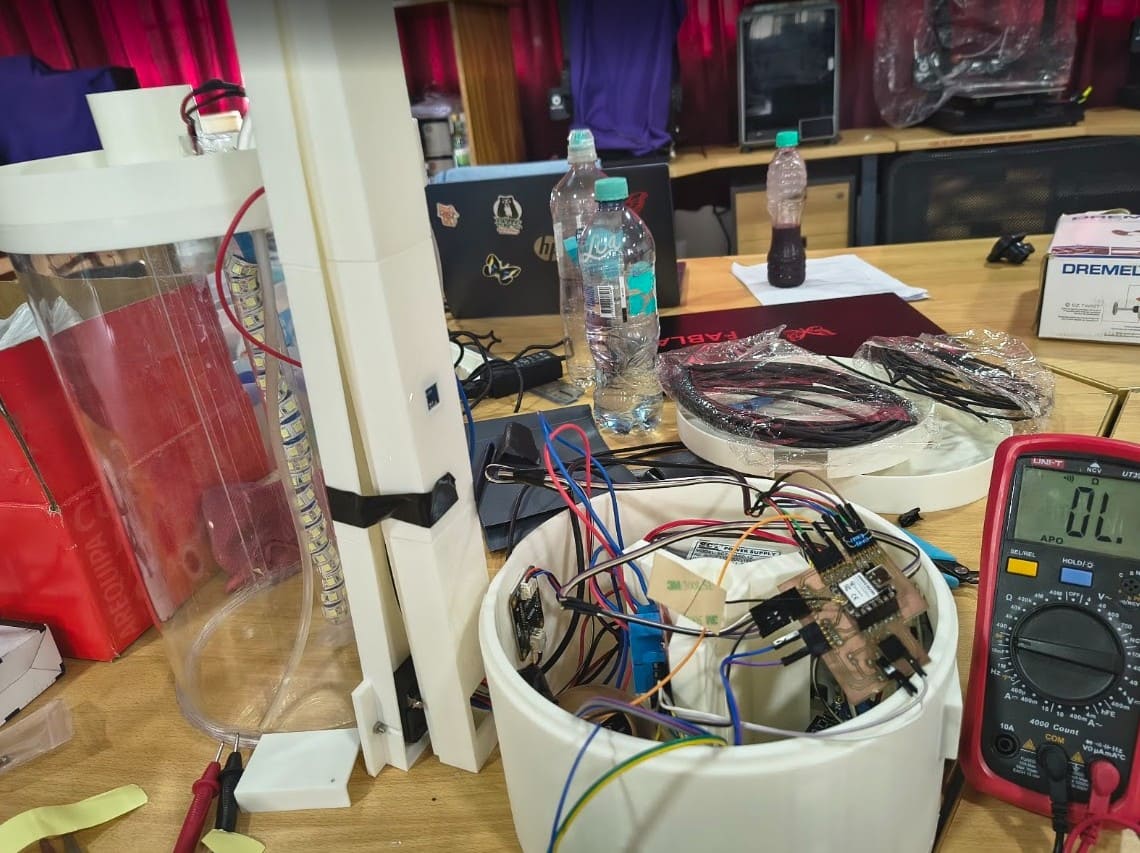
Img. 6: I am really getting tangled with so much wiring, and I burned the photoresistor twice because I was powering it with 5V when it should have been powered with 3V.
6) What Questions Need to Be Answered?
There are still some questions that must be answered during future stages of the project:
- Can light intensity be used to estimate spirulina growth?
- What is the optimal photoperiod to maximize productivity?
- How do pH variations affect culture growth?
- What is the most efficient aeration rate?
- Can the system be scaled for productive applications?
- What is the real accuracy of the sensors after prolonged calibration?
8) What Have I Learned?
The development of SpiruSense allowed me to integrate most of the skills acquired during Fab Academy into a single project. Throughout the process, I applied 2D and 3D design, additive and subtractive fabrication, electronic design and production, embedded systems programming, and the integration of IoT technologies.
One of the most important lessons was understanding the complexity of system integration. Designing individual components is only one part of the work; achieving coordinated operation between all mechanical, electronic, and software systems represents the real challenge.
I also learned the importance of iterative prototyping, problem solving, and continuous documentation. Several parts of the project required redesign, testing, and validation before achieving the expected results.
Finally, this project allowed me to discover new opportunities to apply digital fabrication in the biotechnology field, demonstrating that it is possible to develop intelligent and accessible tools for monitoring and cultivating microalgae using open and low-cost technologies.