Assignment Requirements
Applications and Implications
- 2D and 3D design for the development of structures and components.
- Additive and subtractive fabrication processes for the production of physical parts.
- Electronics design and production using custom PCBs and sensors.
- Embedded programming and microcontroller interfacing using the XIAO ESP32-C3.
- System integration and packaging for a portable and functional prototype.
The final project is planned as an integrated system that combines the different topics and skills developed throughout the course.
Whenever possible, the components and structures of the project are being fabricated instead of purchased, reinforcing the digital fabrication and prototyping process.
The project is designed to operate independently while demonstrating the integration of programming, electronics, fabrication, communication, and interactive system development.
Assignment Requirements
Learning outcomes
- Define the scope of a project.
- Develop a project plan including a schedule and a bill of materials (BOM)t.
- Track the progress of your project.
- Summarise and communicate the essence of your project development.
Have you answered these questions?
- What will it do?.✅
- Who has done what beforehand?.✅.
- What sources will you use?.✅.
- What will you design?.✅.
- What materials and components will be used?.✅.
- Where will they come from?.✅.
- How much will they cost?.✅.
- What parts and systems will be made?.✅.
- What processes will be used?.✅.
- What questions need to be answered?.✅.
- How will it be evaluated?.✅.
- Uploaded summary slide (placeholder).✅.
- Uploaded video clip (placeholder).✅.
- Checked they are linked in the final presentation schedule.✅.
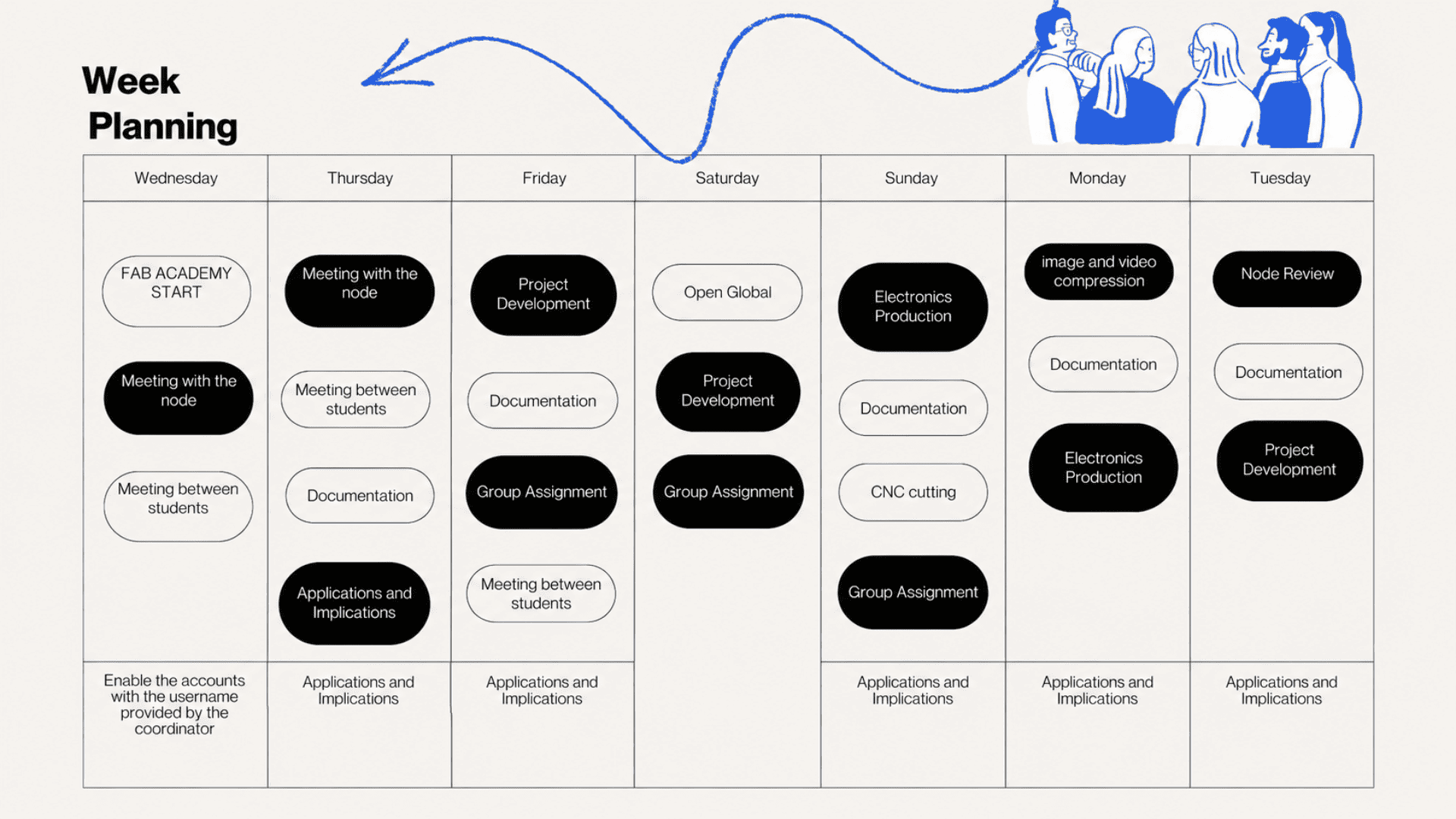
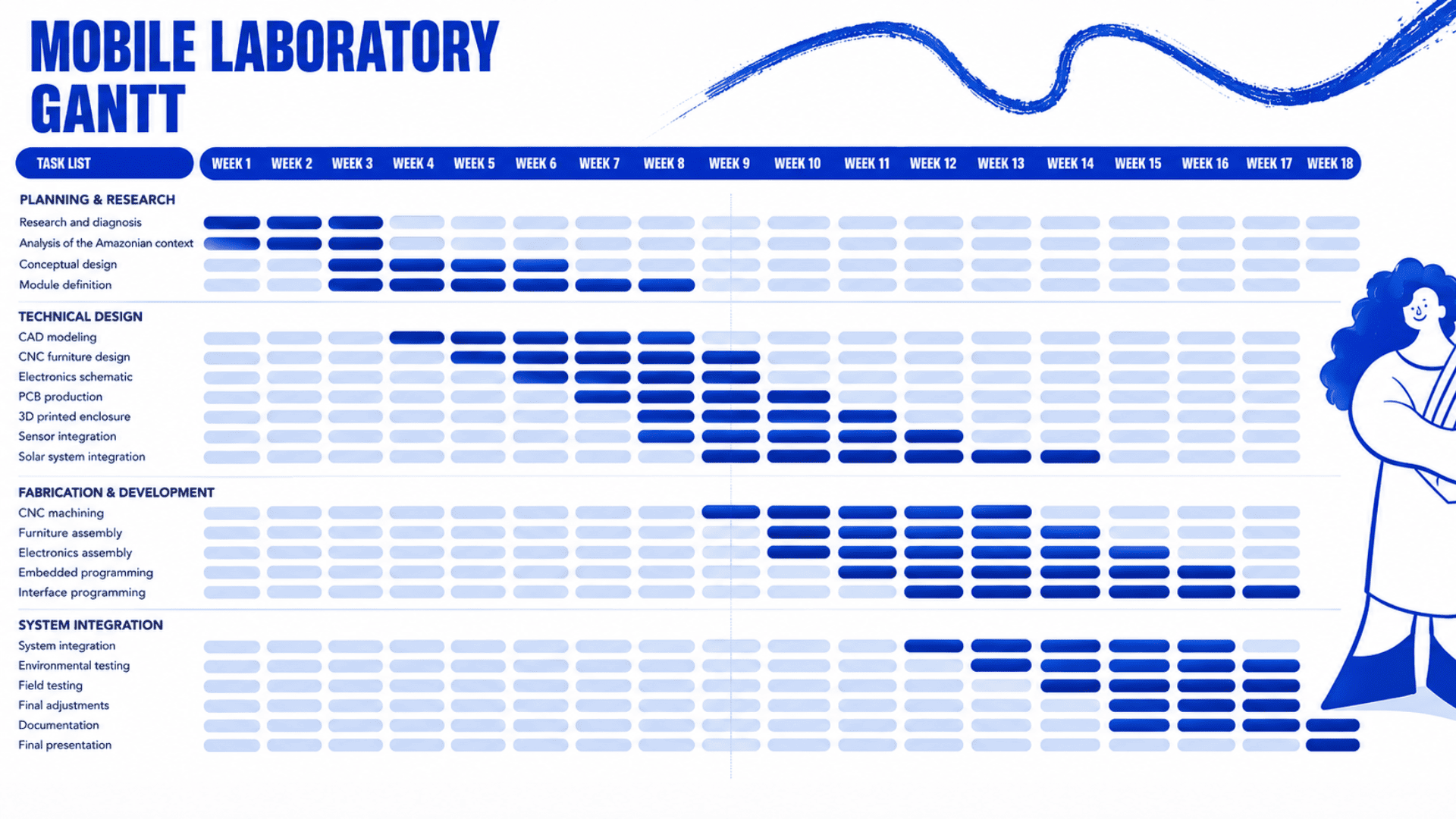
Weekly planning
The final project is currently under development and prototyping, progressively integrating the knowledge and skills acquired throughout the different weeks of the course. The proposal focuses on the creation of an interactive and sustainable mobile laboratory system capable of combining electronics, environmental monitoring, wireless communication, and visual interfaces.
During this process, different prototypes are being developed to validate the functionality of each part of the system before the final integration stage. These prototypes include 2D and 3D design of structures and components, additive manufacturing processes through 3D printing, and subtractive manufacturing using cutting and machining tools.
In addition, work is being carried out on the design and production of custom electronic boards using the XIAO ESP32-C3 as the main microcontroller. The system integrates sensors, output devices, WiFi communication, and interfaces developed in Processing and RemoteXY to enable real-time interaction and monitoring.
System integration and packaging are also being developed in order to create a modular, portable, and autonomous project. Whenever possible, the project parts and components are being fabricated and customized instead of purchased, reinforcing the learning and experimentation process.
This development process has allowed the practical application of the topics covered during the course, strengthening skills in digital design, programming, electronics, digital fabrication, and system integration for the construction of the final project.
During this week, the planning focused on the integration of all the project subsystems into a single functional prototype. The work included organizing the mechanical structure, electronics, embedded programming, interaction system, power supply, and the final physical enclosure.
The integration process also involved testing the communication between hardware and software, improving component distribution, and verifying that all systems worked together correctly. In addition, the knowledge acquired throughout the course was applied by combining programming, electronics, 3D design, digital fabrication, and interface development to achieve a more stable, interactive, and organized final result.
The goal this week was to integrate all the previously developed project
subsystems into a single, functional prototype. This included integrating
the mechanical structure, electronics, embedded programming, interaction
system, power supply, and final physical enclosure.
The aim was not only to verify that each subsystem functioned correctly
individually, but also to evaluate the project's behavior as a complete,
functional, and interactive system with a more organized and professional appearance.
Individual Assignment
System Design and Furniture Planning
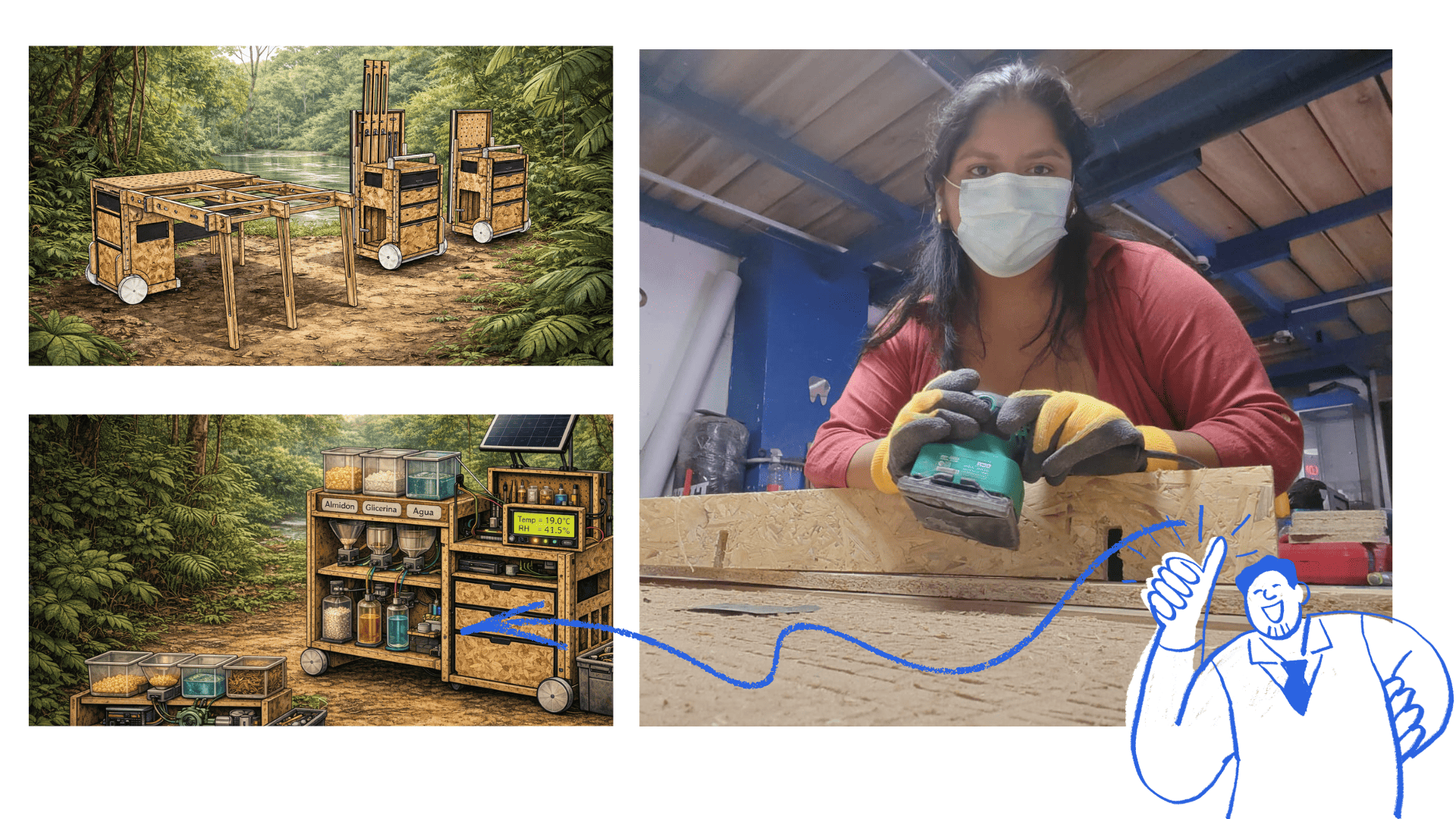
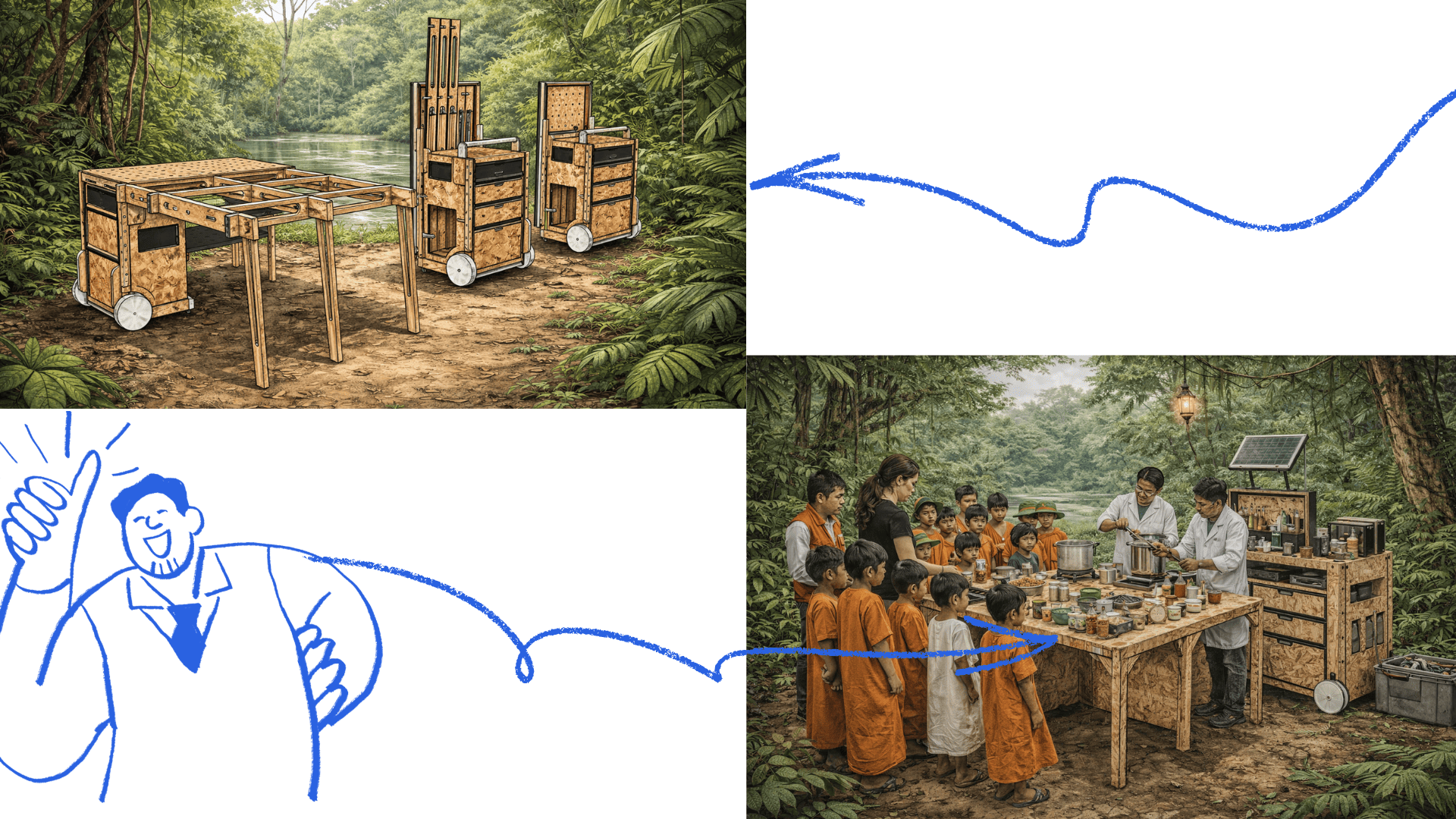
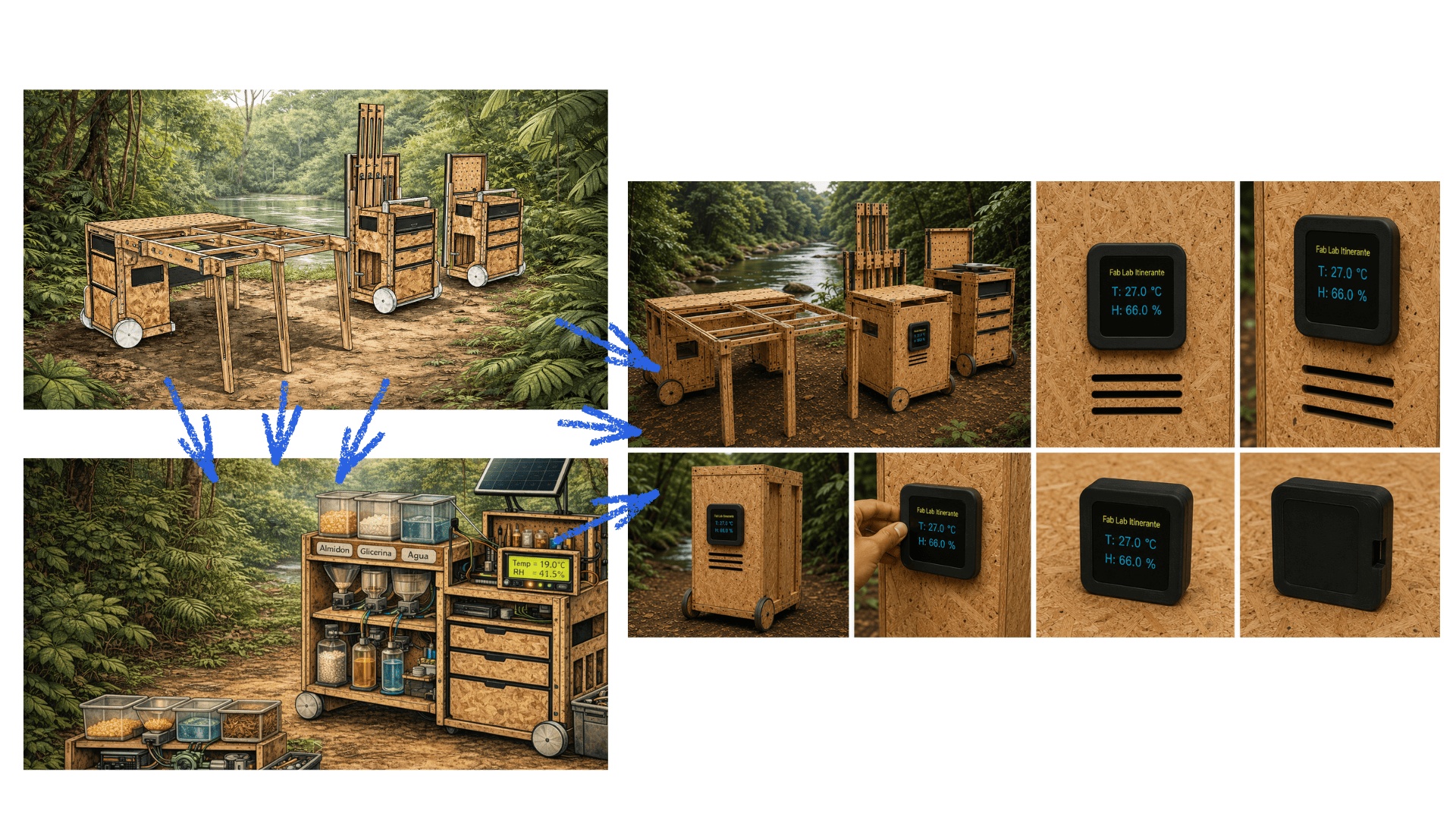
The design of the Mobile Laboratory furniture system was developed based on the experience of workshops carried out in the Peruvian Amazon and the need to transport educational kits, technological tools, and laboratory equipment to different communities. Due to the territorial and fluvial conditions of the Amazon region, the project aimed to create a portable, resistant, and adaptable solution.
The project was conceived as a modular and detachable mobile furniture unit, designed to be easily transported in the trunk of a car or by boat. In addition, the design sought to integrate different systems into a single piece of furniture, combining storage, workspace, and energy supply within one functional structure.
As part of the digital fabrication process, CNC technology was considered for the design and cutting of the structural parts of the furniture, allowing greater precision, easier assembly, and the possibility of replicating the system in future versions.
The furniture functions as a durable storage chest that protects mobile workshop and laboratory kits from humidity, rain, and continuous field use. When deployed, it transforms into a foldable and extendable worktable, creating a functional workspace in communities where access to basic furniture is limited.
In addition, the system integrates solar panels and a battery storage system to provide renewable energy for charging phones, lamps, and essential electronic devices in areas where electrical infrastructure is limited or nonexistent.
- Modular and detachable design adaptable to different workshops and activities.
- Portable format suitable for transportation by car or boat.
- Digital fabrication using CNC technology for precision and assembly.
- Secure storage system for kits and equipment.
- Integrated solar panel and battery storage system.
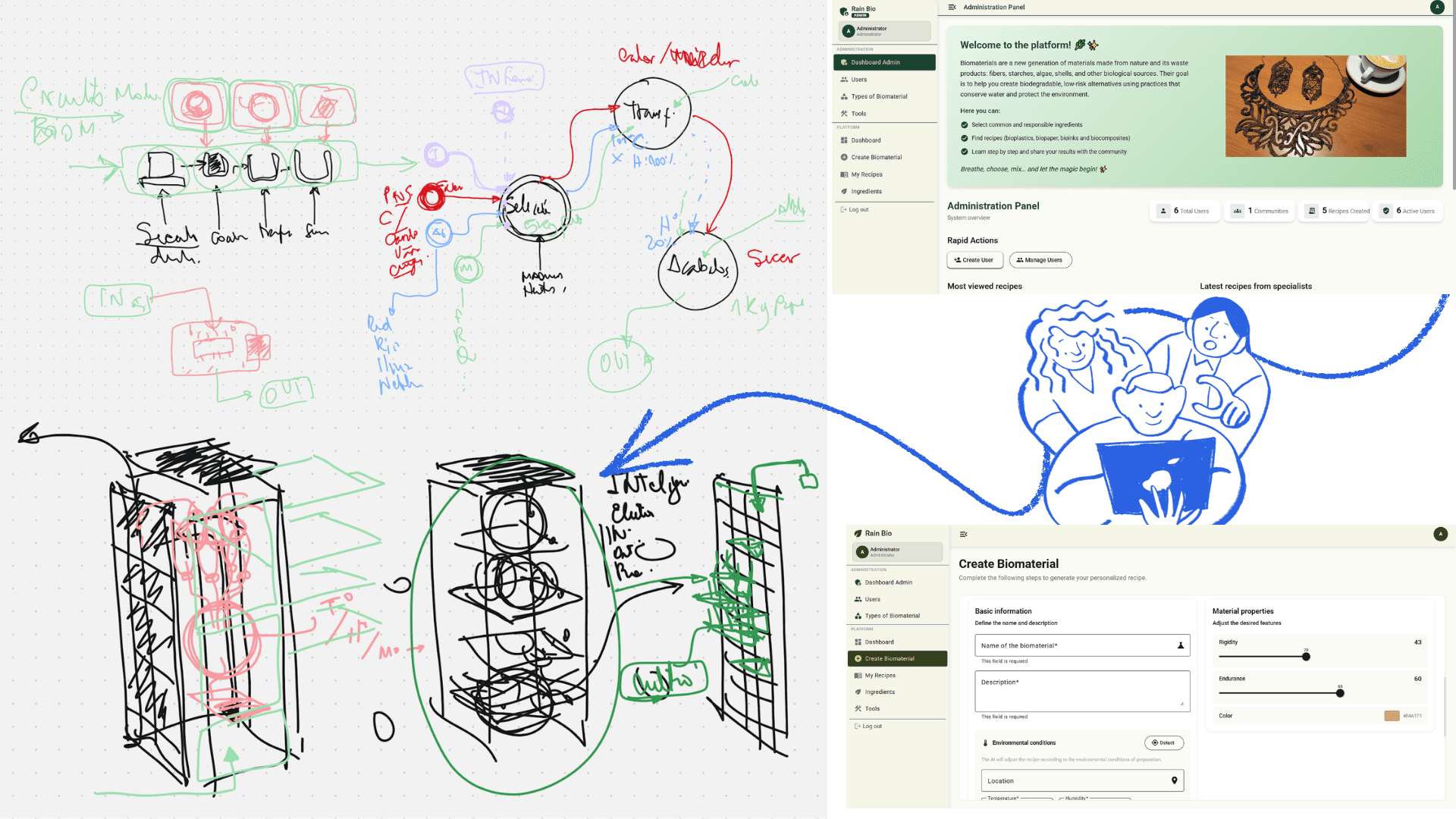
What will it do?
The project will develop a modular and interactive Mobile Laboratory capable of transporting tools, educational kits, and electronic equipment to different native communities in the Peruvian Amazon. The system will store materials, generate energy through solar panels, monitor environmental variables, and provide real-time interaction through sensors, an OLED display, and wireless communication.
In addition, the system will be connected to a biomaterials website where temperature, humidity, and environmental data will be collected and visualized over time. This information will help analyze and optimize the proportions used in biomaterial development while continuously improving the project during the course.
Who has done what beforehand?
The project takes references from previous experiences related to mobile laboratories, modular portable furniture, technological educational systems, and autonomous energy projects. It also builds on the knowledge acquired during Fab Academy in areas such as digital design, electronics, embedded programming, 3D printing, CNC fabrication, and system integration.
What sources will you use?
- Arduino and XIAO ESP32-C3 technical documentation.
- Processing and RemoteXY tutorials and libraries.
- Digital fabrication and CNC design references.
- Portable solar energy system information.
- Workshops and experiences developed in the Peruvian Amazon.
- Processes and content learned during Fab Academy.
What will you design?
- A modular portable furniture system.
- An integrated folding table.
- 3D printed electronic enclosures.
- Custom PCBs.
- OLED and Processing visual interfaces.
- A solar energy and battery system.
- An environmental monitoring system.
- A storage and organization system for tools and educational kits.
What materials and components will be used?
- OSB wood panels for the CNC structure.
- 3D printed parts.
- Digitally fabricated PCBs.
- XIAO ESP32-C3 microcontroller.
- DHT11 sensor.
- LDR sensor.
- SSD1306 OLED display.
- RGB LEDs and switches.
- Cables and connectors.
- Solar panel and rechargeable battery.
- Vinyl for visual identity and signage.
Where will they come from?
- Digital fabrication laboratory.
- Commercial electronic suppliers.
- Local materials for structure and assembly.
- Self-fabrication using CNC and 3D printing.
- Reuse and adaptation of components from previous assignments.
How much will they cost?
The project cost will depend on electronic materials, wood, solar panels, and batteries. To continue building the furniture system, it was necessary to purchase OSB boards and additional electronic components.
However, the project seeks to reduce costs through self-fabrication, digital fabrication processes, and the reuse of components developed during previous Fab Academy assignments.
| # | Component | Quantity | Total Price (USD) |
|---|---|---|---|
| 1 | XIAO ESP32-C3 | 1 | US$ 16.22 |
| 2 | LCD 4x20 Display | 1 | US$ 5.41 |
| 3 | OLED Display 0.96" | 1 | US$ 5.14 |
| 4 | SMD 1206 Resistors | 30 | US$ 8.11 |
| 5 | 40 Pin Male Connector | 10 | US$ 2.70 |
| 6 | 40 Pin Female Connector | 10 | US$ 2.70 |
| 7 | Desoldering Wick 1.5 mm | 1 | US$ 1.89 |
| 8 | DHT11 Module | 2 | US$ 4.32 |
| Material | Quantity | Unit Price (USD) | Total (USD) |
|---|---|---|---|
| OSB Board | 4 | US$ 104.00 | US$ 416.00 |
Components used
| Component | Function |
|---|---|
| XIAO ESP32-C3 | Main microcontroller and data processing unit |
| DHT11 | Temperature and humidity input sensor |
| LDR Sensor | Light intensity sensor |
| OLED SSD1306 | Real-time data visualization |
| RGB LED | Visual status indicator |
| Processing | Monitoring and control graphical interface |
What parts and systems will be made?
- Modular CNC structure.
- Folding table.
- Electronic enclosure.
- Custom PCBs.
- 3D printed internal supports.
- Storage system.
- Solar energy system.
- Monitoring and interaction electronic system.
- Bio-Lab branding and identity graphics.
What processes will be used?
- 2D and 3D design.
- CNC cutting.
- 3D printing.
- PCB design and production.
- Electronic soldering.
- Arduino programming.
- Processing and RemoteXY interface development.
- Hardware and software integration.
- Modular assembly.
- Vinyl cutting for visual identity.
What questions need to be answered?
- How can a portable and resistant laboratory for the Amazon be created?
- How can renewable energy be integrated into a mobile laboratory?
- How can the internal furniture space be optimized?
- How can stable communication between hardware and software be achieved?
- How can electronic components be protected during transportation?
- How can multiple subsystems be integrated into one functional system?
- How can environmental data be collected and visualized in real time for biomaterial development?
How will it be evaluated?
- Correct operation of sensors and electronics.
- Hardware and software integration.
- Furniture portability and resistance.
- Quality of digital fabrication.
- Energy system performance.
- Real-time interaction using OLED and wireless communication.
- Organization and integration of all mobile laboratory subsystems.
- Ability to collect and visualize environmental data on the biomaterials website.
What tasks remain unfinished?
The project is currently in the prototyping and integration stage of the Mobile Laboratory. The remaining tasks include completing the furniture assembly, fully integrating the electronic systems, and optimizing the internal organization of the components. Work will also continue on the solar energy system and the connection with the biomaterials web platform.
What has worked? What has not worked?
Throughout these weeks, different electronic boards and components were tested progressively. Some boards presented initial errors during the fabrication and programming process; however, these problems allowed improvements in the electronic design and strengthened the technical learning process.
With each iteration, the integration between hardware and software became more stable and functional. The prototyping process helped identify design improvements and optimize system performance.
What questions still need to be resolved?
One of the main pending tasks is completing the fabrication and assembly of the modular furniture structure for the Mobile Laboratory. Important progress has already been achieved in the design, cutting, and assembly of the structural parts.
In addition, the internal distribution of the electronic components still needs to be optimized, ensuring proper integration and protection of all subsystems inside the furniture.
What will happen next and when?
During the next stages of the project, the complete integration of all Mobile Laboratory systems will continue, including the structure, electronics, environmental monitoring, solar energy system, and interactive interfaces.
The goal is to finalize a stable and functional prototype capable of performing final tests related to functionality, portability, environmental monitoring, and real-time data visualization connected to the biomaterials platform.
Lessons Learned
Throughout the development of the Mobile Laboratory project, several important lessons were learned regarding system integration, digital fabrication, and interdisciplinary design.
One of the main lessons was understanding the importance of planning the integration of all subsystems from the beginning. Mechanical design, electronics, programming, energy systems, and physical structure must work together as a complete system rather than as independent parts.
The project also demonstrated the value of iterative prototyping. During the process, multiple adjustments were required in the PCB design, component distribution, furniture dimensions, and wiring organization to ensure proper functionality and compatibility.
Another important lesson was learning how digital fabrication tools such as CNC machining and 3D printing can be integrated into a real-world project to create customized, functional, and adaptable solutions for specific environmental and community needs.
Finally, this experience reinforced the importance of designing technology with context in mind. Developing a portable and autonomous Mobile Laboratory for the Peruvian Amazon required considering transportation, humidity, energy limitations, and accessibility in remote communities.