Week 19 - Invention, Intellectual Property, and Income
Assignment
This week is about what happens after the prototype is shown: how I would publish the work, what license I choose, who the project is for, and what still needs to be finished before the final presentation. I am writing this as a practical plan, not as a pitch deck.
Project status
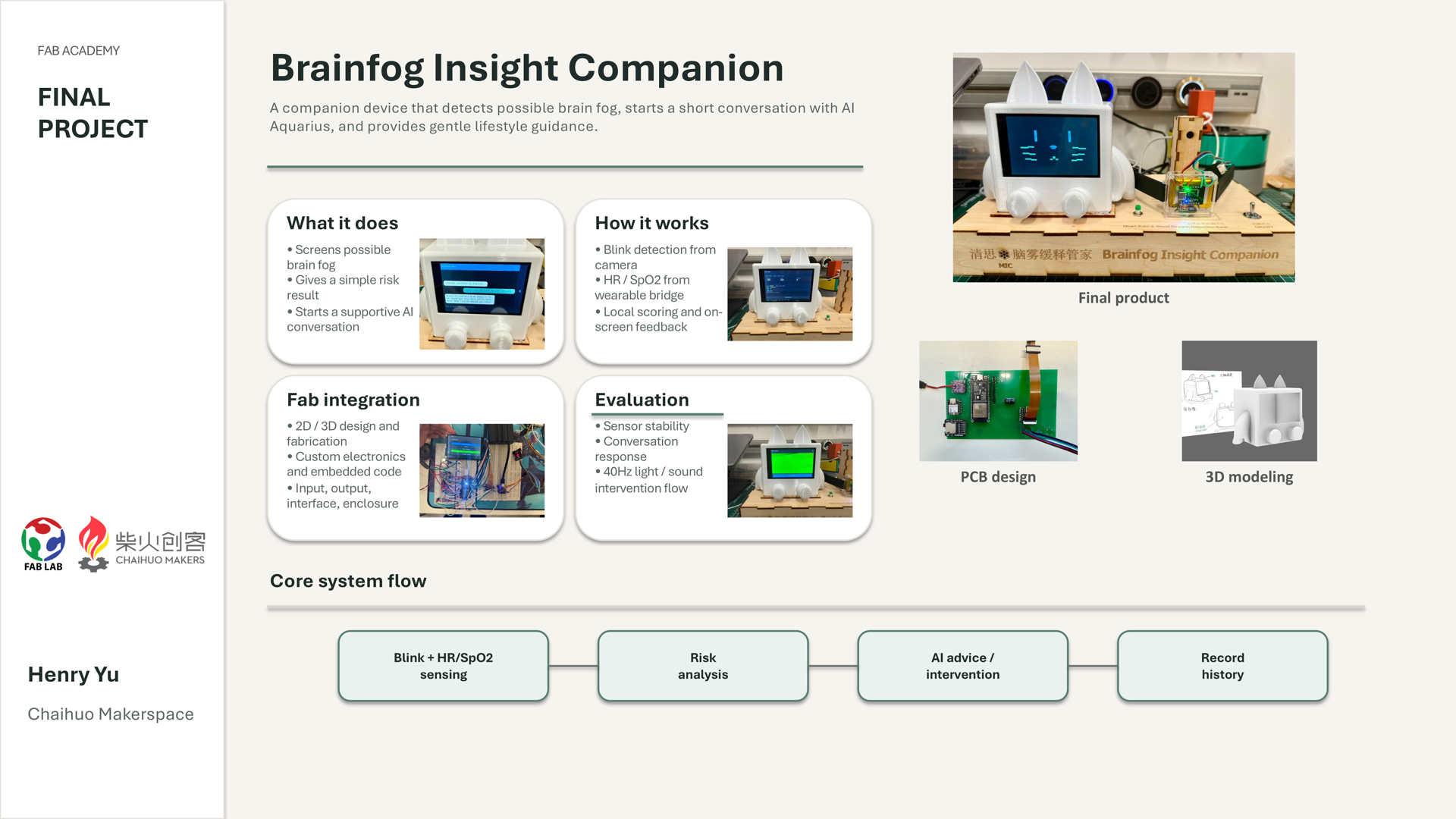
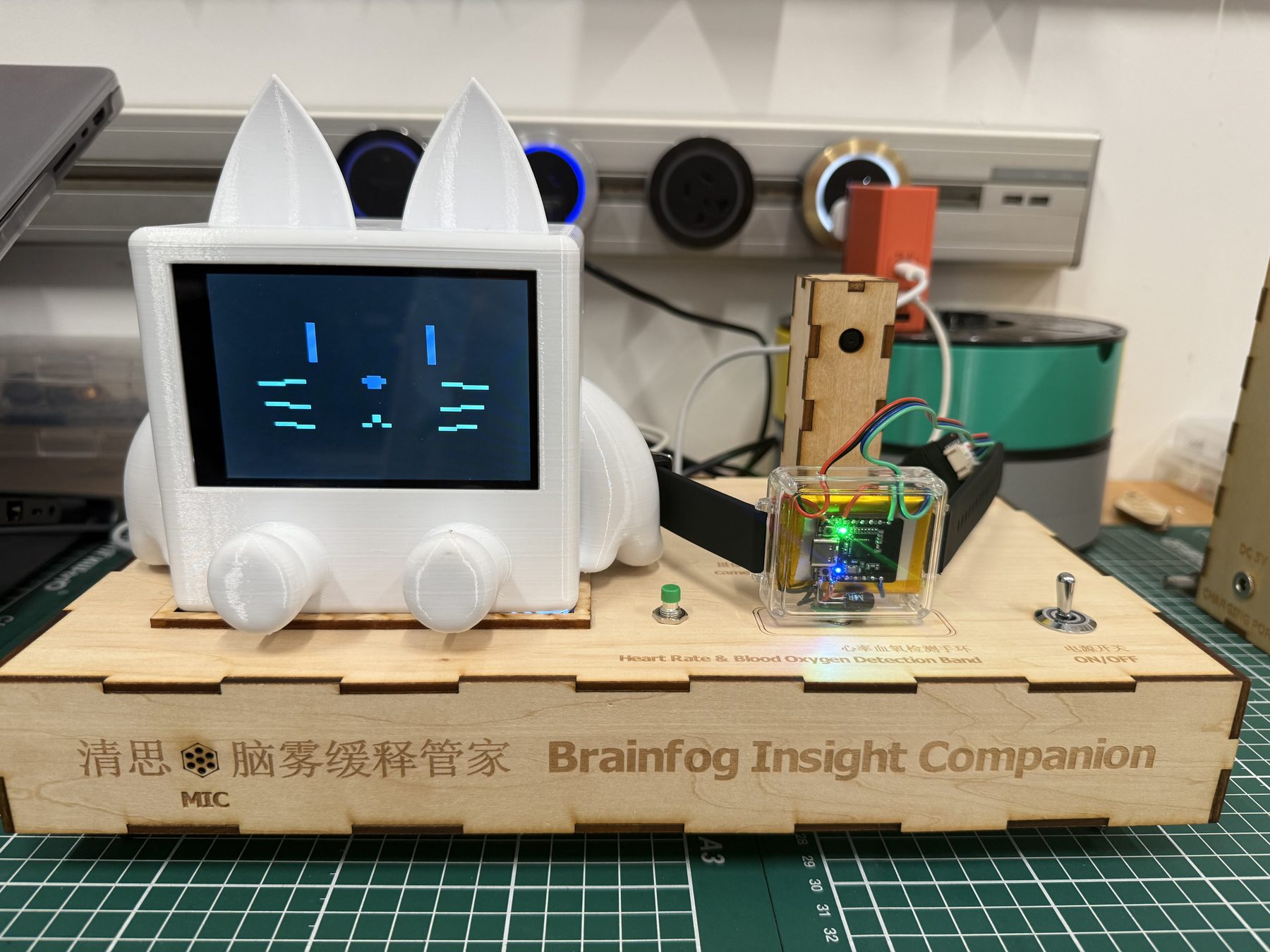
Brain Fog Insight Companion is now an integrated prototype. The desktop host is packaged into a laser-cut platform with a 3D printed screen/speaker shell, a camera tower, a watch charging position, a proactive dialogue button, a master switch, and a rear Type-C power input. The wearable band works as a separate sensing unit. The host electronics moved from breadboard testing to my own PCB.
License choice
I am splitting the license by file type because the project has both code and documentation. The firmware and software should be easy to reuse in other embedded projects. The site, photos, videos, CAD, and design documentation should stay shareable but not become a commercial asset without permission.
| Material | License | Reason |
|---|---|---|
| Firmware and software code | MIT License | Simple, common, and friendly to forks. Keep the copyright notice, then use or modify the code. |
| CAD, PCB documentation, photos, videos, and written pages | Creative Commons Attribution-NonCommercial-ShareAlike 4.0 | People can learn from it and adapt it, but commercial reuse needs a separate conversation. |
| Third-party libraries and services | Their original licenses or terms | I do not relicense libraries, cloud APIs, or modules I did not write. |
The final slide should include a short notice: Code: MIT. Documentation/design/media:
CC BY-NC-SA 4.0. Copyright 2026 Henry Yu.
Dissemination plan
The first audience is Fab Academy: reviewers, instructors, and future students who want to see how the prototype was built. For them, the website and repository matter more than social media. I will keep the week pages, final project page, source files, presentation slide, and one-minute video in the site so the build can be followed without asking me for a private folder.
The second audience is people who experience brain fog and want a non-medical tool to reflect on their state. For them, I would share a short demo video and a plain-language explanation: what the device senses, what it does not know, and why it should not be treated as diagnosis. The competition materials I prepared for the same project are useful here only as outreach practice: a poster, a short talk, and simple public-facing language.
| Channel | What I would share | Why |
|---|---|---|
| Fab Academy site | Weekly process, final project page, source links, slide, and video. | Best place for evaluation and rebuild notes. |
| GitLab / later public mirror | Firmware, PCB files, CAD exports, and license files. | Best place for people who want to fork the project. |
| School or maker demo | Integrated prototype, one-minute demo, and safety disclaimer. | Lets real users react to the form and interaction. |
| Short public posts | Problem explanation, build photos, and a link back to the documentation. | Raises awareness without pretending the prototype is a medical product. |
Income plan
I do not plan to sell this Fab prototype as a finished product. The health claim risk is too high, and the prototype still needs better validation before it should be used outside demos. If the project continues, the first income path would be education: a simplified kit for learning about wearable sensing, blink detection, and embedded interaction. The second path would be custom workshops or installation help, where the value is teaching and setup rather than selling a black-box medical device.
Any health-facing version would need consent design, data handling rules, clearer validation, and professional review. Until then, I will describe it as a wellness-support and learning device.
Future development
I would not expand the project by adding more features first. The next work should make the current loop more believable and easier to rebuild.
| Direction | Next step | Why it matters |
|---|---|---|
| Wearable comfort | Design a cleaner band enclosure and test longer wear sessions. | The sensor only helps if the user will actually wear it. |
| Blink detection reliability | Test the XIAO ESP32S3 Sense model in more lighting conditions and camera angles. | Bad blink data would make the whole brain-fog estimate noisy. |
| PCB cleanup | Fold more wiring into the next PCB revision and add clearer connectors. | The current build works, but service and assembly should be less fragile. |
| Non-medical advice | Rewrite prompts and UI copy so every suggestion is framed as wellness support. | The device must not sound like it diagnoses or treats disease. |
| Education kit | Make a simplified version with one sensor path, one screen, and one intervention. | This is the most realistic sharing path after Fab. |
Progress tracking
| Question | Current answer |
|---|---|
| What tasks are completed? | 2D platform, 3D host shell, PCB design and soldering, wearable prototype, local eye-state model, voice interaction test, integrated desktop packaging, and final presentation draft files. |
| What tasks remain? | Final video edit, final slide polish, source-file cleanup, secrets removal, better cable strain relief, and one last full-system run after documentation is updated. |
| What is working? | The desktop host boots, the screen runs, the voice path works in testing, the wearable can be tested, and the system has a product-like physical form. |
| What is not fully solved? | Blink detection depends on lighting and camera angle. The wearable is still a prototype. The final PCB and enclosure need more service-friendly mounting. |
| What questions need to be resolved? | How reliable is the blink count in normal use? How much battery runtime does the wearable get? How should advice be worded so it stays non-medical? |
| What have I learned? | System integration is mostly about boring constraints: where wires bend, what can be opened later, what stays powered, and which board should own each job. |
Remaining calendar
| Step | Task |
|---|---|
| Before final upload | Finish `presentation.png` and compressed `presentation.mp4` without changing the project facts. |
| Documentation pass | Link Week 16, Week 18, Week 19, Week 20, and the final project page together. |
| Source cleanup | Remove WiFi/API secrets, add license notes, and keep source files reachable from the site or repository. |
| Post-Fab | Test longer sessions, improve the wearable case, and decide whether the project remains a learning build or becomes a research prototype. |
Presentation media status
The website root already contains draft final presentation files: presentation.png and presentation.mp4. I am not replacing them on this page yet because the final edit may change after the last round of shooting.