Networking and comunications
Grpup Assignment
Wireless communication between two ESP32 microcontrollers using ESP-NOW.
Nowadays, wireless communication between devices is essential in the development of IoT (Internet of Things) systems. ESP32 microcontrollers enable the implementation of this type of communication efficiently through the ESP-NOW protocol, which allows data exchange without the need for a conventional WiFi network.
In this practice, a bidirectional communication system was developed between two ESP32 modules, where each device includes a switch (input) and an LED (output). The objective is that when the switch of one ESP32 is activated, the LED of the other device turns on, thereby demonstrating direct and real-time wireless communication.
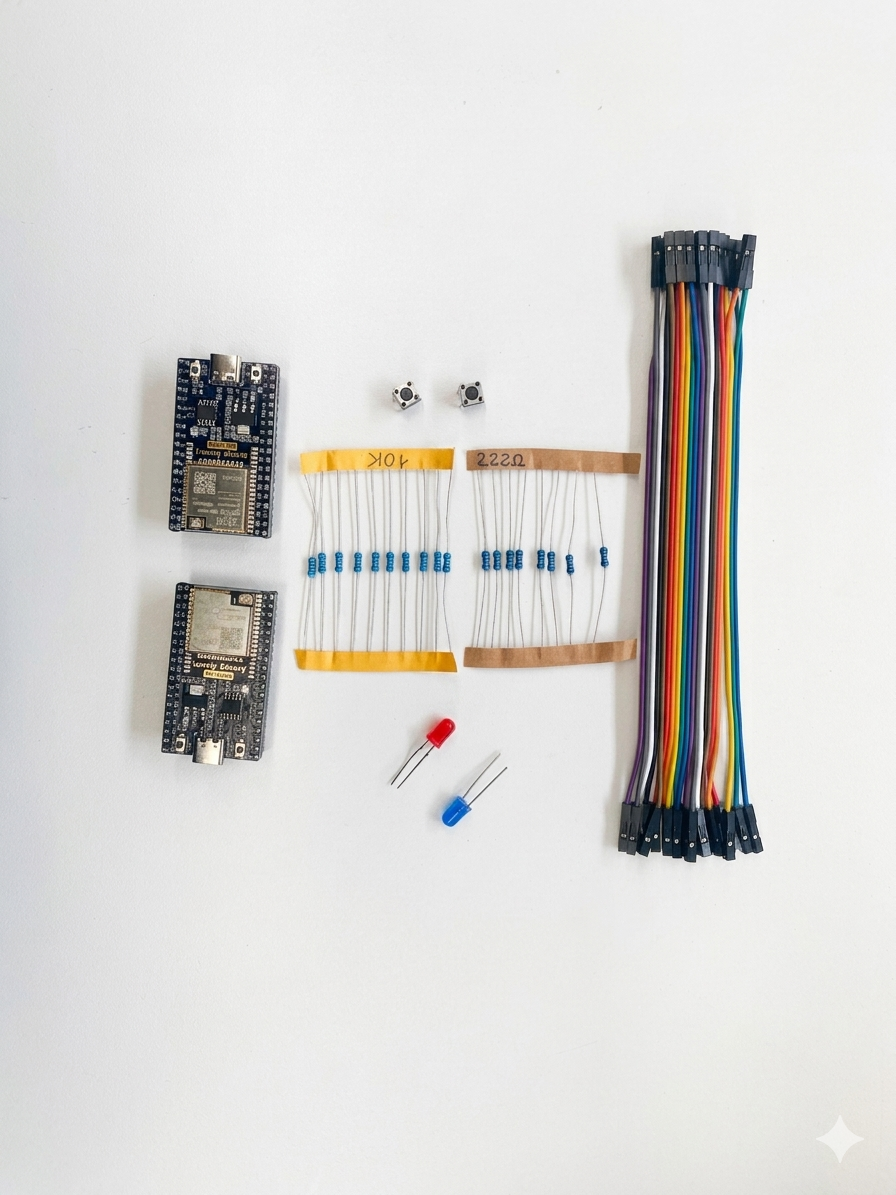
Materials
- 2 ESP32 modules
- 2 LEDs
- 2 resistors 220 Ω
- 2 push buttons (switches)
- Breadboard
- Jumper wires
- Computer with Arduino IDE installed
Connection Diagram
Each ESP32 was configured as follows:
LED Connection
- GPIO 2 → 220 Ω resistor → LED anode
- LED cathode → GND
Push Button Connection
- GPIO 4 → push button → 3.3 V
- Internal configuration: INPUT_PULLDOWN
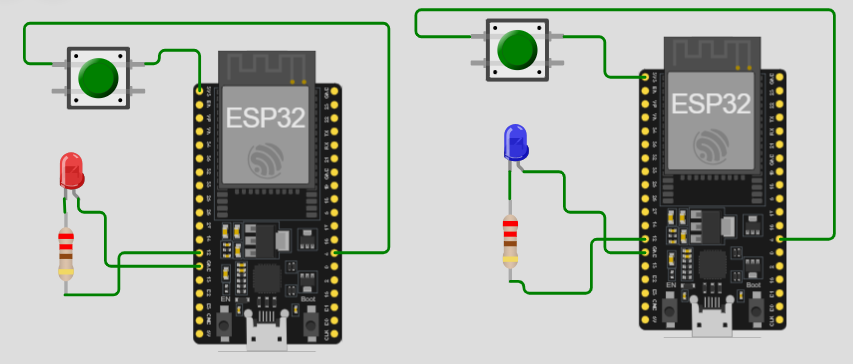
This same configuration is repeated on both devices, allowing each ESP32 to operate simultaneously as both transmitter and receiver.
Development
Initially, the correct operation of the components was verified individually by testing the LED activation and the push button reading through the serial monitor.
Subsequently, the MAC addresses of each ESP32 were obtained, which are required to establish communication using the ESP-NOW protocol.
A program was implemented in which each ESP32 performs the following tasks:
- Reads the state of its push button
- Sends this information to the other device
- Receives the remote push button state
- Turns its LED on or off according to the received signal
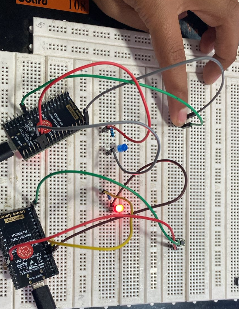
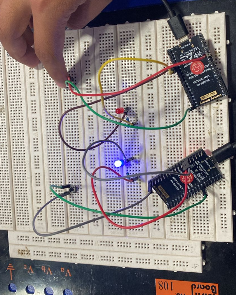
The communication was carried out bidirectionally, allowing both devices to interact with each other without the need for a router or internet connection.
Implemented Code
Code ESP32 A
#include <WiFi.h>
    #include <esp_now.h>

    #define LED_PIN 2
    #define BOTON_PIN 4
    // MAC del ESP32 B
    uint8_t peerAddress[] = {0x88,0x57,0x21,0xE0,0x45,0x5C};
    bool estadoRemoto = 0;
    void OnDataRecv(const esp_now_recv_info_t *info, const uint8_t *data, int len) {
    if (len == 1) estadoRemoto = data[0];
    }
    void setup()
    {
    Serial.begin(115200);
    pinMode(LED_PIN, OUTPUT);
    pinMode(BOTON_PIN, INPUT_PULLDOWN);
    WiFi.mode(WIFI_STA);
    WiFi.disconnect();
    esp_now_init();
    esp_now_register_recv_cb(OnDataRecv);
    esp_now_peer_info_t peerInfo = {};
    memcpy(peerInfo.peer_addr, peerAddress, 6);
    esp_now_add_peer(&peerInfo);
    }
    void loop()
    {
    bool estadoLocal = digitalRead(BOTON_PIN);
    uint8_t data = estadoLocal;
    esp_now_send(peerAddress, &data, 1);
    digitalWrite(LED_PIN, estadoRemoto);
    delay(50);
    }
Code ESP32 B
#include <WiFi.h>
#include <esp_now.h>

#define LED_PIN 2
#define BOTON_PIN 4
// MAC del ESP32 A
uint8_t peerAddress[] = {0x88,0x57,0x21,0xE0,0x31,0x08};
bool estadoRemoto = 0;
void OnDataRecv(const esp_now_recv_info_t *info, const uint8_t *data, int len) {
    if (len == 1) estadoRemoto = data[0];
}
void setup()
{
    Serial.begin(115200);
    pinMode(LED_PIN, OUTPUT);
    pinMode(BOTON_PIN, INPUT_PULLDOWN);
    WiFi.mode(WIFI_STA);
    WiFi.disconnect();
    esp_now_init();
    esp_now_register_recv_cb(OnDataRecv);
    esp_now_peer_info_t peerInfo = {};
    memcpy(peerInfo.peer_addr, peerAddress, 6);
    esp_now_add_peer(&peerInfo);
}
void loop()
{
    bool estadoLocal = digitalRead(BOTON_PIN);
    uint8_t data = estadoLocal;
    esp_now_send(peerAddress, &data, 1);
    digitalWrite(LED_PIN, estadoRemoto);
    delay(50);
}
Results
A stable wireless communication was successfully established between the two ESP32 modules. The observed results were as follows:
- When the push button on ESP32 A is pressed, the LED on ESP32 B turns on.
- When the push button is released, the LED turns off.
- Similarly, ESP32 B controls the LED on ESP32 A.
- The system response is immediate, demonstrating low communication latency.
Conclusions
It was verified that the ESP-NOW protocol enables efficient, fast, and reliable direct wireless communication between ESP32 devices without requiring network infrastructure, making it suitable for applications in automation, home automation, and industrial control systems.